

Hemp Shipping Regulations: What Businesses Must Know
Hemp shipping regulations define the legal rules, carrier policies, and documentation requirements that govern how hemp and hemp-derived products can be transported within the United States. The 2018 Farm Bill established hemp as a federally legal agricultural commodity, but compliance today involves far more than a single law. Carriers like USPS, UPS, and FedEx each impose their own requirements on top of federal rules. State laws at the destination add another layer. For any business or individual shipping hemp products in 2026, understanding this full regulatory picture is the difference between a successful delivery and a seized shipment.
What is hemp shipping regulations and why it matters
Hemp shipping regulations are the combined set of federal statutes, carrier-specific policies, and state laws that control how hemp and hemp-derived products move through commerce. The baseline comes from the 2018 Farm Bill, which legalized hemp as any cannabis plant containing no more than 0.3% delta-9 THC on a dry weight basis. That definition has since been updated. Effective November 12, 2025, federal law amended the definition of hemp to measure total THC including THCA, not just delta-9 THC alone. This change directly affects what products qualify as legal hemp for shipment purposes.
The practical implication is significant. A product that previously tested compliant under delta-9 THC measurement alone may now exceed the 0.3% threshold when THCA is included in the calculation. Shippers who have not updated their testing protocols and certificates of analysis since November 2025 are operating on outdated compliance documentation. This is not a minor administrative detail. Carriers and federal inspectors use these documents to determine whether a shipment is legal hemp or a controlled substance.

Three federal agencies share oversight of hemp commerce. The USDA regulates hemp production, licensing, and compliance testing at the farm level. The FDA regulates hemp-derived products intended for human or animal consumption, including CBD oils and edibles. State governments regulate retail sale and possession within their borders. Understanding which agency governs which part of the supply chain is foundational to building a compliant shipping operation.
What federal regulations govern the shipment of hemp?
Federal hemp transportation laws operate through several overlapping statutes and agency rules. The key frameworks shippers must understand include:
- 2018 Farm Bill (Agriculture Improvement Act of 2018): Removed hemp from the Controlled Substances Act’s definition of marijuana, making federally legal hemp shippable in interstate commerce for the first time. Hemp must contain no more than 0.3% THC to qualify.
- Amended THC definition (effective November 12, 2025): The updated statutory definition measures total THC including THCA, closing a loophole that allowed high-THCA products to circulate as compliant hemp. Shippers must now verify that their products meet this stricter standard.
- USDA hemp program: The USDA regulates production and compliance testing at the farm level. Once hemp leaves the farm and enters commerce, regulatory authority shifts to the FDA and individual states for consumption products.
- FDA oversight: The FDA regulates hemp-derived consumables, including ingestible CBD products. FDA has not yet approved a general pathway for CBD as a dietary supplement, creating ongoing legal ambiguity for certain product categories.
- Controlled Substances Act prohibitions: Marijuana, synthetic cannabinoids, and any cannabis product exceeding the legal THC threshold remain Schedule I controlled substances. Shipping these products, regardless of state legality, violates federal law and exposes shippers to criminal liability.
- State retail and possession laws: States impose their own requirements on hemp-derived products sold or possessed within their borders. A shipment that is federally legal may still violate destination state law, creating seizure risk at the point of delivery.
The regulatory shift from delta-9 THC testing to total THC testing demands updates in product classification, testing methodologies, and shipping documentation workflows. Shippers who source products with high THCA content must retest under the new standard before shipping.
How do USPS, UPS, and FedEx regulate hemp shipments?
Carrier policies for shipping hemp products operate as an additional compliance layer beyond federal law. Meeting federal legal standards does not guarantee that a carrier will accept a shipment. Each major carrier has established its own rules, and enforcement is at the carrier’s discretion.
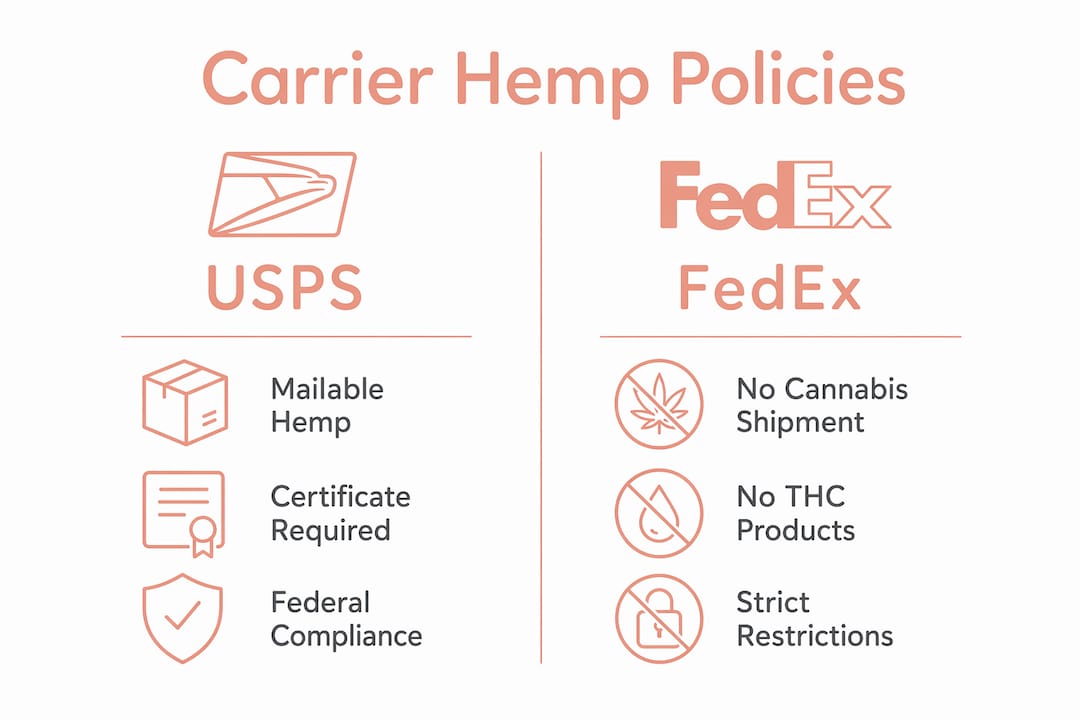
USPS governs hemp mailability under Publication 52, which places the responsibility for compliance squarely on the mailer. Postal personnel determine nonmailability, and USPS can refuse or intercept shipments that do not meet its standards. Hemp products that comply with the 2018 Farm Bill and carry proper documentation are generally mailable through USPS, but the mailer bears full legal responsibility for every package submitted.
UPS has the most detailed carrier-specific requirements for hemp shipments. The process involves several mandatory steps:
- Establish a dedicated UPS account specifically for hemp shipments. Standard accounts are not eligible.
- Obtain and maintain all applicable state and federal licenses for hemp production and distribution.
- Provide a Certificate of Analysis (COA) from an accredited third-party laboratory demonstrating that THC levels in the specific lot being shipped fall below 0.3% delta-9 THC.
- Package shipments without any outer markings, logos, or language that identifies the contents as hemp or cannabis.
- Apply Adult Signature Required service to all hemp shipments.
- Acknowledge that UPS reserves the right to refuse or discontinue service for any shipment that does not meet all requirements, even if the product is federally legal.
FedEx takes the most restrictive position. FedEx prohibits shipping cannabis, THC, and marijuana-derived CBD regardless of whether the shipment is legal in both the origin and destination states. Hemp-derived CBD products that meet federal legal standards may be shippable through FedEx, but shippers should verify current FedEx policy directly before tendering any hemp-related shipment.
Pro Tip: Always request a written confirmation from your carrier account representative before shipping a new hemp product category. Carrier policies update frequently, and verbal assurances do not protect you if a shipment is refused or seized.
What are the challenges of shipping hemp across state lines?
Interstate hemp shipment sits at the intersection of federal preemption and state regulatory authority, and that intersection creates real operational risk. Federal law permits interstate commerce in compliant hemp, but states regulate retail and possession of hemp-derived consumption products within their borders. A shipment that is fully legal under federal law can still be seized if it arrives in a state where the product type is restricted.
The key challenges shippers face when moving hemp across state lines include:
- Destination state restrictions: Some states have banned specific hemp-derived cannabinoids, including delta-8 THC and THCA products, even when those products are federally compliant. Shipping into a restricted state exposes both the shipper and the recipient to legal risk.
- Seizure at delivery points: Law enforcement in destination states can intercept shipments that violate local possession or retail laws, even if the shipment originated legally and traveled through compliant channels.
- Return handling complexity: If a shipment is refused or returned from a restricted state, the shipper must have a compliant return logistics process in place. Abandoned or undeliverable hemp shipments create additional legal exposure.
- SKU-level routing decisions: Businesses shipping multiple hemp product types must map each SKU against destination state laws and route shipments accordingly. A single product catalog cannot be shipped uniformly to all 50 states.
- Documentation at transit points: Hemp shipments passing through states with strict cannabis laws may face scrutiny at transit hubs. Carrying complete documentation, including COAs and licensing records, in every shipment reduces this risk.
The practical solution is to build destination state compliance into the order management system before a shipment is created, not after a problem arises. Logistics design in hemp distribution involves managing regulatory complexity at delivery points due to FDA and state controls over consumer products, and this complexity extends well beyond initial production compliance.
What practical steps ensure hemp shipping compliance?
Compliance with legal hemp shipping guidelines requires a documented, repeatable process. The following steps apply to both businesses and individuals shipping hemp products.
Licensing and registration come first. Shippers must hold all applicable federal and state licenses for hemp production, processing, or distribution. Licenses must be current and match the products being shipped. Expired or mismatched licenses are a common reason for carrier refusal.
Product testing and COA management are the operational core of compliance. Every shipment must be supported by a batch-specific COA from an accredited laboratory. General product compliance documentation is insufficient. The COA must correspond to the exact lot being shipped and must reflect testing under the current total THC standard, including THCA, as required since November 2025.
Packaging and labeling must meet both carrier and regulatory requirements. Outer packaging should not identify the contents as hemp or cannabis. Labels on the product itself must accurately reflect cannabinoid content, net weight, and batch number. Mislabeled products create compliance failures at multiple points in the supply chain.
Carrier account setup requires advance preparation. UPS requires a dedicated account established before the first shipment. USPS requires the mailer to certify compliance at the time of mailing. Attempting to ship hemp through a standard commercial account without prior carrier authorization is a compliance failure that can result in account termination.
Pro Tip: Maintain a compliance folder for each product lot that includes the COA, the applicable license, the destination state compliance check, and the carrier authorization confirmation. This folder should travel with the shipment documentation and be retrievable within minutes if a carrier or law enforcement inquiry arises.
- Verify destination state laws before generating a shipping label
- Apply Adult Signature Required service on all carrier-required shipments
- Store COAs digitally and link them to specific lot numbers in your order management system
- Review and update all compliance documentation after any federal or state regulatory change
- Train fulfillment staff on documentation requirements so errors do not occur at the packing stage
Key takeaways
Hemp shipping compliance requires current documentation, carrier-specific account setup, and destination state verification for every shipment.
| Point | Details |
|---|---|
| Federal definition updated | As of November 12, 2025, total THC including THCA must stay below 0.3%; update all COAs accordingly. |
| Carrier policies vary significantly | UPS requires dedicated accounts and batch-specific COAs; FedEx restricts cannabis-derived products entirely. |
| State laws govern destination risk | Federally compliant hemp can still be seized if destination state laws prohibit the product type. |
| Batch-specific COAs are mandatory | General product compliance is insufficient; COAs must match the exact lot being shipped. |
| Logistics design is part of compliance | SKU routing, return handling, and storage must account for state-level regulatory variation. |
Why hemp shipping compliance is harder than most shippers expect
I have seen businesses invest heavily in product quality and then lose shipments because their compliance documentation was one version behind. The most common mistake is treating the COA as a one-time credential rather than a lot-specific document that must be regenerated for every new production batch. Carriers like UPS are explicit about this requirement, and their inspection processes are designed to catch exactly this gap.
The November 2025 change to total THC measurement caught a significant number of operators off guard. Products that were compliant under delta-9 THC testing alone needed to be retested and reclassified. Shippers who did not update their documentation workflows in time shipped products that were technically non-compliant under the new standard, even though nothing about the physical product had changed. The regulatory definition moved, and the documentation had to move with it.
State-level variation is the other persistent challenge. I have watched well-run operations build clean federal compliance programs and then discover that three of their top-selling SKUs cannot legally be delivered to customers in certain states. The solution is not to stop shipping. The solution is to build destination state screening into the order workflow so that restricted products are flagged before a label is printed, not after a package is returned or seized.
Carrier enforcement is also less consistent than the written policies suggest. Some shipments pass through without documentation review. Others are held and inspected thoroughly. Building compliance as if every shipment will be inspected is the only approach that holds up over time. Relying on inconsistent enforcement is not a compliance strategy. It is a risk that compounds with every shipment.
— John
Explore compliant hemp products from Coastalhemp

Coastalhemp sources hemp-derived products from verified growers and top-tier brands, with quality and documentation standards built into every product in the catalog. Whether you are shipping full spectrum CBD oil or exploring the full range of hemp-derived cannabinoids, Coastalhemp provides products backed by third-party testing and accurate labeling. Every item is designed to meet current federal and carrier compliance requirements. Visit Coastalhemp to browse the full selection of compliant hemp products, from THCA diamonds to organic hemp wraps, and ship with confidence knowing your products meet today’s regulatory standards.
FAQ
What is the current federal THC limit for legal hemp shipments?
Federal law, as amended effective November 12, 2025, defines legal hemp as containing no more than 0.3% total THC including THCA on a dry weight basis. Products exceeding this threshold are classified as controlled substances and cannot be legally shipped.
Can you ship hemp through USPS?
Hemp products that comply with federal law are generally mailable through USPS under Publication 52, but the mailer bears full legal responsibility for every package. USPS postal personnel retain the authority to determine nonmailability and refuse any shipment.
Does FedEx ship hemp products?
FedEx prohibits shipping cannabis, THC, and marijuana-derived CBD products regardless of state legality. Hemp-derived products meeting federal standards may be eligible, but shippers must verify current FedEx policy directly before tendering any hemp shipment.
What documents are required to ship hemp with UPS?
UPS requires a dedicated shipper account, current state and federal licenses, a batch-specific Certificate of Analysis showing THC levels below 0.3% for the exact lot being shipped, plain outer packaging, and Adult Signature Required service on all hemp shipments.
Can hemp be shipped across state lines legally?
Federally compliant hemp can be shipped interstate under the 2018 Farm Bill, but destination state laws governing retail and possession still apply. Shipments that violate destination state law can be seized even if the product meets all federal requirements.



Comments