

What Lion's Mane Gummies Can Actually Do for You
Lion’s mane gummies are most likely to support attention and working memory, ease mild stress and improve sleep quality, and gently modulate immune function, based on a handful of small but promising human trials. The evidence is real but not definitive: the FDA has not approved lion’s mane for any therapeutic use, and trial sizes remain modest. Potency also swings widely between brands, so which gummy you buy matters almost as much as whether you take one at all.
Here’s the honest breakdown of what the science currently supports:
- Cognition: Modest gains in visual attention and working memory over 8 weeks of daily use, not instant sharpness.
- Mood and sleep: Reduced stress and better subjective sleep quality, typically after several weeks of consistent intake.
- Immune function: Cytokine modulation and antioxidant activity, mostly demonstrated in cell studies and early human research.
Pro Tip: Treat lion’s mane like a daily habit, not a one-time fix. Nearly every trial showing benefit involved weeks of continuous use, not a single gummy before a big meeting.
Key Takeaways
Lion’s mane gummies show their most consistent, human-trial-backed benefits in attention, working memory, mood, and sleep quality when taken daily for at least eight weeks, not as a one-time dose.
| Point | Details |
|---|---|
| Cognitive gains take time | The 2026 trial showed improved attention and memory after 8 weeks at 2 g/day, not after a single serving. |
| Mood and sleep respond well | Two independent trials found reduced stress and better sleep quality with daily use over several weeks. |
| Read the extract ratio | Gummy labels in mg only translate to trial doses if you know the extract-to-mushroom ratio behind them. |
| Safety looks reassuring short-term | Mild GI upset affects under 10% of trial participants, with no long-term human safety data yet available. |
| Coastalhemp offers vetted options | Gushrooms Magic Gummies, Round Trip Mushroom Gummies, and FLOAT Lollipops each list clear mushroom sourcing. |
Table of Contents
- Lion’s Mane Gummies Benefits: What Each Claim Is Actually Based On
- What Human Clinical Trials on Lion’s Mane Actually Show
- How to Take Lion’s Mane Gummies for Real Results
- Are Lion’s Mane Gummies Safe? Side Effects and Interactions
- What to Look for in a Quality Lion’s Mane Gummy
- How Coastalhemp Vets Mushroom Gummies
- A Science-Forward Take on Lion’s Mane Gummies
- Coastalhemp Makes Choosing a Mushroom Gummy Simple
- Sources
- FAQ
Lion’s Mane Gummies Benefits: What Each Claim Is Actually Based On
Health-conscious shoppers hear a lot of promises about lion’s mane. Some hold up under scrutiny. Others are borrowed from petri-dish research and stretched further than the data supports. Here’s what separates the two.
Cognitive benefits: attention, memory, and the neurogenesis question
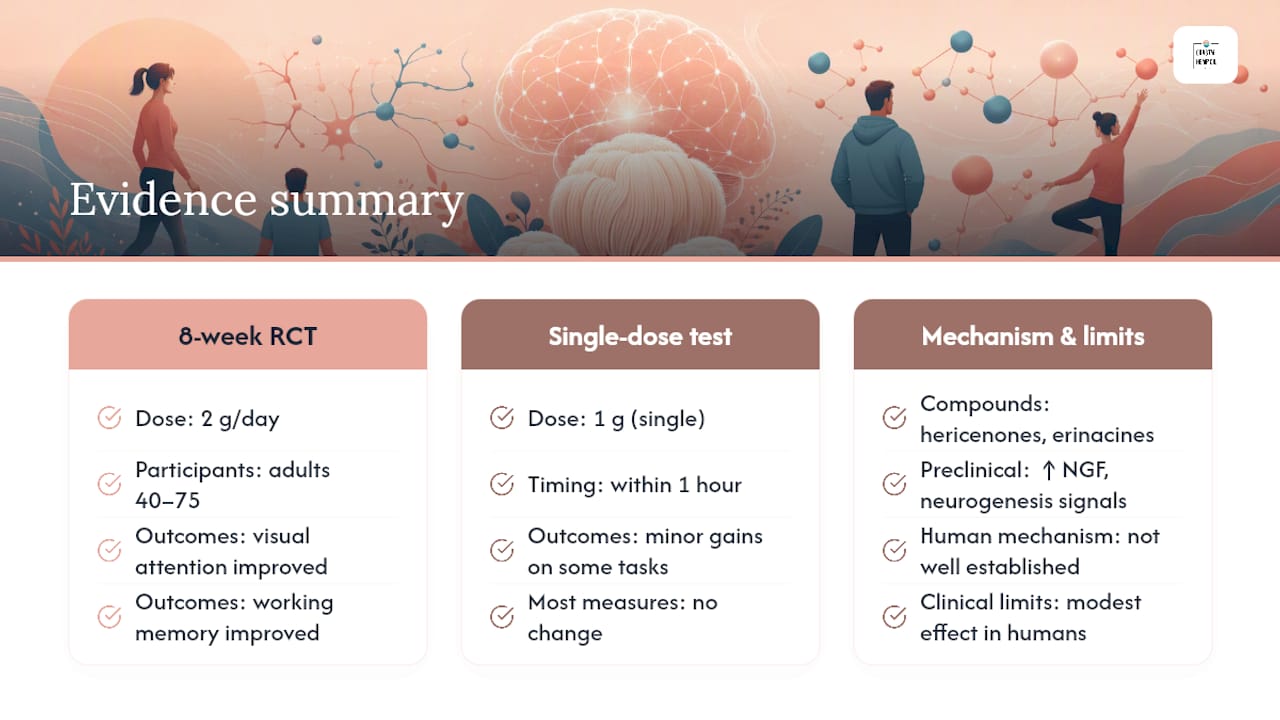
The strongest human evidence for lion’s mane centers on attention and working memory. A randomized, double-blind, placebo-controlled trial gave adults aged 40 to 75 with self-reported cognitive concerns 2 grams per day of Hericium erinaceus, combining fruiting body and mycelial biomass, for eight weeks. Compared with placebo, the treatment group showed measurable improvements in visual attention and working memory, along with better subjective sleep quality, morning restedness, and mood. No adverse events were reported in the study group.
The proposed mechanism involves compounds unique to this mushroom: hericenones and erinacines, which in preclinical models appear to stimulate nerve growth factor (NGF) production and support neurogenesis. NGF is a protein your nervous system uses to maintain and repair neurons. If lion’s mane genuinely nudges NGF production upward in humans the way it does in lab models, that would explain the attention and memory signals researchers keep finding. But narrative and systematic reviews are careful to note that this mechanism is far better established in preclinical models than in people. Human data supports a real, modest effect. It does not yet support claims about reversing cognitive decline or protecting against dementia, however often those claims circulate in wellness marketing.
A separate small trial found that a single 1 gram dose produced minor improvements on some cognitive tasks within an hour, while most measures showed no change at all. That mixed result matters for expectations: some people report feeling sharper almost immediately after taking lion’s mane, but the clinical narrative overwhelmingly favors consistent, daily use over any acute effect.
Mood, anxiety, and sleep support
A pilot trial using a lower daily dose, 1.8 grams over 28 days, found subjective reductions in stress among young adults, along with some improvement in cognitive processing speed. It was a small study, and “subjective” is an important qualifier. Participants reported feeling less stressed; the trial did not rely solely on blood biomarkers or clinical anxiety scales to confirm it.
The larger 2026 trial adds weight to the sleep and mood side of the equation. Participants taking 2 grams daily for eight weeks reported better sleep quality and improved mood scores compared with placebo, alongside the cognitive gains. Two trials, run independently with different doses and durations, both pointing toward mood and sleep benefits, is a more convincing pattern than either result alone.
Immune modulation and inflammation
This is where the fruiting body versus mycelium distinction actually changes the conversation. A study on Hericium erinaceus mycelium in human immune cells found that mycelium extracts reduced proinflammatory cytokines, specifically IL-1β, during a simulated immune challenge, and showed stronger iron-chelating antioxidant activity compared to a fruiting body extract tested in the same research. Cytokines are signaling proteins your immune system uses to ramp inflammation up or down; a reduction in IL-1β under stress conditions suggests the mycelium extract helped keep an inflammatory response from overshooting.
This does not mean mycelium is universally “better” than fruiting body. It means the two forms behave differently at a biochemical level, and a gummy made primarily from mycelial biomass will likely deliver a different effect profile than one built from fruiting body extract. Most quality gummies, including the trial formulation that produced the strongest cognitive results, actually combine both.
Heart health, blood sugar, and cancer claims: proceed with caution
You’ll find lion’s mane marketed for heart health, blood sugar regulation, and even cancer support. These claims trace back almost entirely to animal and cell-culture research, not human trials. There is currently no human clinical trial establishing lion’s mane as an effective intervention for cardiovascular disease, diabetes, or cancer. Preclinical signals are worth watching. They are not a reason to substitute a gummy for medical treatment in any of these areas.
What Human Clinical Trials on Lion’s Mane Actually Show
Separating solid evidence from marketing spin means looking directly at trial design, not just the “healthy” conclusion. Three human trials anchor most of what we currently know about lion’s mane, and they don’t all agree on every outcome.
| Trial | Dose & duration | Sample size | Measured outcomes |
|---|---|---|---|
| 2026 randomized, double-blind, placebo-controlled trial | 2 g/day, 8 weeks | 109 adults, ages 40 to 75 | Improved visual attention, working memory, sleep quality, morning restedness, and mood versus placebo |
| Pilot trial in young adults | 1.8 g/day, 28 days | Small pilot cohort | Subjective stress reduction and modest gains in cognitive processing speed |
| Acute single-dose study | 1 g, single administration | Small sample | Minor improvement on select cognitive tasks; most measures unchanged |
A few consistent patterns emerge across this evidence:
- Sleep and mood improvements show up repeatedly, even across different doses and trial designs.
- Attention and working memory respond better to sustained daily dosing (weeks, not days) than to a single serving.
- Effect sizes are modest, not dramatic. Nobody in these trials went from foggy to razor-sharp overnight.
- Cross-trial comparison is genuinely difficult because preparations differ. Fruiting body content, mycelium ratios, extraction methods, and how a “gram of mushroom” gets defined all vary from study to study, a limitation researchers openly acknowledge when interpreting results.
The honest limitation here is sample size. The 2026 trial’s 109 participants is respectable for a supplement study, but it’s a fraction of what’s needed to satisfy the kind of evidence bar the FDA applies to actual drugs. Durations topped out at eight weeks, so nobody has data on what happens after six months or a year of daily gummies. And because no two trials used identical extract ratios, you can’t simply stack these results together as if they were one larger study.
Reviews synthesizing this body of work land on a fair verdict: lion’s mane shows a real, reproducible signal for attention, mood, and sleep, built on preclinical neuroprotective mechanisms that are still being confirmed in humans. That’s a meaningfully different claim than “clinically proven to boost brain health,” and it’s worth holding onto that distinction every time you read a product label.
How to Take Lion’s Mane Gummies for Real Results
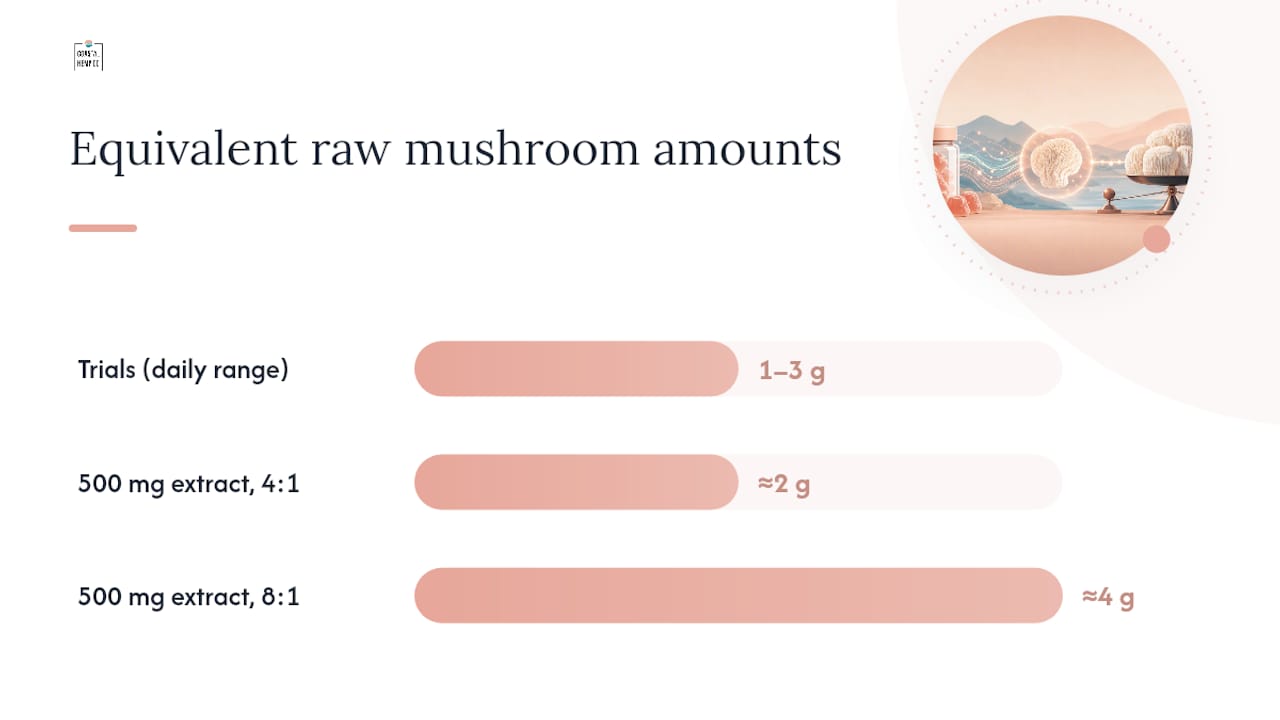
Clinical trials dosed lion’s mane in grams of mushroom material, typically in the 1 to 3 gram per day range. Gummy labels, by contrast, usually list milligrams of extract, which is a completely different unit unless you know the extract ratio behind it. A gummy that says “500 mg lion’s mane extract” could represent a meaningfully different amount of active mushroom material depending on whether that extract is a 4:1, 8:1, or higher concentration. This is the single most overlooked detail in gummy shopping, and it’s why two products with similar-looking labels can produce very different real-world effects.
Here’s how to translate trial doses into a gummy routine that actually mirrors the research:
- Check the extract ratio on the label. If it’s not listed, that’s already a red flag worth noting before you buy.
- Estimate your daily mushroom-equivalent intake. A gummy with a clearly stated 500 mg extract at an 8:1 ratio roughly corresponds to 4 grams of raw mushroom material, in the range trials used.
- Start with the manufacturer’s suggested serving rather than doubling up on day one; consistency matters more than an aggressive starting dose.
- Commit to a 4 to 8 week trial period before judging whether it’s working, mirroring the duration used in the trials that showed real cognitive and mood benefits.
- Take it at the same time each day, ideally with food, since consistency of timing appears to matter more than whether you take it on an empty stomach.
If you notice mild stomach upset in the first few days, that’s a reported, if uncommon, response. Taking your gummy with a meal rather than first thing in the morning often resolves it.
Pro Tip: If a gummy label just says “mushroom blend” without breaking out lion’s mane specifically, or without a certificate of analysis (COA) you can actually look up, treat that as a reason to keep shopping. A trustworthy brand will tell you exactly how much Hericium erinaceus is in each gummy and back it with third-party lab results.
Are Lion’s Mane Gummies Safe? Side Effects and Interactions
Across the human trials reviewed here, lion’s mane has a reassuring safety profile for a short-term supplement, though “reassuring” doesn’t mean “risk free.” Clinical trial reports note mild gastrointestinal complaints in fewer than 10% of participants, along with rare cases of hypersensitivity or rash. No trial reviewed here found a signal for liver toxicity or serious adverse events. The 2026 trial specifically reported none in its treatment group.
What’s missing is long-term data. Every major human trial ran for eight weeks or less, so nobody can currently tell you what happens after a year of daily use. That’s not a red flag, but it is a real gap you should factor into your own decision.
A few groups should talk to a clinician before adding lion’s mane gummies to a routine:
- Pregnant or nursing individuals, since safety data in this population simply doesn’t exist yet.
- Immunocompromised people, given lion’s mane’s immune-modulating activity.
- Anyone on anticoagulants, as mushroom compounds can theoretically affect clotting in ways not well studied in combination with blood thinners.
- Anyone undergoing active cancer therapy, where any supplement with immune or cellular activity warrants an oncologist’s input first.
On the regulatory side, it’s worth stating plainly: there is no FDA-approved therapeutic use for lion’s mane, and as a dietary supplement, it isn’t reviewed by the agency for efficacy or potency before it reaches shelves. That places the burden of quality control on the brand you buy from, which is exactly why label transparency and third-party testing matter as much as the dose itself.
Before starting, run through a quick checklist: confirm the extract ratio, check for a current COA, note any medications you’re taking, and start with a single serving to gauge tolerance.
What to Look for in a Quality Lion’s Mane Gummy
Not all lion’s mane gummies are built the same, and the label tells you most of what you need to know before you ever open the bottle. Look for the species name, Hericium erinaceus, stated explicitly rather than a vague “medicinal mushroom blend.” A trustworthy label also specifies whether the product uses fruiting body, mycelium, or a combination, since these forms carry different bioactive profiles, and the extract ratio (like 8:1 or 10:1) that lets you convert milligrams into an actual mushroom-equivalent dose.
Third-party testing separates serious brands from the rest. A current certificate of analysis (COA) should confirm the product is screened for heavy metals and microbial contamination, and for hemp companies carrying multiple product lines, it should also confirm no unintended cannabinoid cross-contamination from shared manufacturing lines. If a brand can’t produce a COA on request, that’s a decision-making red flag on its own.
Do the serving-size math before you buy. A gummy that requires eight servings a day to reach trial-equivalent intake isn’t a realistic daily habit, no matter how good the ingredient list looks. Price-per-effective-dose, not price-per-bottle, is the number that actually matters.
Within Coastalhemp’s catalog, a few options illustrate these principles in practice. Gushrooms Magic Gummies lean into a clearly labeled mushroom formulation built for everyday use. Round Trip Mushroom Gummies offer another gummy-format option worth comparing against your daily dose target. For readers who prefer a different edible format, the FLOAT Mushroom Lollipops 50ct box applies the same mushroom-blend approach in a lollipop rather than a gummy.
How Coastalhemp Vets Mushroom Gummies
Coastalhemp partners directly with growers and established brands rather than white-labeling anonymous formulations, which is part of why product sourcing stays consistent across the catalog. That partnership model also shapes the educational content published alongside these products, including guidance on general mushroom gummy benefits for readers comparing formats.
Quality control in this category comes down to a simple standard: can the brand tell you exactly what’s in the gummy, and can they prove it with a lab result? That’s the bar every listed product gets held to.
This article was written by John, drawing on the clinical research and product-quality standards outlined above to guide the selection criteria used across Coastalhemp’s mushroom gummy listings.
A few notes on how the three featured products map to the buying criteria discussed earlier:
- Gushrooms Magic Gummies present a clearly labeled mushroom formulation suited to daily, consistent use.
- Round Trip Mushroom Gummies offer a comparable gummy format for readers weighing dose and serving size against trial-equivalent targets.
- FLOAT Mushroom Lollipops apply the same sourcing standard in an alternative edible format for those who prefer not to take a gummy.
A Science-Forward Take on Lion’s Mane Gummies
The conventional advice on lion’s mane treats it like a light switch: take it, feel sharper, done. The actual research tells a slower story, one where the real payoff shows up over weeks of consistent use, not the first afternoon. That’s a harder sell for marketing copy, but it’s a far more honest one, and it’s the framing every reader deserves before they spend money on a bottle.
What gets underweighted in most coverage is the extract-ratio problem. Two gummies can list the same milligram count and deliver wildly different amounts of actual mushroom material, and almost nobody explains that clearly. If I had to pick the one habit that separates people who get results from people who don’t, it’s this: read the extract ratio before you read the marketing claims.
The mycelium versus fruiting body debate matters too, but less than quality control does. A well-sourced blend of both, backed by a real COA, will outperform a “proprietary blend” from a brand that won’t show its work, regardless of which form dominates.
— John
Coastalhemp Makes Choosing a Mushroom Gummy Simple
Sorting through vague “mushroom blend” labels and unverifiable extract claims is exactly the friction Coastalhemp built its catalog to remove. Every mushroom gummy listed comes from a named grower or brand partnership, with clear species and extract information instead of guesswork.

If cognitive focus is your priority, start with Gushrooms Magic Gummies and check the extract ratio against the daily target discussed above. If sleep and stress are your main concern, the Celestial nighttime gummies offer a complementary, cannabinoid-based route worth comparing alongside your mushroom routine. And if you’d rather skip the math altogether and browse verified options directly, visit Coastalhemp’s mushroom gummy selection to compare labeled potency and third-party testing side by side before you check out.
This article is general information, not a substitute for advice from a qualified doctor. Consult a qualified healthcare professional about your own circumstances before acting on anything here.
Sources
- A randomized, double‑blind, placebo‑controlled study evaluating the impact of Hericium erinaceus (Lion’s Mane) on cognitive performance and subjective wellbeing — medRxiv
- Narrative reviews and systematic perspectives on mushroom neuroprotection — PMC
- Calm Under Challenge: Immune‑Balancing and Stress‑Quenching Effects of Hericium erinaceus Mycelium in Human Immune Cells — MDPI
FAQ
What happens when you take lion’s mane every day?
Daily use over several weeks is when the clinical trials show the clearest benefits: better attention, working memory, sleep quality, and mood. Single doses tend to produce, at best, minor and inconsistent effects.
What are lion’s mane gummies good for?
Human trials point to modest improvements in attention, working memory, mood, and sleep quality, plus some immune-modulating and antioxidant activity, though effects are gradual rather than immediate.
Does lion’s mane give you a buzz?
No. Lion’s mane is not psychoactive and produces no intoxicating effect; any acute changes reported in trials were minor and limited to specific cognitive tasks, not a felt “high.”
Is ashwagandha or lion’s mane better?
They target different goals: ashwagandha’s research leans toward stress and cortisol regulation, while lion’s mane’s strongest human evidence centers on attention, working memory, and sleep quality, so the better choice depends on which benefit you’re after.


Comments