

450 to 500°F Rosin Dabs: Preserve Terpene Flavor with Cold Start
For rosin, the sweet spot sits at 450 to 500°F, with a flavor-focused floor around 420°F for live and cold-cure rosin chasers. Go higher and you get thicker clouds, but you trade away the terpenes that make rosin worth dabbing in the first place. Your exact number shifts with your rig and dab size, but the real lever is technique: a cold-start dab and a good carb cap matter more than any single degree on the dial.
TL;DR:
- Dab most rosin between 450 and 500°F to preserve delicate terpenes, with live and cold-cure rosin favoring the lower end of this range.
- Smaller dabs require cooler temperatures, around 20 to 30°F below standard, to vaporize evenly and retain flavor.
- Use an infrared thermometer to accurately measure your rig’s temperature instead of relying on visual cues or glow color.
- Cold-start dabbing prevents terpene scorched-off by gradually heating low-temp loaded rosin for better flavor preservation.
- Store rosin in airtight, UV-resistant containers, refrigerate unused portions, and avoid excessive air exposure to maintain potency and flavor quality.
Table of Contents
- What Is the Ideal Dab Temperature for Rosin?
- How Do You Hit These Temps on Your Rig?
- What Is Cold-Start Dabbing and Why Does It Preserve Flavor?
- Does Dab Size Change Your Ideal Temperature?
- How Should You Store Rosin to Protect Its Flavor?
- Why Rosin Needs Different Temps Than Wax or Shatter
- My 5-Step Rosin Routine
- Shop a rosin-friendly lineup
- Sources
- FAQ
What Is the Ideal Dab Temperature for Rosin?
Rosin behaves differently under heat than distillate, shatter, or budder, which is exactly why a single “best temperature” doesn’t exist for concentrates as a category. Rosin retains a fuller, more delicate terpene profile because it’s made through solventless pressing rather than chemical extraction, and that profile degrades fast once you push past the mid 500s.
Three practical zones cover almost every rosin session you’ll ever run.
Flavor zone (420 to 480°F): small vapor columns, near-total terpene preservation. This is where live rosin and cold-cure rosin taste best, because their terpene content is higher and more fragile to begin with.
Balanced zone (480 to 510°F): the everyday range most rosin dabbers settle into. You get a fuller cloud with only a modest flavor trade-off, and it works across pressed rosin, hash rosin, and full-melt alike.
Cloud zone (510 to 550°F): bigger visible vapor, but flavor drops off noticeably and hits get harsher. Push past roughly 570°F and terpenes start to combust outright, producing the burnt, acrid taste that ruins an otherwise good batch.
| Temperature range | Effect on flavor and vapor | Best use case |
|---|---|---|
| 420–480°F | Maximum terpene preservation, light vapor | Live rosin, cold-cure rosin, flavor chasing |
| 480–510°F | Full vapor, minor flavor loss | Daily dabs, most pressed rosin |
| 510–550°F | Big clouds, noticeable flavor loss, harsher | Social dabs, tolerance breaks |
| 570°F+ | Combustion, burnt terpenes | Avoid entirely |
Peer-reviewed work on inhalation chemistry backs up why the lower end tastes better: volatile aromatic compounds evaporate at comparatively low temperatures, while it takes more heat to aerosolize cannabinoids into a dense cloud. That’s the whole trade-off in one sentence: flavor evaporates early, clouds show up late.
How Do You Hit These Temps on Your Rig?
Getting to 480°F reliably takes different moves depending on what you’re dabbing on.
- Torch and quartz banger. Heat until you see a faint orange glow, then kill the torch and let it sit. Cooldown time depends on banger thickness. A thin-wall banger might only need 35 to 40 seconds, while a thick terp-slurper style banger holds heat longer and often needs 45 to 60 seconds before it settles into the 450 to 500°F window. An infrared thermometer removes the guesswork if you dab often enough to justify the $15 to $20 purchase.
- E-rig. Start around 480°F and nudge in 10°F increments until the hit matches what you want. E-rigs remove most of the trial and error that makes torch dabbing frustrating for beginners, since the setpoint stays locked once you dial it in.
- E-nail. Give it a full warm-up cycle before your first dab, since e-nails can read a stable number on the display before the coil has actually equalized. For bigger dabs, bump the setpoint 10 to 15°F higher than your usual target so the extra mass still vaporizes cleanly.
- Terp slurper or nectar collector. Heat the sides of the dish, not the center, and stay conservative with rosin specifically. Slurpers run hotter by design for viscous concentrates, so rosin can scorch fast if you treat it like you would a thicker extract.
Pro Tip: Buy a cheap infrared thermometer before you buy a fancier banger. Knowing your actual number beats guessing by glow color or a mental countdown, and it’s the fastest way to find your personal sweet spot.
What Is Cold-Start Dabbing and Why Does It Preserve Flavor?
Cold-start, sometimes called a reverse dab, flips the usual order: you load the rosin into a cool banger first, then heat it gradually instead of dropping concentrate onto a superheated surface.
- Place your dab in the bottom of a room-temperature banger.
- Put your carb cap on right away.
- Apply gentle, indirect heat to the outside of the banger until you see the rosin start to bubble.
- Rotate the carb cap slowly to chase the puddle of melting rosin around the dish as it vaporizes.
- Inhale in slow, steady draws, using shallow lung volume so you actually taste what’s happening rather than just moving air.
Cold-start works because it never exposes rosin to a flash of extreme heat, which is exactly what scorches terpenes on contact with a traditionally superheated banger. The rosin heats evenly instead of unevenly, so you don’t get one burnt edge and one raw spot in the same dab.
Pro Tip: Start with rice-grain-sized dabs when you’re flavor chasing. You can always load a bigger dab next time, but you can’t undo a scorched terpene profile once it’s happened.
Does Dab Size Change Your Ideal Temperature?
Yes, and this is one of the most overlooked variables in the whole process. Dab size and heat need to move together, not independently.
- Small dabs vaporize almost instantly, so run 10 to 30°F cooler than your usual target and cap for a shorter window.
- Medium dabs are where the standard 480 to 510°F balanced zone was built for, and most rosin sessions land here.
- Large or social dabs can tolerate a slightly higher starting temperature, but you’re trading flavor for volume the moment you go big.
- Cold-cure and live rosin generally want 20 to 40°F less heat than pressed rosin, since their terpene content is more concentrated and more heat-sensitive to begin with.
- Full-melt hash rosin follows the same low-heat logic, given how clean and terpene-rich a true full-melt batch tends to be.
Adjust in small steps, not big jumps. A 10°F nudge tells you more about your personal preference than swinging 50°F in either direction.
How Should You Store Rosin to Protect Its Flavor?
None of this dialing-in matters if your rosin has already degraded in the jar. Rosin is notably sensitive to heat, light, and air, so the storage habits between sessions matter almost as much as the temperature you dab at.
- Keep it in an airtight, UV-blocking container, never a clear jar left on a windowsill.
- Refrigerate for anything you’re not dabbing within a couple of weeks.
- Minimize how often you open and close the container, since repeated air exposure oxidizes terpenes over time.
- Transfer small amounts to a daily jar instead of digging into your main stash constantly.
- Watch for muted smell, a drier or waxier texture, and a darker color. All three are signs the terpenes have already started breaking down.
- Mid-session, swab your banger while it’s still warm between dabs so leftover residue doesn’t scorch and taint your next hit.
Why Rosin Needs Different Temps Than Wax or Shatter
Rosin sits at the low end of the concentrate spectrum for a reason that has nothing to do with marketing and everything to do with chemistry. Solvent-based concentrates like shatter, budder, and most wax are refined through processes that strip out some of the more delicate terpenes along the way, which is part of why shatter often performs better at higher temperatures, roughly 500 to 550°F, without the same flavor penalty rosin pays at that range.
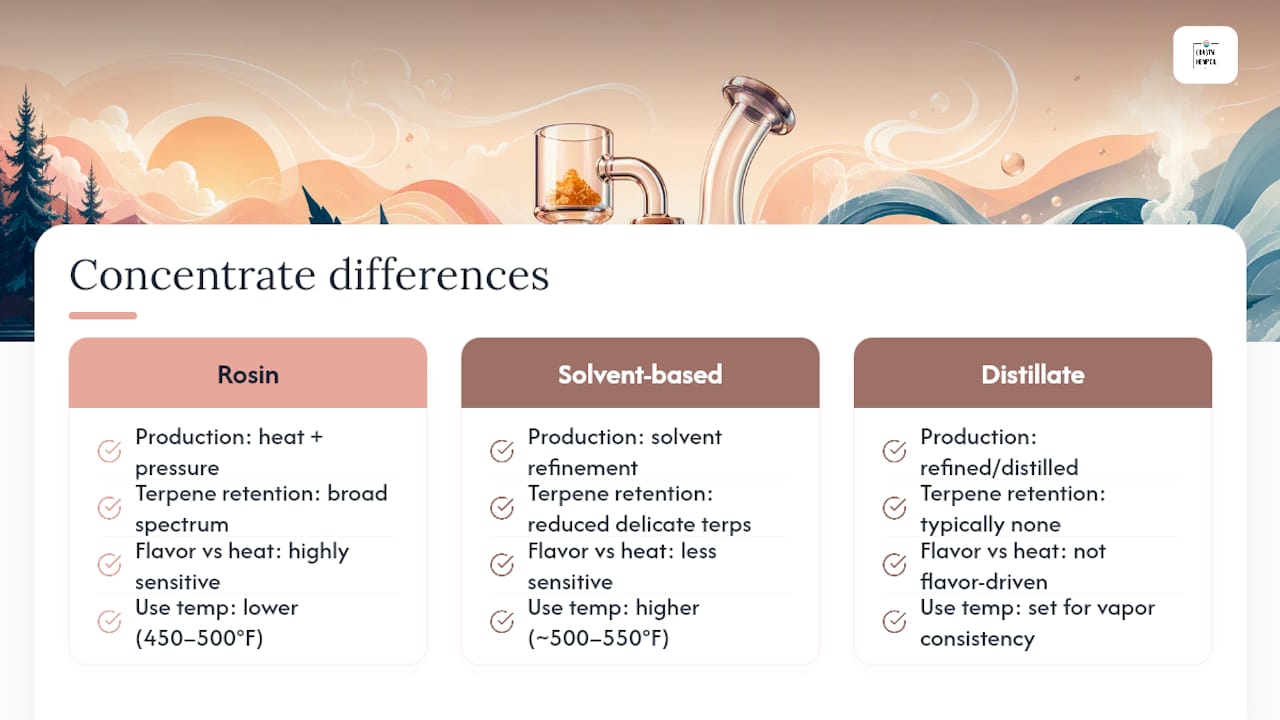
Rosin, by contrast, is made purely with heat and pressure, no solvents involved. That process keeps a broader spectrum of terpenes intact, which is exactly why rosin is more heat-sensitive: there’s simply more delicate aromatic content to lose. Dab a piece of shatter at 550°F and you’ll get a strong hit with acceptable flavor. Dab live rosin at the same temperature and you’ll taste burnt plastic-like notes where citrus or gas terpenes used to be.
This is also why distillate and vape cartridges use entirely different heat curves. Distillate has no terpene content of its own in most cases, so heat settings there are about vapor consistency, not flavor preservation. Rosin is the opposite case: heat management is almost entirely a flavor question, with cloud size as the secondary concern. If you’re used to running a shatter dab at 520°F and you load rosin at the same number, expect a rougher, less flavorful hit than you’re used to.
My 5-Step Rosin Routine
I default to 480°F and drop to 450°F for anything labeled live or cold-cure. Cold-start every time, capping the second the dab is loaded and rotating at the first sign of bubbling. I size dabs small on weekdays, bigger only when flavor isn’t the point. And I swab the banger warm, every single session, no exceptions.
— John
Shop a rosin-friendly lineup
If you’re building a flavor-first setup, the products you pair with your rig matter as much as the temperature you dial in. Coastalhemp’s premium THCA flower and concentrates selection is built around exactly this kind of low-temp, terpene-forward dabbing, sourced from growers and brands chosen for quality rather than volume.
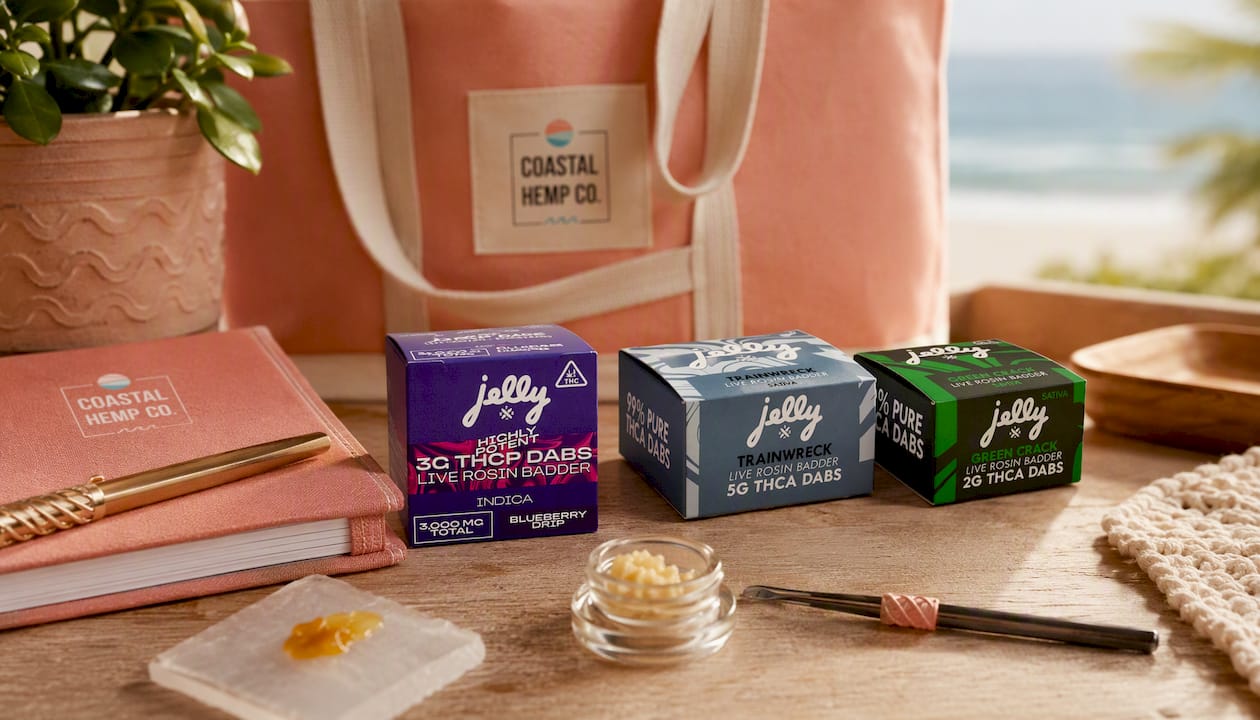
If concentrates aren’t your only interest, the catalog runs wider than rosin. The Habit THCA Sauce Ceramic Coil Cartridge suits anyone who wants concentrate-level flavor without a torch involved at all, while the Jelly THCA Live Sugar Blend Gummies 3-Pack Bundle and Trippy Sugar THCa Diamonds 2G give you other ways to explore live-derived cannabinoids beyond the dab rig. For readers curious about strain-specific terpene notes before they buy, the Cherry Zest strain guide from Green on the Go Delivery is a solid outside reference on what different terpene profiles actually taste like.
Rounding out the accessory side matters too. A quartz banger, a proper carb cap, and a cheap IR thermometer are the three pieces of gear that will do more for your flavor than any single product swap. Once your setup is dialed, browse the full THCA flower and concentrates category to find rosin and rosin-adjacent products that match the flavor-first approach this guide walks through, and place an order when you’re ready to put the temperature chart to use.
Sources
For deeper technical detail, see the Resin Manual guide on rosin storage and the peer-reviewed inhalation chemistry study referenced above.
- Best temperature to dab rosin (Resin Manual)
- Best Dab Temp 2026: Wax & Live Rosin Chart (Oil Slick)
- Dab Temperature Guide: The Best Temp for Dabs | Puffco
- Peer-reviewed article on thermal effects (NCBI PMC)
FAQ
What Temperature Should You Dab Rosin At?
Aim for 450 to 500°F for most rosin, dropping to 420 to 480°F for live rosin or cold-cure batches where flavor is the priority.
How Long Should You Let a Quartz Banger Cool Before Dabbing?
Wait roughly 40 to 60 seconds after torching, depending on banger thickness, until it visibly stops glowing and settles into the 450 to 500°F range.
Does Live Rosin Go Bad?
Yes. Live rosin degrades faster than it might seem if it’s exposed to heat, light, or repeated air contact, showing up as muted aroma, a drier texture, and darker color over time.
Does Rosin Get You Higher Than Other Concentrates?
Potency depends more on cannabinoid content than on concentrate type, but rosin’s fuller terpene profile often produces a more pronounced, well-rounded effect at the same temperature compared to more heavily processed concentrates.
How Many Hits Is a Gram of Rosin Worth?
It depends heavily on dab size, but rice-grain-sized flavor-chasing dabs from a single gram typically stretch across multiple sessions, while larger cloud-chasing dabs will use up a gram much faster.


Comments