

Store Gummies Properly: Keep THC and CBD Fresh 12–24 Months
The best way to store gummies properly is to keep them sealed in their original packaging, or an airtight food-safe container, in a cool, dark, dry spot away from direct light. Add a food-safe desiccant packet once a pack is opened. Refrigerate or freeze only for long-term storage, and always transfer sealed to avoid trapped moisture. THC products need separate, clearly labeled, childproof storage at all times.
TL;DR:
- Humidity control is the most critical factor in maintaining gummies’ texture and potency, requiring airtight containers and desiccant packets, especially after opening.
- All storage environments should be kept between 55 and 70 degrees Fahrenheit with 35% to 50% relative humidity to optimize shelf life and quality.
- Reusable rigid containers with high-barrier materials outperform flimsy bags or cardboard, which often allow moisture and air exchange, causing texture and safety issues.
- THC and CBD gummies must be stored separately in clearly labeled, childproof containers to prevent accidental ingestion and ensure safe handling.
- Homemade gummies should be consumed within a few weeks, stored in sealed, cool environments, and cooled fully before sealing to prevent internal moisture migration.
Table of Contents
- Why Proper Gummy Storage Matters for Freshness and Safety
- The Four Enemies of Gummy Storage: Humidity, Heat, Light, and Oxygen
- Best Storage Methods Step by Step: Containers, Location, and Labeling
- Packaging, Materials, and Humidity Control That Actually Work
- Storing THC, CBD, and Homemade Gummies Safely
- Gummy Shelf Life: Realistic Timelines and Warning Signs
- How Coastalhemp Packages and Recommends Gummies for Better Storage
- What Actually Matters Most in Gummy Storage
- Shop Storage-Friendly Gummies and Edibles at Coastalhemp
- Sources
- FAQ
Why Proper Gummy Storage Matters for Freshness and Safety
A gummy left in a hot car for a single afternoon tells you almost everything about why storage matters. It comes back either welded into a sticky mass or baked into something closer to a hard candy. Neither texture is a defect. It’s chemistry responding to the exact conditions you put the product through.
Humidity swings are the biggest culprit. When ambient moisture rises, gummies pull water in and turn tacky. When the air runs dry, they give up moisture and stiffen. Colorcon’s formulation research identifies relative humidity control as the single biggest factor separating a gummy that holds its bite from one that turns into a puddle or a rock.
Potency degrades through a different path than texture does. Heat speeds up the breakdown of active compounds, oxygen slowly oxidizes them, and light, especially UV, can fade pigments and degrade certain cannabinoids over time. None of these processes happen instantly. They compound quietly, batch after batch, the longer a product sits in the wrong conditions.
The safety side deserves equally direct attention:
- Gummies typically have low water activity and low pH, which lowers the risk of bacterial growth compared to many other foods, according to a chewable gel stability review in American Pharmaceutical Review.
- That low-risk profile does not eliminate spoilage. Humidity exposure and contamination can still cause mold growth on the gummy surface.
- Accidental ingestion, especially by kids or pets, is a documented and serious risk with THC edibles, per CDC data on cannabis-related poisoning.
- THC and CBD gummies can look nearly identical once removed from packaging, which is exactly why labeling matters as much as temperature control.
The Four Enemies of Gummy Storage: Humidity, Heat, Light, and Oxygen
Every storage mistake traces back to one of four forces, and they don’t act in isolation. Fix one and ignore the others, and you’ll still end up with a ruined batch.
- Humidity. This is the dominant factor in gummy failure. Even small RH fluctuations cause a pack to absorb ambient moisture and turn sticky, or lose internal moisture and turn brittle, according to Colorcon’s manufacturing guidance. Manufacturers spend more engineering effort on internal-pack humidity than almost any other variable.
- Heat. Warmth softens the gelling matrix and accelerates cannabinoid breakdown. Gelatin-based gummies are notably heat-sensitive and can slump or fuse together in warm conditions, while pectin-based formulas tolerate heat somewhat better but are more vulnerable to moisture.
- Light. UV exposure fades color and can degrade light-sensitive active compounds over weeks of exposure on a sunny windowsill or in a clear jar.
- Oxygen. Slower than the others, but constant. Oxidation dulls flavor and chips away at potency over months, which is why vacuum-sealing or oxygen absorbers matter for anything stored longer than a few weeks.
Pro Tip: Squeeze the outside of a sealed bag gently. If you feel individual gummies stuck together as one solid block instead of separate pieces, humidity has already started working against you, even if the pack looks fine.
Aldevra, a cannabis kitchen consulting group, recommends holding edibles at roughly 55 to 70 degrees Fahrenheit with relative humidity between 35% and 50 percent for the best balance of texture and potency retention. That range is narrower than most home kitchens run without any thought, which is exactly why casual storage habits so often backfire.
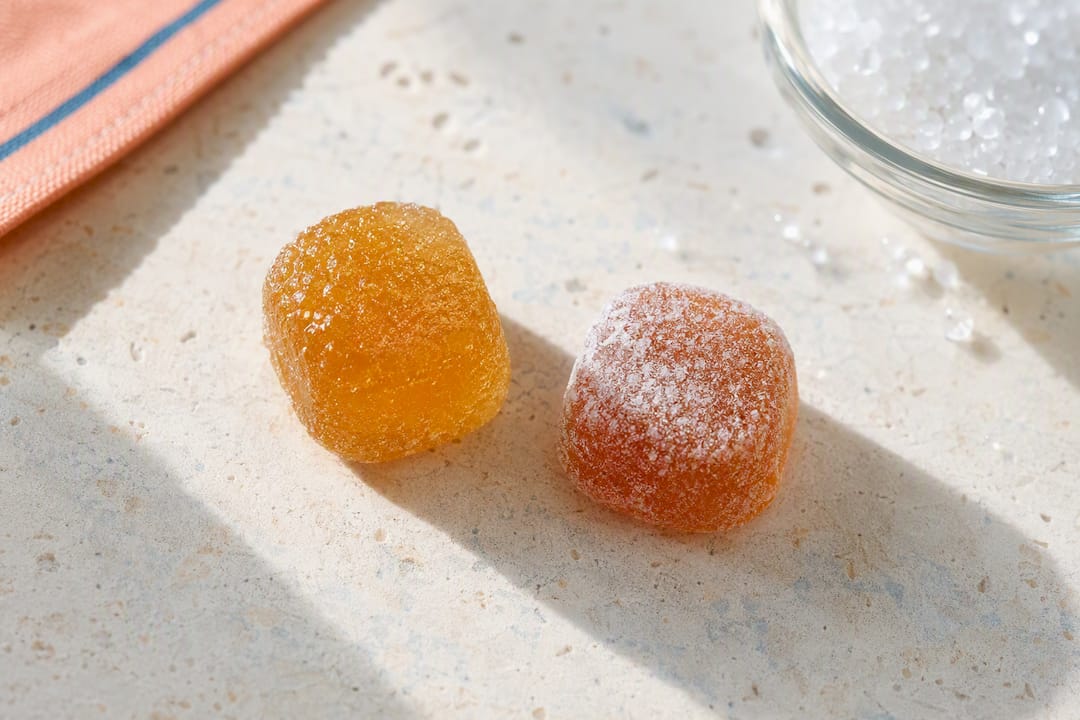
Watch for the tells: a faint sweating sheen on the surface, a white sugary “bloom” coating, an off or sour smell, or any visible fuzz. Any one of those is a signal to stop and inspect, not a texture quirk to shrug off.
Best Storage Methods Step by Step: Containers, Location, and Labeling
Original packaging is engineered on purpose. Brands select barrier materials, seal strength, and even the amount of headspace based on how the specific formulation behaves over time, so keeping gummies in that packaging until you’re ready to eat them is usually your strongest move.
Once a pack is open, the container you switch to matters as much as where you put it.
- Choose airtight and rigid. Glass jars with a rubber gasket seal or thick PET plastic jars beat flimsy resealable bags every time, since a rigid container resists the small punctures and gaps that let humidity sneak in.
- Skip cardboard and thin bags. Cardboard absorbs moisture itself and thin flexible plastic flexes enough to let air exchange happen at the seams, undermining the whole point of an airtight setup.
- Pick one consistent spot. A cabinet away from the stove, a pantry shelf, or a closet drawer works better than rotating locations, because temperature and humidity swings do more damage than a slightly warmer steady spot.
- Refrigerate with a plan, not a habit. A refrigerator can extend shelf life, but the crisper drawer’s humidity works against you unless the gummies sit in a sealed, desiccant-equipped container first. Skipping that step is the single most common refrigeration mistake.
- Freeze only for long stretches. Vacuum-sealing or a dedicated freezer bag protects texture better than a standard container, and always thaw the package sealed, at room temperature, so condensation forms on the outside of the packaging instead of directly on the gummies.
- Label everything you repackage. Write the date opened, the potency per piece, whether it’s THC or CBD, and any special storage note directly on the new container.
Here’s a fast dos and don’ts rundown for anything you’re actively managing at home:
Do: keep original packaging sealed as long as possible, transfer to rigid airtight containers when opened, add a desiccant packet, store at a stable cool temperature, and label every repackaged batch.
Don’t: leave gummies in a car, store them near a stove or sunny window, reuse a crisper drawer without a sealed container first, or mix THC and CBD products in the same unlabeled jar.
Packaging, Materials, and Humidity Control That Actually Work
Not all packaging earns its keep, and the difference shows up fast once a container is opened and handled daily.
High-barrier materials do the heaviest lifting. Mylar bags, PET jars, and cold-formed blister packs resist both moisture transfer and oxygen exchange far better than standard plastic, which is exactly why commercial edible producers lean on them for anything meant to sit on a shelf for months. Aldevra’s storage guidance points to these packaging solutions as more reliable than refrigeration alone for preventing stickiness at scale.
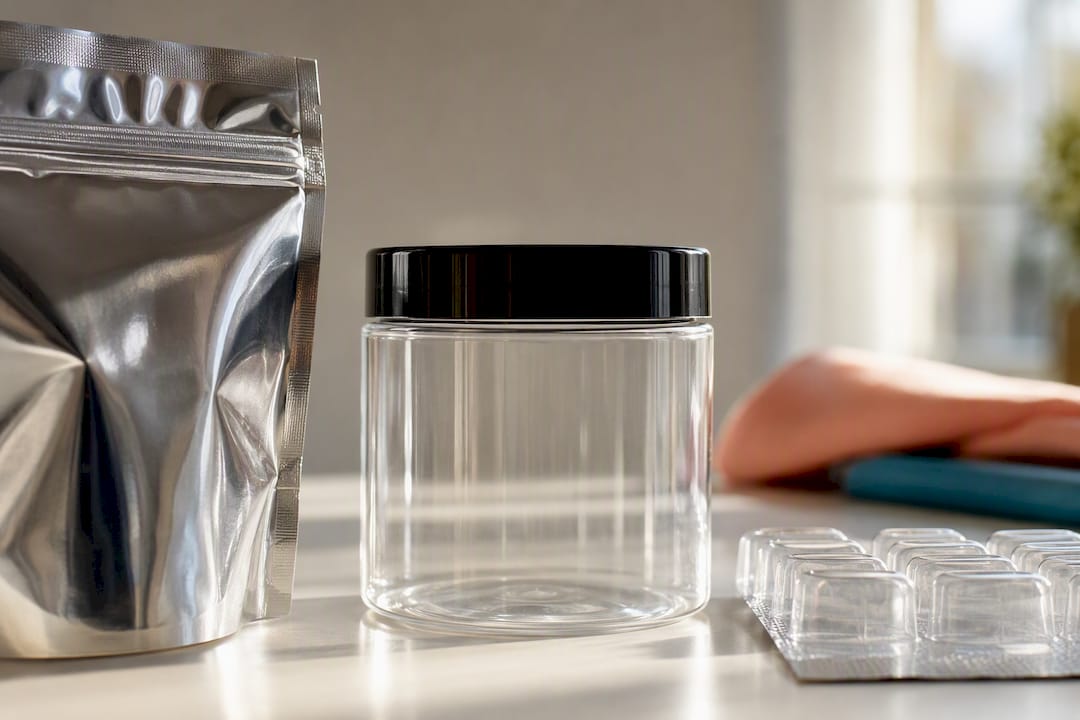
Food-safe silica gel packets are worth adding to any container you’ve opened. Drop one in, keep it away from direct contact with the gummies themselves, and never eat it, obviously, but don’t panic if a piece brushes against the packet either. For longer storage windows, oxygen absorbers paired with an RH stabilizer packet slow both moisture swings and oxidation at once, a combination that matters more the longer the storage period stretches.
Single-serve wrapping cuts stickiness dramatically since each piece stays isolated from its neighbors, though it does mean more packaging waste than a bulk container. That tradeoff is worth weighing based on how quickly you actually go through a batch.
| Packaging type | Moisture barrier | Best use case |
|---|---|---|
| Mylar bag | High | Long-term or bulk storage |
| PET jar with lid | High | Everyday countertop or pantry use |
| Cold-formed blister pack | High | Individual doses, travel |
| Cardboard box | Low | Not recommended for opened product |
| Thin resealable bag | Low to moderate | Short-term only, not ideal |
Cardboard, plain paper, and thin flexible bags consistently underperform because they either absorb moisture directly or flex enough at the seams to let air slip through, undoing whatever humidity control you thought you had.
Storing THC, CBD, and Homemade Gummies Safely
THC and CBD gummies can sit side by side on a counter looking completely identical, which is precisely the problem. Separate them physically, and label each container with the compound type and dose per piece. If children or pets share the household, a lockable container isn’t optional. CDC data on cannabis poisoning confirms this is a real and recurring cause of emergency calls, not a rare edge case.
Refrigeration can help preserve potency in THC edibles by slowing the compound breakdown that heat accelerates, but it only works in your favor if the product stays sealed. An open pack in a standard fridge picks up ambient humidity fast, which reintroduces the exact stickiness problem you were trying to avoid in the first place. Coastalhemp’s guide on how hydration affects hemp edibles walks through why that moisture balance matters for the actual eating experience, not just shelf appearance.
Homemade batches deserve extra caution. Without a certificate of analysis or commercial-grade packaging, you’re working with more variables than a manufactured product ever has. Treat homemade gummies as shorter-lived, plan to eat them within a few weeks rather than months, and cool the molds fully to room temperature before sealing them. That rapid cooling step minimizes the internal moisture migration that can wreck texture before you ever get the batch into storage, per Aldevra’s production guidance.
Traveling with THC gummies raises a separate set of questions around what’s actually permitted and where, and Coastalhemp’s breakdown of flying with hemp gummies covers what TSA screening typically involves. The short version for storage purposes: keep products sealed in original, labeled packaging whenever travel is allowed, since an unlabeled loose gummy invites questions no one wants at a security checkpoint.
Gummy Shelf Life: Realistic Timelines and Warning Signs
Unopened, properly packaged gummies commonly last 12 to 24 months, with the exact window depending on the formulation and how well the original packaging controls humidity and oxygen. Once opened, expect a shorter window of roughly 3 to 12 months, and where you land in that range comes down almost entirely to how well you control humidity, refrigeration, or freezing afterward.
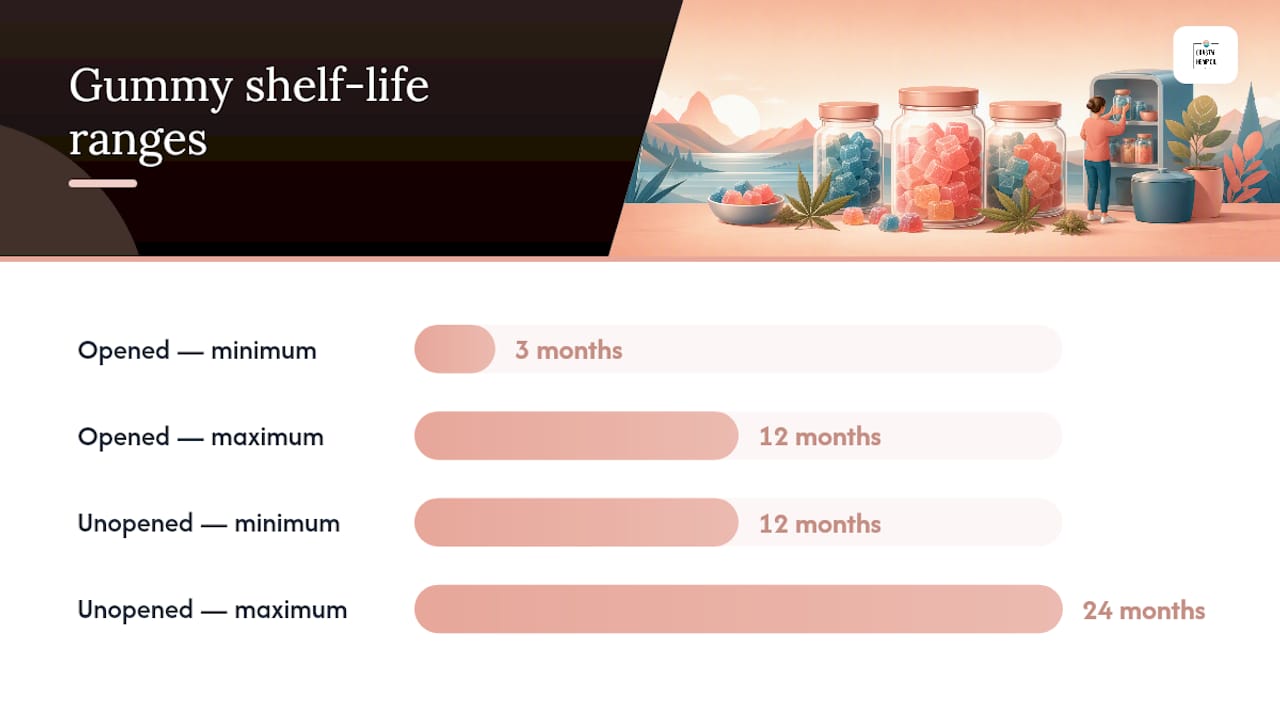
Under standard storage conditions around 68 to 77 degrees Fahrenheit and 50 to 60% relative humidity, a pharmaceutical stability review found gummies can realistically hold for one to two years. That range exists because gummies tend to run low on water activity and low on pH, two factors that independently slow microbial growth even without refrigeration.
Trust your senses over the calendar date on any label:
- Visible mold or fuzzy spots mean discard immediately, no exceptions. The USDA’s food safety guidance on mold is unambiguous on this point.
- An off, sour, or unusually chemical smell is a discard signal even without visible mold.
- A sticky, fused mass usually means humidity damage, not necessarily spoilage, but check for smell and mold before eating.
- Extreme hardening suggests moisture loss and probably potency decline, even if it’s technically still safe to eat.
How Coastalhemp Packages and Recommends Gummies for Better Storage
Getting a gummy from a lab to your kitchen counter without it turning into a sticky mess involves more than a good recipe. It requires packaging decisions made with storage in mind from the start.
Some brands and growers build storage resilience into the product itself, not as an afterthought. That shows up in a few concrete ways worth checking for on any label:
- Individually sealed or portioned packaging reduces the surface area exposed to air each time you open the container.
- Sugar-coated or dusted gummies resist sticking to each other better than uncoated formulations, especially in slightly humid conditions.
- Mylar-backed or foil-lined packaging blocks light and moisture more effectively than clear plastic.
- Clear labeling of THC versus CBD content and potency per piece helps you store and separate products correctly from the moment they arrive.
Whenever a certificate of analysis is available on a product page, take a minute to check it alongside the storage instructions. The two pieces of information together tell you far more about how a batch will hold up than either one alone.
What Actually Matters Most in Gummy Storage
Most storage advice online overweights refrigeration and underweights humidity control, and that ordering is backwards. A gummy sitting in a sealed, desiccant-equipped container on a cool shelf will usually outlast one tossed loose into a fridge drawer, because the fridge introduces moisture risk that most people never account for.
The conventional wisdom treats “keep it cold” as the whole answer. It isn’t. Temperature is one input among four, and humidity does more damage, faster, than heat alone in most home storage scenarios. If you take one thing from this guide, make it the desiccant packet, not the fridge shelf.
Homemade gummies get treated too casually, too. People apply commercial shelf-life expectations to a batch that lacks a certificate of analysis or engineered packaging. Shorter storage windows and more conservative handling aren’t overcaution there. They’re just realistic given what you don’t know about the batch.
Prioritize the container and the environment first. Worry about the fridge second, and only once the sealing problem is solved.
— John
Shop Storage-Friendly Gummies and Edibles at Coastalhemp
You’ve got the storage plan down: airtight, cool, dark, and dry. What actually simplifies that plan is starting with products built to hold up in the first place, and that’s where Some product catalogs include items designed for better storage performance.
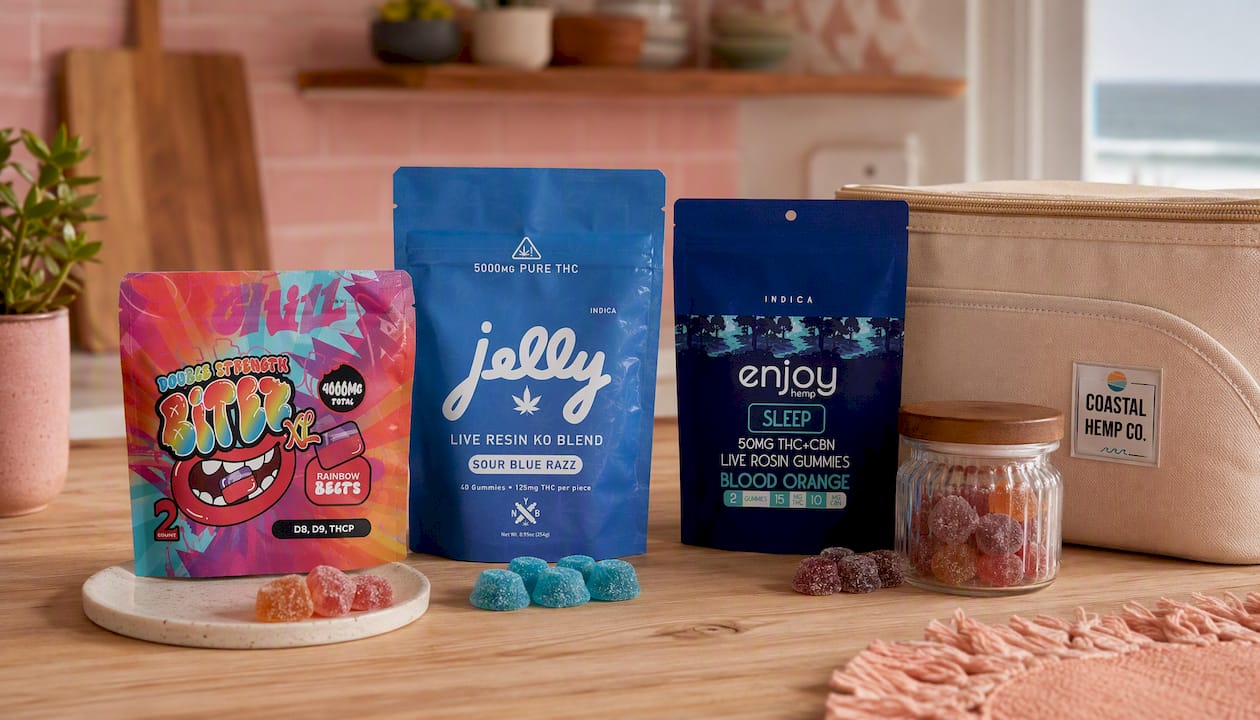
The Jelly THCA Live Sugar Blend Gummies 3-Pack Bundle uses a sugar-dusted coating that resists sticking even after the pack has been opened a few times. For anyone easing off cannabinoids in favor of a milder edible, the Gushrooms Magic Gummies come in packaging designed to stay fresh through the same humidity and light exposure that ruins lesser products. If bedtime is the goal, the Enjoy Sleep Gummies THC + CBN 2-Pack ship in a compact, resealable format that’s easy to store away from kids and pets between doses. Prefer to skip the guesswork entirely? The Monthly Mystery Hot Box delivers a fresh curated mix on a recurring schedule, so nothing sits in your cabinet long enough to become a storage problem.
Browse the current lineup, check the packaging notes on each product page, and build a rotation that never outlasts its own shelf life.
Sources
- Crafting Better Gummies — Colorcon
- How to Store Cannabis Gummies to Prevent Stickiness, Mold & Texture Loss — Aldevra
- Microbiological attributes of chewable gels (gummies) — American Pharmaceutical Review
- Molds in food — USDA FSIS
- Cannabis-related poisoning — CDC
FAQ
What’s the Best Way to Store Edible Gummies?
Keep them sealed in original packaging or an airtight food-safe container, in a cool, dark, dry place, and add a food-safe desiccant packet once opened to control internal humidity.
Can I Eat Edibles That Are Two Years Old?
Unopened gummies stored properly can sometimes last up to 24 months, but check for mold, off smells, or extreme texture changes before eating anything that old, and when in doubt, discard it.
How Should I Store Homemade Gummies to Keep Them Fresh?
Cool the batch fully to room temperature before sealing it, store it in an airtight container with a desiccant, and plan to eat it within a few weeks since homemade batches lack the engineered packaging and testing that extend commercial shelf life.
Does Refrigerating Edibles Make Them Stronger?
No, refrigeration doesn’t increase potency. It can slow the heat-driven breakdown of active compounds and help preserve potency over time, but only if the product stays sealed against humidity while it’s in the fridge.


Comments