

Flying With Hemp Gummies: What TSA Actually Allows
Yes, you can fly with hemp-derived gummies on domestic U.S. TSA classifies compliant hemp products as allowed in both carry-on and checked bags. Two things matter most before you head to the airport: keep the gummies in their original, factory-sealed packaging, and bring the batch’s Certificate of Analysis (COA) along with your purchase receipt.
TL;DR:
- Keep gummies in their original, sealed packaging and carry a batch-specific Certificate of Analysis to verify THC levels before flying.
- The federal legal limit for delta-9 THC in hemp products is 0.3%, but state laws and local restrictions may be stricter once you land, so check destination regulations beforehand.
- Solid edibles like gummies are exempt from TSA’s liquids rule, making them easier to transport than tinctures or beverages, which must follow the 3-1-1 rule.
- Most TSA encounters with compliant hemp gummies end quickly when proper documentation is provided; staying calm and volunteering paperwork speeds the process.
- International travel with hemp-derived THC products is risky, as crossing borders often violates local laws regardless of compliance within the U.S.
Table of Contents
- What Does TSA Actually Say About Hemp Products?
- How Should You Pack and Document Your Gummies for the Checkpoint?
- Why Gummies Beat Tinctures and Other Liquid Hemp Products for Travel
- Do State Laws Still Matter If TSA Allows Your Gummies?
- What Happens If TSA or Police Flag Your Gummies?
- Coastal Hemp’s Approach to Travel-Ready Hemp Products
- What Should You Know About International Flights and Customs?
- Do Airlines Have Their Own Rules Beyond TSA?
- What Are the Real Penalties If You’re Caught With Noncompliant Gummies?
- How Do You Verify a Product Is Actually Under the THC Limit?
- The Real Gap in Most Travel Advice on This Topic
- Travel-Ready Picks From Coastalhemp
- Sources
- FAQ
What Does TSA Actually Say About Hemp Products?
TSA’s own medical marijuana guidance permits hemp-derived CBD and other hemp products containing no more than 0.3% delta-9 THC in both carry-on and checked luggage. That threshold comes directly from federal law, not from TSA itself.
The 2018 Farm Bill defines hemp as cannabis containing 0.3% delta-9 THC or less by dry weight. Anything above that line is legally marijuana under federal law, regardless of how it’s marketed or labeled. This is the single number that determines whether your gummies count as hemp or as a controlled substance at a federal checkpoint.
Here’s what a lot of travelers get wrong about TSA’s role:
- TSA officers are screening for security threats, not running a drug enforcement operation.
- They don’t carry equipment to field-test THC concentration on the spot.
- If a product looks like it could be illicit marijuana, or if it’s unlabeled and unverifiable, officers can refer the matter to local law enforcement.
- The final call at the checkpoint always rests with the individual screening officer, not with a printed policy page.
You may have seen headlines in 2026 claiming TSA “changed” its marijuana policy. Fact-checkers at Snopes confirmed that wording updates to TSA’s website didn’t reflect any real policy shift. Compliant hemp products remain allowed. The confusion itself is a good reason to travel prepared rather than relying on a headline you half remember.
How Should You Pack and Document Your Gummies for the Checkpoint?
Documentation is what separates a five-second bag check from a twenty-minute conversation with a supervisor. Follow this sequence before you leave home:
- Leave the gummies in their original packaging. Factory-sealed containers with a visible lot number give an officer an immediate, verifiable reference point. Repackaging into a travel pouch or pill case erases that reference and invites more questions.
- Match your COA to the lot number on the label. A batch-specific COA that ties directly to your product, not a generic lab report from the brand’s website, resolves doubt fastest.
- Save the COA in two places. Print a copy and also keep a digital version on your phone, since a dead battery shouldn’t be the reason you can’t verify compliance.
- Keep your purchase receipt with the product. It backs up the COA by showing where and when you bought the item.
- If an officer asks, hand over the packaging, COA, and receipt together, without being asked twice. Volunteering the documentation before it’s requested usually shortens the interaction, not lengthens it.
Pro Tip: Take a photo of the COA and receipt side by side before you pack, so you have a backup image on your phone even if the printed copy gets buried in a suitcase.
Why Gummies Beat Tinctures and Other Liquid Hemp Products for Travel
Solid edibles have a real advantage over liquid hemp products: they’re exempt from TSA’s 3-1-1 liquids rule. That rule requires liquids, including tinctures, hemp beverages, and syrups, to be in containers of 3.4 ounces (100 ml) or less, all fitting inside a single quart bag for carry-on.
Gummies skip that math entirely.
- Carry-on: Gummies in original packaging, no size restriction tied to the liquids rule.
- Checked bags: Also allowed, though keeping them in carry-on with your documentation is safer if you want quick access.
- Tinctures and beverages: Must comply with 3-1-1 in carry-on, or go in checked luggage where the liquids rule doesn’t apply.
- Labeling: Any liquid product should keep its original bottle and cap intact. Transferring it into a travel-size container strips away the batch information you’d need if questioned.
If you’re choosing between formats specifically for air travel, a solid edible removes one entire category of friction.
Do State Laws Still Matter If TSA Allows Your Gummies?
Federal law sets the floor, not the ceiling. A product can be perfectly legal under the 2018 Farm Bill and still run into trouble depending on where you land, because state cannabis laws vary widely and some states restrict hemp-derived cannabinoids more tightly than federal law does.
Check your destination before you pack, not after you’ve already boarded.
- Search “[your destination state] hemp THC law” alongside the NCSL state tracker for a fast read on local restrictions.
- Some states cap total THC per package or ban certain hemp-derived compounds outright, even when the product is under 0.3% delta-9 THC.
- U.S. territories, including Puerto Rico and Guam, are treated as domestic destinations for TSA screening purposes, so the federal standard still applies there.
One number worth remembering: the 0.3% delta-9 THC threshold is the federal line, but it’s not universal. A handful of states apply their own, stricter definitions of legal hemp, which means a product that clears TSA screening without issue could still violate local law once you’ve landed.
What Happens If TSA or Police Flag Your Gummies?
Most encounters end quickly once documentation is on hand. But it helps to know the realistic range of outcomes and how to handle each one calmly.
- Show your COA and receipt immediately. This resolves the majority of questions before they escalate.
- Ask for a supervisor if the initial officer seems uncertain. A second, more experienced set of eyes often speeds things along.
- Stay calm and keep your phone recording if the situation gets tense. You’re allowed to document your own interaction at a public security checkpoint.
- Decide whether to accept confiscation or push back. If an officer insists on confiscating a clearly compliant product, you can accept the loss and file a complaint later, or ask to speak with law enforcement directly if you believe the product is being wrongly flagged.
- Follow up in writing. Contact TSA through its official complaint channels and keep copies of your COA, receipt, and any paperwork issued at the checkpoint.
The scenario to avoid is arguing extensively at the checkpoint itself. TSA officers have discretion, and a calm, documented approach resolves far more situations than an argument does.
Coastal Hemp’s Approach to Travel-Ready Hemp Products
Coastalhemp sources hemp products with lab documentation built into the process, not bolted on afterward. Every product listing carries a downloadable COA, so you’re not scrambling to request one the night before a flight.
For travelers specifically, a few practical notes:
- Solid formats, like gummies, are the lowest-friction option discussed above, and Coastalhemp’s Slightly Elevated Vibe Gummies are one example built around that format.
- COAs are available directly from each product page, matched to batch numbers.
- Coastalhemp’s blog post on flying with Delta 9 goes deeper into THC-specific travel questions if your product isn’t a straightforward hemp gummy.
Look for a lab report tied to your specific batch, not a generic brand-wide lab summary, no matter which company you buy from.
What Should You Know About International Flights and Customs?
Everything covered so far applies to domestic U.S. travel. International trips are a different situation entirely, and the risk profile changes substantially once customs authorities in another country get involved.

TSA’s screening rules govern what happens inside a U.S. airport. A product that’s fully compliant for a flight from Chicago to Miami can become a serious legal problem the moment you land in a country with zero-tolerance cannabis laws.
The safest approach for international travel is straightforward: leave hemp-derived THC gummies at home. If you rely on hemp products for anxiety, sleep, or general wellness, look into CBD-only formulations with no detectable THC, and still verify the destination country’s specific import rules before departure, since some nations restrict CBD products too. Customs enforcement abroad doesn’t offer the same officer discretion that TSA screening does domestically, and penalties in some countries range from confiscation to criminal charges. This is one area where “it was legal where I bought it” carries no legal weight once you’ve crossed a border.
Do Airlines Have Their Own Rules Beyond TSA?
TSA governs what goes through security. Airlines can add their own restrictions on top of that, and they don’t always publicize them clearly.
Some carriers include general language in their contracts of carriage about prohibited items that goes beyond federal drug law, occasionally sweeping in cannabis-derived products even when those products are federally legal hemp. This is rare for compliant hemp gummies specifically, but it’s worth a quick check of your airline’s website under “prohibited items” or “hazardous materials” before a trip, especially if you’re flying internationally on a U.S. carrier or connecting through a country with stricter cannabis laws.
Crew discretion is a separate consideration from airline policy. A flight attendant who notices you taking a hemp gummy midflight has no obligation to intervene, since the product is federally legal and TSA-permitted, but individual crew members can ask questions if they’re unfamiliar with hemp regulations. Having your COA accessible on your phone resolves this the same way it resolves a TSA checkpoint question.
The practical takeaway: TSA rules are the primary hurdle, but they aren’t the only one. A quick look at your specific airline’s policy page takes two minutes and removes any lingering uncertainty about connecting flights or international codeshares.
What Are the Real Penalties If You’re Caught With Noncompliant Gummies?
The consequences depend almost entirely on whether the product is genuinely compliant, and whether you can prove it on the spot.
If your gummies test as federally compliant hemp and you have documentation, the realistic worst case is a delay while an officer confirms that with a supervisor. TSA itself doesn’t prosecute drug crimes, but it can refer the matter to local law enforcement, and what happens next depends on the state you’re in. Some states have decriminalized small amounts of THC-containing products; others still treat possession as a criminal matter, particularly if the product isn’t clearly hemp-derived.
Confiscation is the most common outcome even in gray-area cases, since officers often err toward removing the item rather than escalating further. Criminal charges are less common for genuinely compliant hemp products but become a real risk if the THC content actually exceeds the legal limit or if state law treats the product more strictly than federal law does. This is exactly why the documentation habits covered earlier, original packaging, a matching COA, a receipt, aren’t optional extras. They’re the difference between a two-minute checkpoint conversation and a much longer one involving a second agency.
How Do You Verify a Product Is Actually Under the THC Limit?
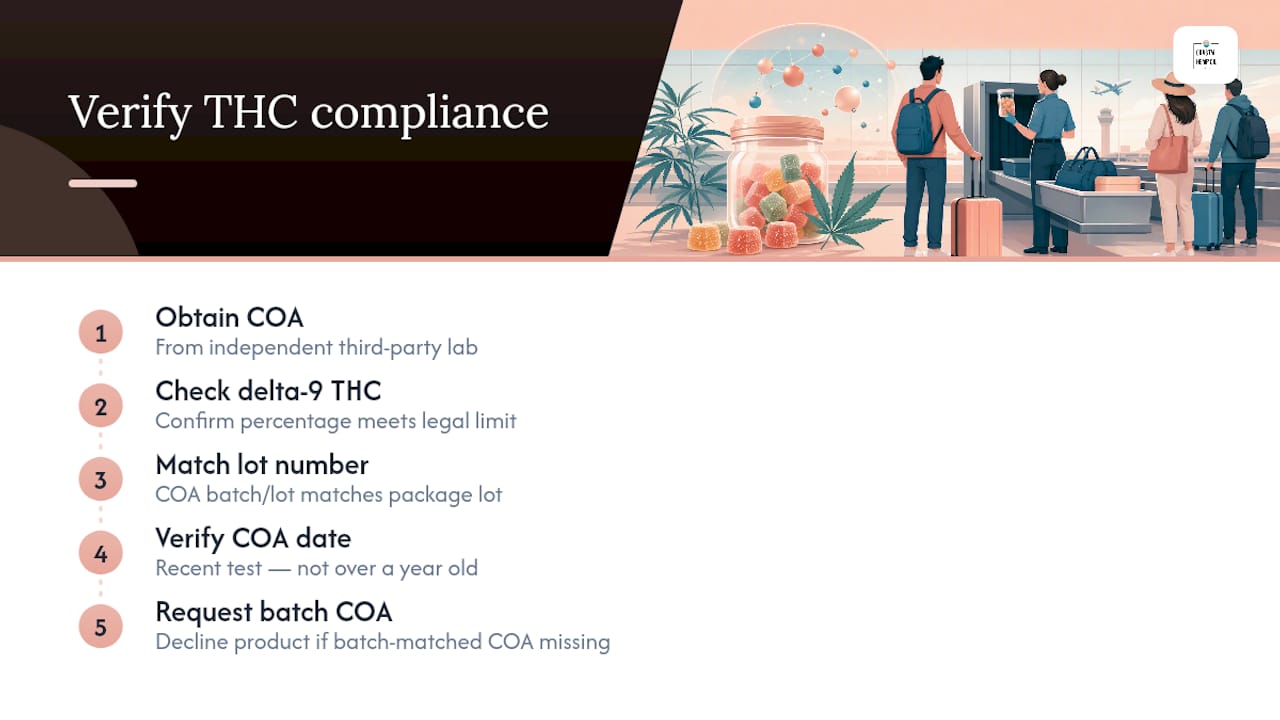
Don’t take a label’s word for it. Verify the number yourself before you ever pack a bag.
Start with the COA. A legitimate one comes from a third-party lab, not the brand’s in-house testing, and it should show a specific delta-9 THC percentage tied to the exact batch or lot number printed on your product’s packaging. If the COA on a brand’s website doesn’t include a lot number that matches what’s on your container, you don’t actually have proof that document applies to the product in your hand.
Check the date on the COA too. Hemp products can shift slightly in cannabinoid content over time, and a lab report from over a year ago doesn’t necessarily reflect what’s in a product you bought recently. Reputable sellers test each new batch and update their COAs accordingly. Retail sources that publish detailed packaging and lab-testing practices alongside their products give you a useful model for what thorough documentation looks like.
If a brand can’t produce a batch-matched COA on request, that’s a signal to look elsewhere, regardless of how confidently the packaging is labeled.
The Real Gap in Most Travel Advice on This Topic
Most guidance on this subject either overstates the risk (treating every hemp product like it’s one bad interaction from a federal case) or understates it (implying TSA’s green light means nothing else matters). Neither is accurate, and the truth sits in a less dramatic middle ground.
The federal law is genuinely permissive. Where the conventional advice falls short is in treating that legal fact as the end of the conversation. It isn’t. State law, officer discretion, and the physical reality that no checkpoint officer can chemically verify your product’s THC content in real time all sit on top of that federal baseline.
What actually reduces risk isn’t hoping TSA reads the situation correctly. It’s removing the guesswork before you ever reach the checkpoint: a solid product form, original packaging, a batch-matched COA, and a receipt. That combination doesn’t just satisfy TSA policy on paper, it gives an officer everything needed to make a fast, confident call. Skip the documentation and you’re relying entirely on discretion. Bring it, and you’ve done the one thing actually within your control.
— John
Travel-Ready Picks From Coastalhemp
Coastalhemp built its catalog around the exact travel logistics covered above, so you’re not left guessing which format to trust at a checkpoint.
Solid, single-serving gummies remain the easiest hemp product to travel with, since they skip TSA’s liquids rule entirely and present cleanly in original packaging. The Enjoy Sleep Gummies THC + CBN 2 Pk is a compact, factory-sealed option that fits easily in a carry-on for red-eye flights or long layovers. If you want to sample a wider range of solids before committing, the Monthly Mystery Hot Box delivers a rotating selection so you can find a format you’re comfortable flying with month over month. Every product page includes a downloadable, batch-matched COA. Save it to your phone and print a copy before your trip date, so you’re never scrambling at security. Browse the current lineup and pull your COA today, well before you’re standing in the TSA line.
Sources
- Medical Marijuana | Transportation Security Administration
- Congress
- State medical marijuana laws | NCSL
FAQ
Can I Travel With CBD Gummies on a Plane?
Yes.
Do Hemp Gummies Count as Liquids Under the 3-1-1 Rule?
No. Solid edibles like gummies are exempt from TSA’s 3.4-ounce liquids rule, which applies only to tinctures, beverages, and other liquid hemp products.
What Happens if a State I’m Flying To Has Stricter Hemp Laws?
Federal law allows the product, but state law can still create legal exposure once you land, so check the destination state’s rules through the NCSL tracker before you travel.
Can TSA Officers Test My Gummies for THC on the Spot?
No. TSA officers don’t carry field-testing equipment for THC concentration, which is why a batch-matched COA is the fastest way to resolve any questions at the checkpoint.
Is It Safe to Bring Hemp Gummies on International Flights?
It’s not recommended. Many countries treat any THC content as illegal regardless of the U.S.


Comments