

104 FDA Reports: Delta 8 Side Effects Adults Should Know
Delta 8 THC produces psychoactive effects similar to delta 9, and the FDA’s own adverse event data confirms it can trigger reactions ranging from anxiety and dizziness to seizures and loss of consciousness. Most reported cases are mild to moderate, but a meaningful share end in an ER visit. The bigger issue often isn’t the molecule itself. It’s what else ends up in the product, and how much of it a person accidentally consumes.
TL;DR:
- Most adverse delta 8 reactions involve edible overdose, with delayed onset increasing the risk of consuming too much during the waiting period.
- Poor manufacturing practices can leave residual solvents, unreacted chemicals, or undisclosed delta 9 THC in products, greatly elevating health risks.
- Children and individuals with psychiatric histories face higher dangers, especially from mislabeling, accidental ingestion, or product contamination.
- Inhalation provides near-instant effects, allowing better dose control, while edibles’ delayed response often results in severe, prolonged intoxication.
- Choosing properly tested, batch-specific products and dosing low and slow can significantly reduce the risk of severe side effects from delta 8 THC.
Table of Contents
- Delta 8 Side Effects: What People Actually Report
- How Delta 8 Causes Its Effects: A Quick Pharmacology Primer
- Why Manufacturing and Labeling Problems Cause Their Own Side Effects
- Who Faces Higher Risk From Delta 8
- Edibles vs. Inhalation: Why Gummies Are Where Overdoses Happen
- A Practical Checklist for Safer Delta 8 Use
- When Delta 8 Side Effects Need Medical Attention
- How Coastalhemp Approaches Product Safety and Education
- The Editorial Take: What Most Delta 8 Advice Gets Backwards
- Explore Safer, Lab-Verified Options With Coastalhemp
- Sources
- FAQ
Delta 8 Side Effects: What People Actually Report
Anxiety and dizziness top nearly every list of delta 8 side effects, but they’re far from the only symptoms showing up in clinical data. A 2023 analysis of self-reported adverse events in the Journal of Cannabis Research found psychiatric disturbances accounted for 41.2% of reports, with paranoia and anxiety leading the pack.
The most commonly reported acute effects include:
- Anxiety and paranoia, often described as more intense than expected for the dose taken
- Dizziness and confusion, sometimes severe enough to impair coordination or judgment
- Nausea and vomiting, frequently tied to edible overconsumption
- Tremor, reported in a subset of hospital-evaluated cases
- Hallucinations, particularly at high doses or in inexperienced users
- Loss of consciousness, the most serious acute outcome and a common reason for ER transport
The scale of these reports is bigger than most people assume. Between December 2020 and February 2022, the FDA logged 104 adverse event reports tied to delta 8 products.
By the numbers: A significant share of those 104 FDA reports required hospital admission or emergency medical intervention, and many followed ingestion of a food product like a gummy or beverage. Over the same window, national poison control centers logged 2,362 exposure cases.
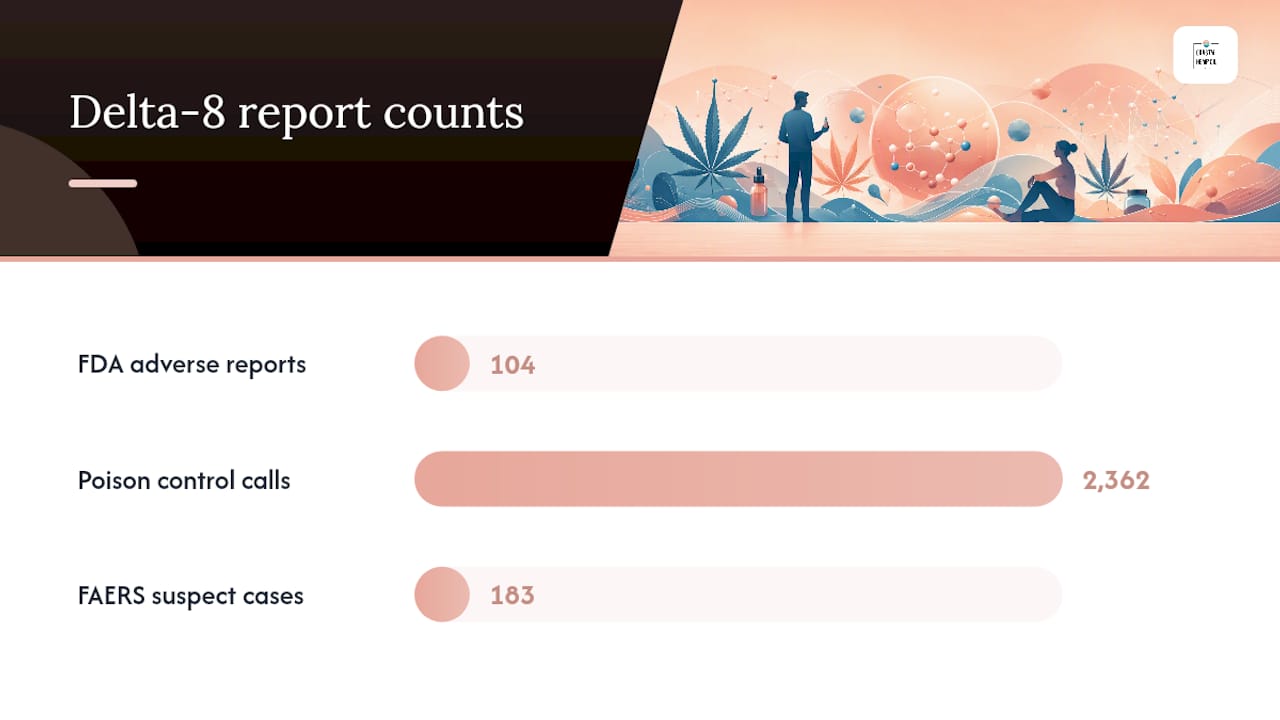
A separate review of the FDA’s Adverse Event Reporting System (FAERS) found 183 total cases naming delta 8 as a suspect drug through mid 2021. Respiratory events like dyspnea and seizures appeared more often than expected, and the reporting odds ratios suggested a genuine safety signal rather than statistical noise.
It’s worth being honest about what these numbers can and can’t tell you. FAERS and poison control data rely on passive, voluntary reporting. Doctors, consumers, and manufacturers submit cases when something goes wrong, but there’s no equivalent system tallying every safe, uneventful use of delta 8. That means the true rate of side effects, mild or severe, is almost certainly undercounted on both ends. What the data does capture reliably is the pattern: when things go wrong with delta 8, psychiatric symptoms and edible-related overdose are the two threads that show up again and again.
How Delta 8 Causes Its Effects: A Quick Pharmacology Primer
Delta 8 THC works the same basic way delta 9 does. It binds to CB1 receptors in the brain and central nervous system, the same receptors responsible for the classic marijuana high: altered perception, relaxation, appetite changes, and mood shifts. The structural difference between the two molecules is small, just the position of one double bond, but that tiny shift changes how tightly delta 8 binds to CB1.
That weaker binding is why delta 8 is often marketed as “half the strength” of delta 9. In practice, potency is relative, not fixed. A 2026 toxicity review in the peer-reviewed literature notes that despite reduced receptor affinity, delta 8 produces a similar clinical picture: dizziness, confusion, sedation, and anxiety. Lower potency per milligram doesn’t mean lower risk if the dose per milligram simply goes up, which is exactly what happens with many high-strength gummies and concentrates on the market.
Here’s the honest caveat: human research on delta 8 is thin. Most of what’s known comes from older, small-scale studies conducted decades ago, before the current wave of synthetic delta 8 products existed, plus a growing but still limited body of case reports and self-reported data. Clinicians and researchers are essentially reverse-engineering delta 8’s risk profile from emergency room visits and social media reports rather than from large controlled trials. Public health experts have generally taken a cautious stance as a result, particularly for people with any history of psychosis risk, recommending abstention until better evidence exists. That gap in the evidence base is a big part of why product quality matters so much, which is where things get complicated.
Why Manufacturing and Labeling Problems Cause Their Own Side Effects
Delta 8 doesn’t grow abundantly in the hemp plant. Nearly all commercial delta 8 is synthesized by chemically converting CBD, and that conversion process is where a lot of the real risk lives. The reaction typically uses acids and solvents to rearrange the CBD molecule into delta 8. Done correctly, with proper purification and testing, the end product is clean. Done poorly or by an unregulated operator racing to meet demand, it can leave behind residual solvents, unreacted starting material, or byproduct isomers that were never studied for safety at all.

This is the mechanism behind a lot of unexplained delta 8 gummy side effects that don’t match what the labeled dose should produce. A gummy that says “25mg delta 8” might also contain unlisted delta 9 THC, residual reaction byproducts, or a wildly different actual potency than what’s printed. The FDA has flagged this directly, warning that commercial delta 8 products haven’t been evaluated or approved by the agency and that conversion byproducts are a real contamination pathway.
Common quality problems to watch for:
- Residual solvents left over from the CBD-to-delta 8 conversion process, which can cause respiratory or gastrointestinal symptoms
- Delta 9 contamination, where a product marketed as delta 8 contains meaningful, undisclosed amounts of the more potent isomer
- Mislabeled potency, where actual cannabinoid content doesn’t match what’s on the packaging
- Heavy metals or microbial contaminants from poor sourcing or manufacturing hygiene
- Child-appealing packaging, gummies and candy-like edibles that look identical to regular snacks
That last point deserves its own emphasis. A significant share of severe pediatric exposure cases trace back to delta 8 edibles that were visually indistinguishable from ordinary candy, sitting in a cabinet or backpack where a curious kid found them.
Pro Tip: Never buy a delta 8 product without a current, batch-specific Certificate of Analysis (COA) from an independent, named lab. If the seller can’t produce one, or the COA is generic and undated, treat that as a hard no, not a minor inconvenience.
Who Faces Higher Risk From Delta 8
Not every body responds to delta 8 the same way, and some groups face meaningfully higher odds of a serious outcome.
Children are the clearest example. Pediatric exposures, almost always accidental ingestion of edibles left within reach, tend to produce worse outcomes than adult exposures because a child’s body weight means even a “normal” adult dose can be a massive relative overdose. CDC health alert data documents clusters of severe pediatric cases requiring hospital evaluation, and prevention here is straightforward: delta 8 products belong in locked, high, childproof storage, never in a kitchen drawer or purse.

People with a personal or family history of psychosis or serious psychiatric illness face a different kind of risk. Cannabinoids that activate CB1 receptors can trigger or worsen anxiety, paranoia, and in rarer cases psychotic symptoms. Given the thin evidence base on delta 8 specifically, the more conservative and defensible position is abstention or a direct conversation with a psychiatric provider before use, not a “try it and see” approach.
Other higher-risk groups include:
- Pregnant or breastfeeding individuals, for whom no cannabinoid is considered safe given the lack of research on fetal and infant exposure
- People with cardiac or respiratory disease, since case reports have linked delta 8 use to dyspnea and rare arrhythmia-type events
- Anyone combining delta 8 with alcohol or sedatives, which compounds sedation and raises overdose risk
- People taking multiple prescription medications, where added CNS depression or metabolic interactions are harder to predict
Edibles vs. Inhalation: Why Gummies Are Where Overdoses Happen
The single biggest practical difference between delta 8 side effects from edibles and from vaping or smoking comes down to timing. Inhaled delta 8 hits the bloodstream in minutes, peaks quickly, and gives the user near-real-time feedback on how strong the effects are. Edibles don’t work that way at all.
- Onset is delayed 30 to 90 minutes after eating a delta 8 gummy or beverage, sometimes longer depending on stomach contents and metabolism.
- First-time or impatient users often redose during that window, assuming the product “isn’t working,” which stacks two or three doses before the first one has even peaked.
- Peak effects and duration run much longer with edibles, often 4 to 8 hours, compared to 1 to 3 hours for inhaled delta 8.
- The overdose curve compounds because by the time the delayed effects hit, the person has already consumed far more than intended.
This pattern shows up repeatedly in poison control and FDA case narratives: someone eats a gummy, feels nothing after 20 minutes, eats another, and ends up in the emergency room hours later with severe anxiety, vomiting, or dangerously impaired coordination. Delayed onset combined with candy-like packaging is one of the most consistent drivers of accidental overconsumption in the entire dataset, for adults and children alike.
A Practical Checklist for Safer Delta 8 Use
If you’re going to use a delta 8 product, treat dosing the same way you’d treat any substance with a real margin for error: start low, wait it out, and don’t guess.
Start low, go slow. A reasonable starting dose for someone with limited THC tolerance is 5 to 10mg, taken as a single edible piece rather than a whole bar or full gummy. Wait a full 2 hours before considering more, given how long edibles take to peak.
Read the COA like it matters, because it does. A trustworthy Certificate of Analysis should show:
- Total cannabinoid content with delta 8 and delta 9 THC reported separately
- Residual solvent screening (from the CBD conversion process)
- Heavy metals testing
- Microbial contaminant screening
- A batch number that matches the product in hand, tested by a named third-party lab
If any of those panels are missing, or the COA is a stock document that doesn’t correspond to the specific batch you’re holding, that’s a red flag worth walking away from.
Store it like medicine, not candy. Keep delta 8 products in original, labeled packaging, in a locked or high cabinet, away from anything that resembles a household snack drawer. Never drive or operate machinery after use. Skip it entirely if you’re mixing with alcohol, benzodiazepines, or other sedatives, since combining depressant effects raises the risk of severe sedation or respiratory suppression.
Pro Tip: Keep a simple log the first few times you try a new batch: product name, dose, time taken, and how you felt over the next four hours. If something goes wrong later, that log is exactly the information poison control or an ER physician will ask for first.
If you’re looking for a way to get familiar effects without the intoxicating variability, it’s worth comparing delta 8 against non-intoxicating CBD before committing to a THC isomer at all.
When Delta 8 Side Effects Need Medical Attention
Most delta 8 reactions resolve on their own with time, water, and a quiet place to sit down. Some don’t, and knowing the difference matters.
Call 911 or go to the ER if you or someone else experiences:
- Loss of consciousness or inability to stay awake
- Seizure activity
- Chest pain, irregular heartbeat, or significant difficulty breathing
- Severe, uncontrollable vomiting
- Confusion so severe the person can’t communicate clearly
- Any pediatric ingestion, regardless of how the child appears, since symptoms can worsen over hours
When you call poison control (800-222-1222) or arrive at an ER, bring or clearly describe the product packaging, the estimated dose consumed, the time of ingestion, and anything else taken alongside it, including alcohol or other medications. That combination of details lets clinicians manage the case faster and more accurately.
It’s also worth reporting the event to the FDA’s MedWatch program once the immediate situation is handled. Passive surveillance systems like FAERS only work if real cases get reported, and every submission adds to the picture regulators and researchers are trying to build.
How Coastalhemp Approaches Product Safety and Education
Coastalhemp works with vetted growers and brands rather than sourcing blind, and every product listed comes with lab documentation customers can actually check before buying, not just a marketing claim about purity. That vetting-first approach exists because so many of the adverse events described above trace back to unverified sourcing rather than the cannabinoid itself.
The catalog also reflects a deliberate push toward variety, so customers aren’t limited to intoxicating THC options if that’s not what they’re after. Functional mushroom edibles like Gushrooms Magic Gummies, the Road Trip Mushroom Chocolate Bar, and FLOAT Mushroom Lollipops offer a non-THC route to functional wellness. For customers who want cannabinoid support without the psychoactivity concerns covered above, CBD + CBG Oil Mellow Mint and Organic CBD Balm with Lavender and Eucalyptus are full-spectrum, non-intoxicating options. There’s even broad-spectrum CBD oil formulated for pets, for households managing exposure risk around animals as well as kids.
For customers who do want THC products, options like Trippy Sugar THCa Diamonds come with the same lab-backed transparency standard applied across the catalog. The goal isn’t pushing any single cannabinoid. It’s making sure that whatever a customer chooses, they’re choosing it with real information in hand.
The Editorial Take: What Most Delta 8 Advice Gets Backwards
Most delta 8 content online frames the conversation as “is delta 8 safe, yes or no,” which is the wrong question. Delta 8 is a mild-to-moderate CB1 agonist with a side effect profile roughly comparable to delta 9. That much is well established. The conventional advice stops there, treating the molecule as the whole story.
It isn’t. The FAERS data, the poison control numbers, and the FDA’s own consumer warnings point overwhelmingly at manufacturing quality and dosing behavior, not the cannabinoid itself, as the real drivers of severe outcomes. A clean, accurately dosed, third-party-tested delta 8 gummy and a contaminated, mislabeled one sold at a gas station are not the same product, even if the label says the same thing.
If you take one thing from this article, make it this: spend your scrutiny on the COA, the lab, and the dose, not on relitigating whether the molecule itself is inherently dangerous. That’s where the actual risk lives, and it’s the one variable you have real control over before you ever open the package.
— John
Explore Safer, Lab-Verified Options With Coastalhemp
Coastalhemp exists for exactly the reader who just read all of that and wants a source they can trust before buying anything. Every product on the site ships with lab documentation available up front, not buried behind a support request, which is the single biggest gap this article just walked through.

If delta 8’s psychoactive variability isn’t what you’re after, the CBD + CBG Oil Mellow Mint delivers full-spectrum support without the intoxication risk profile covered above. Customers who do want a THC edible with verified potency and delta 9 separation on the COA can start with the Jelly THCA Live Sugar Blend Gummies 3-Pack Bundle, one of the catalog’s most transparently tested products. Either way, check the batch-specific lab results on the product page before adding anything to your cart, and start with a low dose regardless of what the label suggests.
This article is general information, not a substitute for advice from a qualified doctor. Consult a qualified healthcare professional about your own circumstances before acting on anything here.
Sources
- 5 Things to Know about Delta-8 Tetrahydrocannabinol – Delta-8 THC
- Self-reported adverse events associated with ∆8-Tetrahydrocannabinol (Delta-8-THC) Use | Journal of Cannabis Research
FAQ
Does delta 8 count as a drug?
Yes. Delta 8 THC is a psychoactive cannabinoid that binds to CB1 receptors and produces intoxicating effects, which is why the FDA tracks it through the same adverse event systems used for other controlled substances.
Is delta 8 safe to use?
Delta 8 carries documented risks including anxiety, dizziness, and in rarer cases seizures or loss of consciousness, and most severe outcomes trace back to contaminated or mislabeled products rather than the molecule alone. Choosing a lab-tested product and starting with a low dose meaningfully reduces the risk.
Is delta 9 safer than delta 8?
Neither isomer has a clearly superior safety profile; delta 9 is more potent per milligram, while delta 8’s biggest risks come from inconsistent manufacturing since it’s typically synthesized from CBD rather than extracted naturally.
What’s a typical delta 9 hangover like?
A delta 9 hangover commonly includes grogginess, headache, dry mouth, and mental fog the day after heavy use, similar to what some users report after high-dose delta 8 edibles given their comparable CB1 activity.
How is delta 8 different from delta 9?
Delta 8 and delta 9 differ by the position of one double bond in their molecular structure, which gives delta 8 weaker CB1 receptor binding and generally milder effects at equal doses, though clinical symptoms reported for both overlap significantly.
Can delta 8 interact with medications I’m already taking?
Delta 8 can intensify sedation when combined with depressants like alcohol or benzodiazepines, and its effect on liver enzymes may alter how some prescription medications are metabolized, so checking with a pharmacist or doctor before combining is worthwhile.


Comments