

Skip DIY: Buy Lab Tested THC Syrups Before 2026 0.4 mg Cap
Ready-made hemp-derived THC syrups are real, tested consumer products, not just a DIY project. Before you buy one, verify a current third-party Certificate of Analysis (COA) and confirm the label lists both per-serving and per-container THC amounts. With federal rules tightening around total THC and container limits in 2026, skipping that COA check is the one mistake that can leave you with a product that’s either underdosed, overdosed, or outright noncompliant.
TL;DR:
- Verify that the product’s COA is batch-specific, recent, and includes a cannabinoid panel that lists both THCA and delta-9 THC to ensure compliance.
- Confirm the label shows both per-serving and total milligrams in the container, especially since federal limits will cap total THC at 0.4 mg per container starting November 2026.
- Start with a low dose of 2.5 to 5 mg total THC and measure precisely with a syringe for accurate dosing, waiting at least ninety minutes before redosing.
- Be aware that the new federal law counts total THC including THCA, so previously compliant products may now exceed the cap and require reformulation.
- Shop with brands that offer clear, batch-specific lab data and contaminant screening, and always check current state regulations before purchasing.
Table of Contents
- What To Check Before Buying a THC Syrup Online
- How Do You Calculate a THC Syrup Dose?
- What Does the 2026 Federal Hemp Law Change?
- How Coastalhemp Screens Its Syrup and Edible Catalog
- Basic Beginner-Friendly THC Syrup Ideas for Beverages
- How Is THC Actually Infused Into Syrup?
- What Kind of Syrup Base Affects Flavor and Potency?
- What Safety Risks Come With THC Syrup?
- How Should You Store THC Syrup to Keep It Fresh?
- An Editorial Take on Buying Syrup Responsibly
- Shop Coastalhemp’s Lab-Verified Syrup and Edible Catalog
- Where to Confirm the Latest Regulatory Details
- Sources
- FAQ
What To Check Before Buying a THC Syrup Online
Every legitimate hemp-derived syrup on the market today ships with paperwork behind it. If a product page doesn’t show that paperwork, treat it as a red flag rather than an oversight.
Start with the COA itself. A real Certificate of Analysis includes a batch number that matches the bottle in your hand, a test date recent enough to reflect the current batch (not a template from a year ago), and a full cannabinoid panel that breaks out THCA separately from delta-9 THC. Consumer guides consistently tell buyers to reject anything without an accessible third-party COA and clear cannabinoid labeling, and that advice matters more now than it did a year ago.
Potency labeling needs to answer three questions at once: milligrams per serving, servings per container, and total milligrams in the container. That third number is the one most shoppers skip, and it’s about to become the most important figure on the label given the new federal container cap discussed below.
Beyond potency, a few practical checks round out the picture:
- Ingredients and allergens. Look for a full ingredient list, sugar or sugar-alcohol content (relevant if you’re diabetic or just watching your intake), and any allergen disclosures.
- Contaminant screening. The COA should cover pesticides, heavy metals, and residual solvents, not just cannabinoid content.
- Shipping and age verification. Legitimate sellers state their shipping restrictions by state and require age verification at checkout.
- Return and support policies. A seller that stands behind its lab data usually publishes a straightforward return policy too.
Brands that skip batch-specific COAs, use vague “hemp extract” language instead of naming actual cannabinoids, or market flavors and packaging that skew toward minors are the products worth walking away from, a pattern flagged repeatedly across buyer checklists for THC syrup.
Pro Tip: Save a screenshot of every COA at the time of purchase. Sellers occasionally update product pages, and having your own record protects you if a batch gets flagged later.
How Do You Calculate a THC Syrup Dose?
Dosing syrup correctly is arithmetic, not guesswork, and the math takes about thirty seconds once you know the container total.
Here’s the basic approach:
- Find the total milligrams in the bottle. Say a bottle lists 200 mg total THC in a 60 ml container. Divide 200 by 60 to get roughly 3.3 mg per ml.
- Decide how much syrup you’re adding to a drink. If you pour 5 ml into a 12 oz beverage, multiply 3.3 mg by 5 to land at about 16.5 mg THC in that glass.
- Adjust for a larger batch. Adding that same 5 ml dose to a full 64 oz pitcher doesn’t lower the total THC. It’s still 16.5 mg, just spread across more liquid, so the whole pitcher needs to be treated as one dose unless you’re portioning it into equal glasses.
For beginners, starting low is the standard guidance across most hemp controlled dosing frameworks: 2.5 to 5 mg total THC is a reasonable first pour for someone new to hemp-derived edibles, with at least 90 minutes to two hours before considering more. Edibles metabolize differently than smoked or vaped hemp, and effects can take longer to show up and last longer once they do.
An oral syringe or graduated dropper beats a kitchen spoon for accuracy every time, since measuring tools designed for concentrated liquids remove the guesswork that a rounded teaspoon introduces. Once you open a bottle, mark the date on the label and jot down your dose-per-ml math right on it.
Mixing syrup with alcohol or eating a heavy meal beforehand can shift how fast you feel effects, generally slowing onset but sometimes intensifying it later, so it’s worth waiting at least two hours before deciding whether to redose, per general guidance on hemp intoxicating effects.
Pro Tip: Make a small index card taped to the fridge or cabinet with your bottle’s mg-per-ml math already worked out. It takes the guessing out of a Friday night pour and keeps everyone in the house on the same page about what “one dose” actually means.
What Does the 2026 Federal Hemp Law Change?
The rules just shifted under your feet, and it happened at the federal level. Under P.L. 119-37, the Continuing Appropriations and Extensions Act, the legal definition of hemp now counts total THC, including THCA, instead of measuring delta-9 THC alone. The same law sets a 0.4 milligram total-THC-per-container cap for finished hemp-derived products, effective November 12, 2026.
That’s a meaningful shift for anyone shopping for syrup. A product that used to comply because its delta-9 count was low can now fail the new standard once THCA gets added into the total. Products that looked federally compliant last year may not clear the bar this year, even with an unchanged formula.
The statute also excludes cannabinoids synthesized outside the plant, and it requires the FDA to publish official lists of naturally occurring cannabinoids and a formal definition of “container,” according to CRS analysis of the new hemp statutory definition. Industry counsel is already urging sellers to run compliance audits and reformulate product lines ahead of the deadline, a signal that the market is bracing for real disruption according to legal reporting on the shift.
A few things to do before you check out:
- Read the COA’s total-THC calculation, not just the delta-9 number, and confirm the test date is current.
- Check your state’s own limits. Some states currently allow higher per-container THC amounts than the new federal standard, creating a patchwork where state rules and federal rules diverge.
- Never assume that a seller’s willingness to ship to your address means the product is legal to possess there. State agriculture departments and cannabis control boards are the actual authority, not the checkout page.
- Favor products with visible contaminant panels over anything relying on brand reputation alone.
For a deeper walkthrough of how this affects specific product categories, Coastalhemp’s hemp-derived THC legality guide breaks down the federal update state by state. Where local dispensaries operate under state license, buying in person remains a reliable way to sidestep interstate shipping uncertainty entirely.
How Coastalhemp Screens Its Syrup and Edible Catalog
Coastal Hemp Company sources from vetted growers and brands rather than white-labeling anonymous formulas, and that sourcing discipline shows up directly on product pages. Every listing is built to show the same information a careful buyer would demand: batch numbers, test dates, and a potency breakdown that doesn’t bury the container total in fine print.
A few examples from the catalog illustrate what that standard looks like in practice:
- Jelly THCA Live Sugar Blend Gummies post batch-specific lab data alongside clear per-piece potency.
- Trippy Sugar THCa Diamonds list total THCA content by weight, not just a vague potency claim.
- CBD + CBG Oil Mellow Mint shows organic, full-spectrum sourcing with milligram totals per bottle.
- Organic CBD Balm with Lavender and Eucalyptus documents ingredient sourcing for topical use.
- CBD Oil for Pets carries the same broad-spectrum lab transparency extended to animal products.
You can filter Coastalhemp’s hemp-derived THC edibles category specifically for items with easily accessible COAs and dosing charts, which saves the step of hunting through a PDF library on a separate compliance page.
Basic Beginner-Friendly THC Syrup Ideas for Beverages
Once you have a tested syrup in hand, using it is simple. The technique that works best for beginners is starting with a small, pre-measured pour rather than eyeballing anything.
A basic sparkling mocktail is the easiest entry point: combine 5 ml of a labeled THC syrup with 8 ounces of sparkling water, a squeeze of citrus, and ice. Stir gently rather than shaking, since carbonation and vigorous mixing can cause foaming that makes it harder to judge your pour visually.
For something warmer, a THC-infused herbal tea works well for an evening wind-down. Brew your tea as usual, let it cool to warm rather than scalding (high heat can degrade some cannabinoids over time), then stir in your measured syrup dose right before drinking.
A fruit-forward option pairs syrup with a splash of cranberry or pomegranate juice over ice, which helps mask any earthy undertone some hemp extracts carry. If you’re using a flavored syrup, a neutral mixer like soda water lets that flavor lead without competition.
The rule across all of these: measure with a syringe or dropper, not a splash, and wait at least ninety minutes before deciding whether a second pour is warranted. Coastalhemp’s PUFFY Delta-9 Syrup product page shows exactly the kind of per-serving math that makes any of these drinks easy to dose consistently.
How Is THC Actually Infused Into Syrup?
Commercial syrup makers use a handful of established infusion methods, and understanding them helps you evaluate what you’re buying, even if you’re not making anything yourself.
Decarboxylation is the first step in most cannabinoid extraction: raw plant material is heated to convert THCA into active delta-9 THC (or, in the case of many hemp products, the THCA is preserved intentionally, which is part of why the new federal rules count it separately). From there, manufacturers typically use one of a few extraction approaches, most commonly a solvent-based method (ethanol or CO2) that pulls cannabinoids out of the plant material into a concentrated oil or distillate.
That distillate then gets infused into a sugar-based syrup base, often with an emulsifier added so the naturally oil-soluble cannabinoids blend evenly into a water-based liquid instead of separating and floating to the top. Emulsification is the step that determines whether a syrup pours evenly and doses consistently glass after glass, or whether the first pour from a bottle carries a different potency than the last.
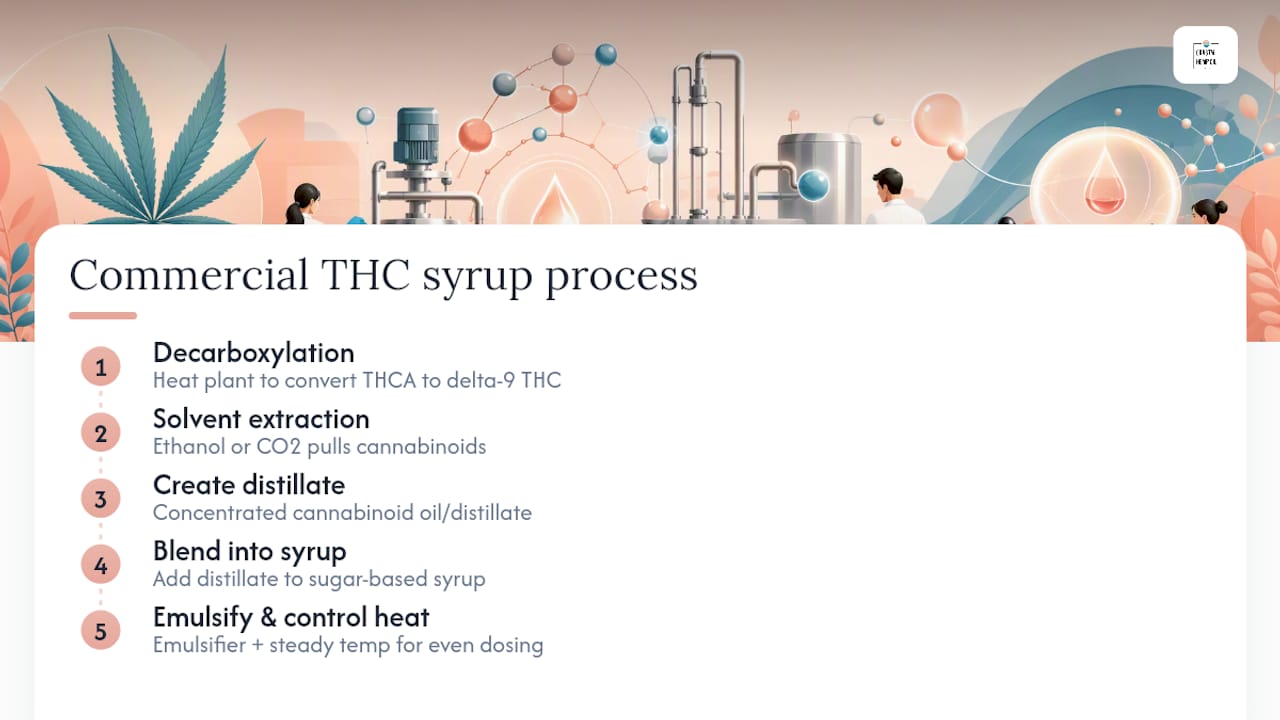
Temperature control during infusion matters too. Overheating during the blending stage can degrade cannabinoid content, which is part of why lab-tested products consistently outperform anything made without equipment built to hold a steady, moderate temperature throughout the process.
What Kind of Syrup Base Affects Flavor and Potency?
The base liquid a manufacturer starts with shapes both how a product tastes and how well it holds cannabinoids in suspension.
Simple sugar syrup, a basic dissolved sugar and water combination, is common because it’s neutral enough to let added flavoring take the lead, whether that’s citrus, berry, or a classic cola profile. Corn syrup bases tend to run thicker and sweeter, which some brands use for a more traditional “syrup” mouthfeel closer to what you’d expect from a cough syrup format.
Agave and honey-based syrups show up in higher-end formulations aimed at buyers who want a less processed ingredient list, generally at a slightly higher price point. These bases can carry a more pronounced natural flavor of their own, which affects how much added flavoring a brand needs.
Sugar-free formulations using alternative sweeteners are increasingly common for buyers managing sugar intake, though they sometimes require more emulsifier to keep cannabinoids evenly distributed since some sugar-free sweeteners don’t bind with oils the same way traditional sugar syrups do. None of these base choices change the actual milligram potency of a product. What matters for potency is always the lab-verified total THC number on the COA, regardless of which syrup base carries it.
What Safety Risks Come With THC Syrup?
Even a well-made, lab-tested syrup carries risks if it’s used carelessly, and most of those risks trace back to dosing rather than the product itself.
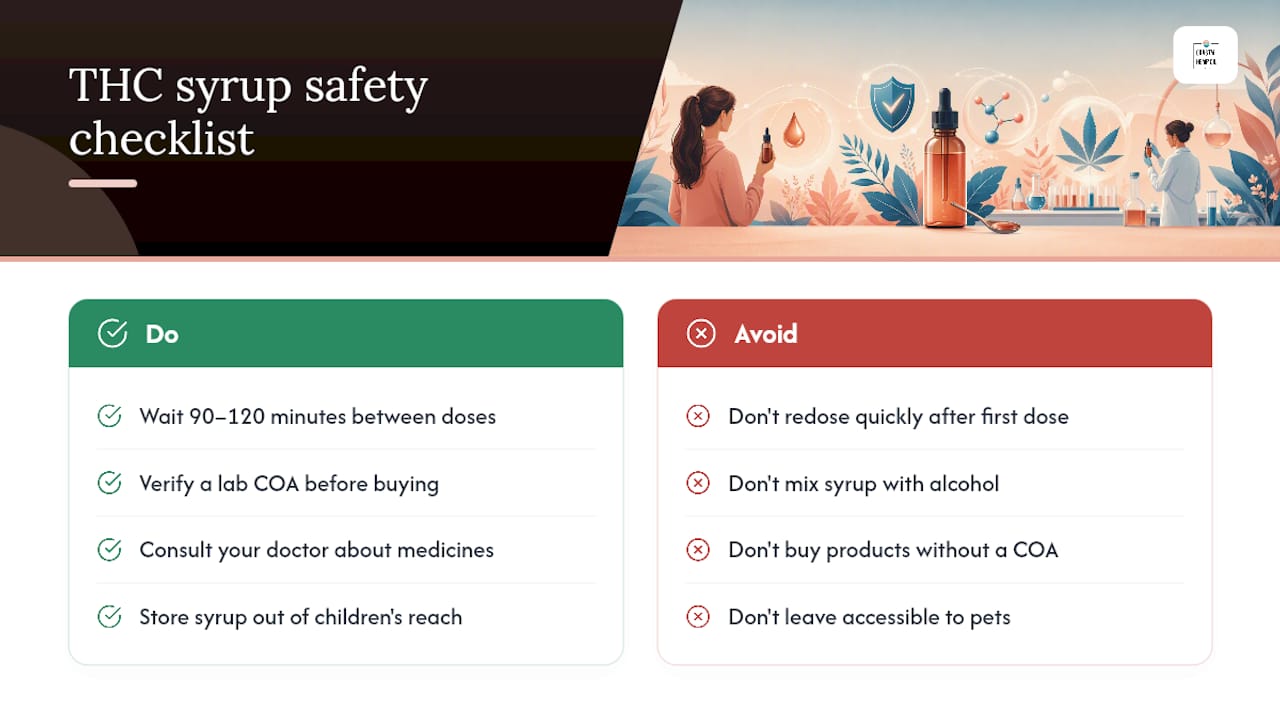
Overconsumption is the most common issue, largely because edibles take longer to hit than smoked or vaped hemp. Someone who doesn’t feel anything after twenty minutes may pour a second dose, not realizing the first one simply hasn’t kicked in yet. That stacking effect is why waiting at least ninety minutes to two hours between doses matters more with syrup than with almost any other format.
Mixing syrup with alcohol amplifies sedative effects for many people and can intensify side effects like dizziness or nausea beyond what either substance would cause alone. Combining hemp-derived THC with prescription medications, especially anything with its own sedative or blood pressure effects, is worth discussing with a doctor before you start experimenting with beverage mixing.
Products without a verified COA carry an added layer of risk: contamination from pesticides, heavy metals, or residual extraction solvents that a proper lab screen would catch. That’s the core reason the buying checklist earlier in this guide leads with COA verification rather than flavor or price.
Store syrup out of reach of children and pets. A sweet, brightly colored liquid in a kitchen cabinet is exactly the kind of product that looks like candy syrup to a curious child, and accidental ingestion of a full-strength dose is a real hazard in households with kids.
How Should You Store THC Syrup to Keep It Fresh?
Potency doesn’t last forever once a bottle is opened, and storage habits make a measurable difference in how long a syrup holds its labeled strength.
Heat and light are the two biggest threats to cannabinoid stability. A bottle left on a sunny windowsill or near a stove will degrade faster than one kept in a cool, dark cabinet or the refrigerator. Most manufacturers recommend refrigeration after opening, both to slow cannabinoid breakdown and to prevent mold growth in a sugar-based liquid that sits at room temperature for weeks.
Airtight sealing matters just as much as temperature. Every time a bottle is left open or loosely capped, oxidation slowly reduces cannabinoid potency and can also let in moisture that shortens shelf life. Always recap tightly right after pouring a dose.
Shake gently before each use if the label recommends it. Some emulsified syrups can separate slightly over time even with a good emulsifier, and a light shake redistributes cannabinoids evenly so your dose from the middle of the bottle matches your dose from the first pour.
Most sealed, unopened hemp-derived syrups carry a shelf life of around one year when stored properly, though refrigeration after opening is generally recommended for continued potency past the first month or two. Label your bottle with the date you opened it so you’re not guessing later about how long it’s been sitting in the fridge door.
An Editorial Take on Buying Syrup Responsibly
The buyers who get the best experience with hemp-derived syrup aren’t the ones who find the strongest product. They’re the ones who read the COA before the flavor description, start with a dose smaller than they think they need, and treat “total THC per container” as the number that actually governs their purchase decision. That habit matters more heading into the 2026 federal changes than it did a year ago, because a product’s old delta-9-only label may no longer reflect what’s actually in the bottle. When in doubt, contact the seller directly for current batch documentation, and check your own state regulator’s page rather than trusting a shipping confirmation to tell you what’s legal where you live.
— John
Shop Coastalhemp’s Lab-Verified Syrup and Edible Catalog
Coastalhemp is the direct alternative to guessing your way through unlabeled online listings: every product page here carries batch-specific COAs and clear per-serving potency, so you’re never choosing between convenience and knowing exactly what’s in the bottle.

If syrup and mixers are what you’re after, the PUFFY Delta-9 Syrup product page shows exactly the potency breakdown this guide has walked through, mg-per-serving and container total both listed up front. Looking for something beyond syrup? The Jelly THCA Live Sugar Blend Gummies carry the same lab transparency in a different format, and the Monthly Mystery Hot Box is a solid way to sample the catalog’s range if you’re still figuring out what works for you.
Before checkout, always confirm the COA matches your batch and double check your state’s current shipping restrictions. If anything on a product page looks unclear, Coastalhemp’s support team can pull up batch documentation directly. Start browsing the hemp-derived THC edibles collection and add a lab-verified option to your cart today.
Where to Confirm the Latest Regulatory Details
For the legislative text itself, review P.L. 119-37 analysis from the Congressional Research Service, and cross-check your own state’s Department of Agriculture or Cannabis Control Board page for local rules that may differ from the federal standard.
Sources
- Congressional Research Service product IN12620 — analysis of hemp definition changes
- Navigating new hemp laws: major shift for the cannabis industry — National Law Review
- CRS: Explanation of the new hemp statutory definition and exclusions
- Buying the Best Hemp Derived Edibles Online: What To Check — Slyng blog
FAQ
Are Ready-Made THC Syrups Legal to Buy?
Legality depends on total THC content per container and your state’s specific rules; federal law now caps finished hemp products at a low total THC per container starting November 2026, though some states currently allow higher limits.
How Much THC Syrup Should a Beginner Start With?
Most guidance suggests starting with 2.5 to 5 mg total THC per dose and waiting at least ninety minutes to two hours before considering more.
What Should I Look for on a THC Syrup Label?
Look for a current batch-matched COA, milligrams per serving, total milligrams per container, and a contaminant panel covering pesticides, heavy metals, and residual solvents.
Does the 2026 Federal Hemp Law Ban THC Syrup?
It doesn’t ban syrup outright, but it narrows what qualifies as compliant hemp by counting total THC, including THCA, and capping containers at 0.4 mg total THC, which some previously compliant products will exceed.
Can I Buy Hemp-Derived Syrup From Coastalhemp?
Yes, Coastalhemp’s catalog includes lab-tested syrup and mixer options like the PUFFY Delta-9 Syrup, each listed with batch-specific COA data and per-serving potency.


Comments