

Hemp Controlled Dosing: Your 2026 Wellness Guide
Hemp controlled dosing is the practice of titrating cannabinoid intake to the smallest effective milligram dose based on individual response, product potency, and timing. This approach differs from simply reading a THC or CBD percentage on a label. What is hemp controlled dosing in practical terms? It means calculating actual milligrams per serving, tracking how your body responds, and adjusting incrementally rather than guessing. The FDA, UK Food Standards Agency, and new 2026 federal law all reinforce this principle by shifting focus from concentration percentages to absolute milligram limits per container. Getting this right protects your health and keeps your product choices legally compliant.
What is hemp controlled dosing and why does it matter?
Controlled dosing for hemp means titrating to the smallest effective milligram dose, not just reading the percent THC or CBD printed on a label. A product labeled “0.3% THC” could contain vastly different total milligrams depending on the package size. That gap between percentage and absolute dose is where most consumer errors happen.
The core principle is straightforward: start low, increase slowly, and wait long enough between doses to accurately judge the effect. This applies to every hemp format, from tinctures to gummies to capsules. The goal is to find your personal minimum effective dose and stay there, rather than escalating unnecessarily.
This matters because cannabinoids like CBD and THC do not follow a simple “more is better” rule. Their pharmacological behavior is more complex, and understanding that complexity is the foundation of safe, effective hemp use.
How does hemp dose response influence dosing strategies?
CBD and THC both exhibit biphasic dose-response curves where low and high doses can produce opposite effects. This inverted-U pattern means a low dose may reduce anxiety while a high dose of the same compound triggers it. More is not always better, and this is the pharmacological reason why.

The biphasic response makes finding your minimum effective dose the primary goal of any controlled hemp dosing strategy. Overshooting that dose does not increase benefits. It shifts the response curve toward unwanted effects like sedation, impaired coordination, or heightened anxiety.
Inter-individual variability adds another layer. Body weight, metabolism, liver enzyme activity, and prior cannabinoid exposure all affect how a person processes a given dose. Two people taking the same 10 mg CBD gummy can have meaningfully different experiences. This is why hemp dosage guidelines consistently emphasize targeting the low effective dose range rather than following a universal number.
Key principles for applying dose-response science to your routine:
- Start at 2.5–5 mg of THC or CBD per dose if you are new to hemp products
- Wait the full onset window before evaluating effects, especially with edibles
- Increase by no more than 2.5 mg at a time, with at least 48 hours between adjustments
- Track your response by noting mood, sleep quality, or discomfort levels after each dose
- Stop escalating once you reach the dose that produces your target effect
Pro Tip: Write down your dose, the time you took it, and how you felt two hours later. Three to five data points reveal your personal dose-response pattern far more reliably than any general guideline.
Microdosing, defined as taking sub-threshold doses below the level of noticeable psychoactive effect, is gaining traction among wellness users who want functional benefits without impairment. For THC, microdoses typically fall in the 1–2.5 mg range. For CBD, functional effects are often reported at 5–10 mg per day.
What are the 2026 federal regulations affecting hemp dosing?
Federal law effective November 12, 2026, fundamentally changes how hemp products are defined and regulated. The new standard shifts from delta-9 THC percentage to total THC milligrams per container. This is a significant departure from the previous 0.3% dry weight threshold.
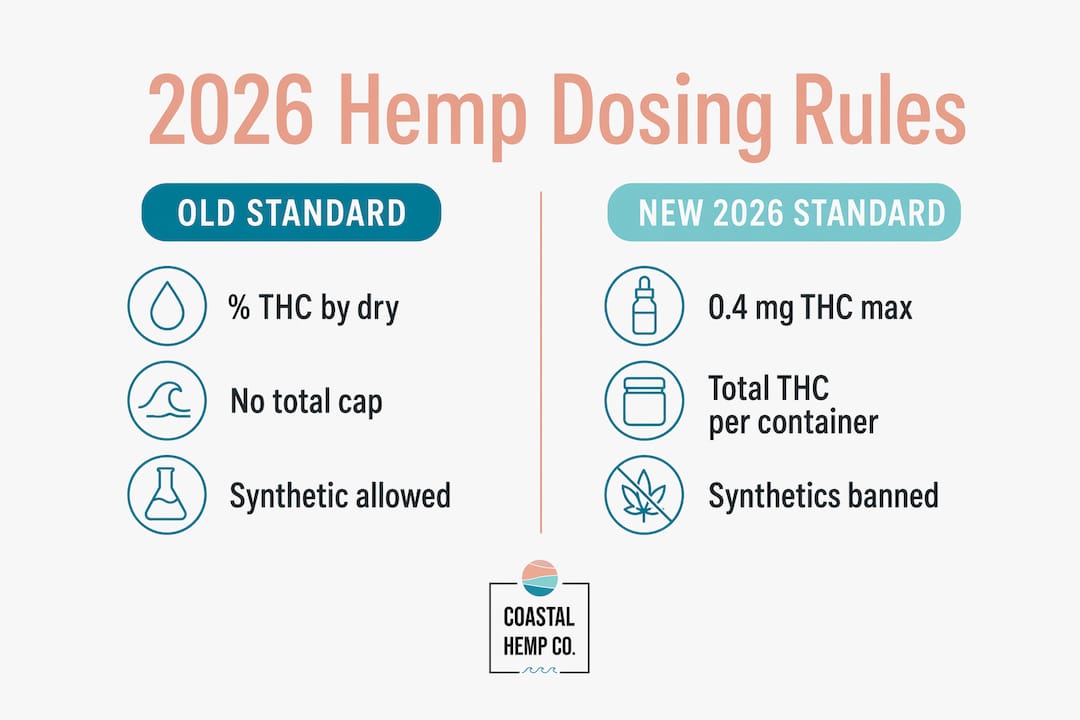
The new cap sets total THC at 0.4 mg per container for hemp-derived cannabinoid products. Many products currently on the market exceed this limit. That means reformulation is required across a large portion of the hemp product category before the compliance deadline.
Understanding the difference between concentration and absolute dose is now a legal requirement for producers and a practical necessity for consumers. A product with 0.3% THC by dry weight in a large package can contain far more than 0.4 mg total THC. Calculating mg per container, not just reading the percentage, is the compliance-minded approach.
| Regulatory Metric | Old Standard | New 2026 Standard |
|---|---|---|
| THC measurement basis | % by dry weight | Total mg per container |
| THC limit | 0.3% delta-9 THC | 0.4 mg total THC per container |
| Synthetic cannabinoids | Permitted in some cases | Prohibited under new law |
| Compliance deadline | Ongoing | November 12, 2026 |
| Consumer impact | Label reading sufficient | Mg calculation required |
The prohibition on synthetic cannabinoids under the new law also affects dosing. Products containing delta-8 THC, THC-O, or HHC derived through chemical synthesis from hemp CBD will face stricter scrutiny. Consumers focused on controlled hemp dosages should prioritize products with transparent, lab-verified cannabinoid profiles. For a deeper look at how these rules affect shipping and product availability, the hemp shipping regulations guide at Coastalhemp covers the compliance landscape in detail.
How to apply controlled dosing with hemp gummies and edibles
Hemp gummy dosing requires a different approach than tinctures or inhalation because of delayed onset and first-pass metabolism. When you eat a hemp gummy, the cannabinoids pass through your digestive system before entering the bloodstream. This process takes time and produces a different pharmacokinetic profile than other delivery methods.
Edible dosing requires waiting until the full peak effect window passes before considering a second dose. That window is typically around two hours. Redosing too soon is the most common cause of overconsumption in edible users, and it is entirely avoidable with patience.
Follow this sequence when starting with hemp gummies:
- Read the label in milligrams, not percentages. A gummy labeled “5 mg CBD” is your dose unit.
- Take one gummy and record the time.
- Wait two full hours before assessing your response. Do not take more during this window.
- Evaluate your experience objectively. Did you feel the target effect? Were there any unwanted responses?
- Decide on your next session. If the effect was insufficient, increase by 2.5 mg at your next session, not the same day.
- Maintain a consistent schedule for at least one week before making further adjustments.
For reference, the UK Food Standards Agency recommends a provisional daily intake of 10 mg CBD for a 70 kg adult as a safe upper limit from all combined sources. That figure provides a useful ceiling for wellness-oriented users who are not under clinical supervision.
Pro Tip: Cut gummies in half to create 2.5 mg increments if your product starts at 5 mg. This gives you finer control during the titration phase without needing a different product.
Certain populations should avoid hemp edibles without medical consultation. These include pregnant or breastfeeding individuals, people taking immunosuppressant medications, and anyone with a history of liver disease. These are not minor cautions. They reflect real physiological risks that controlled dosing alone cannot eliminate. For a broader overview of edible dosing best practices, Coastalhemp’s 2026 guide covers timing, formats, and safety in detail.
What safety considerations strengthen controlled dosing effectiveness?
Safety monitoring is a core component of responsible hemp dosing, not an afterthought. A 2025 US trial found that 5.6% of oral CBD users developed elevated liver enzymes at consumer-range doses. Those elevations resolved after stopping CBD use, but the finding confirms that liver function can be affected at doses some users consider routine.
CBD also affects how the body metabolizes other drugs. CBD interacts with cytochrome P450 pathways, the same enzyme system responsible for processing many prescription medications. This interaction can raise or lower blood levels of other drugs unpredictably. Anyone taking blood thinners, antiepileptics, or immunosuppressants should review their medication list with a pharmacist or physician before adding CBD to their routine.
Practical safety checkpoints for controlled hemp dosing:
- Use only lab-tested products with a certificate of analysis confirming cannabinoid content and the absence of contaminants
- Verify mg per serving matches the certificate of analysis, not just the marketing label
- Monitor for liver-related symptoms such as fatigue, yellowing of the skin, or dark urine if using high CBD doses regularly
- Review all current medications for potential CYP450 interactions before starting or increasing hemp doses
- Consult a physician if you have a chronic health condition, take prescription medications, or plan to use hemp products therapeutically rather than as a supplement
Accurate labeling is the foundation of controlled dosing. A product that claims 25 mg CBD per gummy but actually contains 18 mg or 32 mg makes precise titration impossible. Third-party lab testing, the kind Coastalhemp requires from its partner brands, is the only reliable way to verify that what is on the label matches what is in the product.
Key takeaways
Hemp controlled dosing works because it targets the minimum effective milligram dose, respects the biphasic dose-response of cannabinoids, and aligns with 2026 federal THC limits per container.
| Point | Details |
|---|---|
| Dose in milligrams, not percentages | Calculate actual mg per serving to accurately track and control your cannabinoid intake. |
| Respect the biphasic response | Higher doses can produce opposite effects, so find your minimum effective dose and stay there. |
| Wait before redosing edibles | Edibles peak around two hours after ingestion; redosing too soon causes most overconsumption events. |
| Know the 2026 THC cap | Federal law now limits total THC to 0.4 mg per container, making mg calculations legally necessary. |
| Monitor safety and medications | CBD affects CYP450 drug metabolism and can elevate liver enzymes at higher doses; review medications before use. |
Why patience is the most underrated dosing skill
Most people who have a bad experience with hemp products share one thing in common: they did not wait long enough. They took a gummy, felt nothing after 45 minutes, took another, and then the first one hit. That is not a product failure. That is a timing failure, and it is completely preventable.
What I have come to believe, after spending considerable time studying cannabinoid pharmacology and watching how consumers actually use these products, is that the wellness industry undersells patience as a skill. Everyone wants a protocol, a milligram number, a schedule. Those tools help. But the real variable is your willingness to sit with uncertainty for two hours before making a decision.
The 2026 regulatory changes are actually good news for consumers who care about controlled dosing. Shifting from percentage-based to milligram-based limits forces the entire industry toward the kind of precision that makes titration possible. When a product is required to disclose total mg THC per container, you can do real math. You can divide, compare, and plan. That is a meaningful upgrade from squinting at a 0.3% label and guessing.
The uncomfortable truth is that most dosing mistakes are not about the product. They are about the consumer skipping the titration phase because it feels slow. Start low, wait, record, adjust. That four-step loop is not glamorous, but it is the only method that actually works across different people, products, and goals.
— John
Find your dose with coastalhemp’s lab-tested hemp products
Coastalhemp partners with top hemp brands to bring you products built for precision dosing. Every product in the catalog comes with transparent labeling and third-party lab verification, so you can calculate your actual milligram intake with confidence.

Whether you are starting with a low-dose option or looking for a precisely formulated product, Coastalhemp’s hemp-derived THC edibles collection covers the full range. For those interested in THCv’s distinct functional profile, the Celestial Wellness THCv Gummies offer 200 mg total with clear per-serving dosing information. If high-potency THCA is your focus, the Jelly THCA Live Sugar Gummies deliver detailed labeling for safety-oriented consumption. Every product is selected with controlled dosing in mind.
FAQ
What is hemp controlled dosing in simple terms?
Hemp controlled dosing means taking the smallest milligram dose that produces your desired effect, then maintaining that dose rather than escalating. It relies on tracking your response over time rather than following a one-size-fits-all number.
How many mg of CBD is considered a safe daily dose?
The UK Food Standards Agency sets a provisional daily intake of 10 mg CBD per day for a 70 kg adult from all combined sources. This figure applies to general wellness use, not clinical or therapeutic applications.
Why should i wait before taking a second hemp gummy?
Edibles take up to two hours to reach peak effect due to digestion and first-pass liver metabolism. Taking a second dose before the first peaks is the leading cause of overconsumption and adverse effects in edible users.
What does the 2026 federal THC cap mean for consumers?
Federal law effective November 12, 2026, limits total THC to 0.4 mg per container for hemp-derived products. Consumers should verify that products they purchase comply with this limit by checking lab-verified milligram totals, not just percentage labels.
Can CBD interact with prescription medications?
Yes. CBD inhibits cytochrome P450 liver enzymes, which process many common medications including blood thinners and antiepileptics. Anyone on prescription drugs should consult a healthcare provider before starting or increasing CBD use.



Comments