

90 Second COA Check for Cannabis Buyers Using Coastal Hemp Lab Links
A Certificate of Analysis is the batch-specific lab report tied to the exact product in your hands, and the first thing to check is whether its QR code or link leads to a lab-controlled portal with a matching batch number. If the batch on the report doesn’t match the batch on your package, or the link routes to a generic PDF instead of a lab’s own site, stop there. That single check catches most of the obvious problems before you ever get to potency numbers.
TL;DR:
- Always verify that the QR code or link routes to a lab-hosted portal matching the batch number on your product before trusting a COA.
- Confirm the header fields, including lab accreditation and batch number, match your package to rule out counterfeit or recycled reports.
- Check that safety panels for pesticides, heavy metals, residual solvents, and microbials all pass, especially on concentrates and vapes, to ensure product safety.
- Be aware that cannabinoid results may be listed in different units; convert percentages to milligrams per gram for more accurate comparisons, especially on edibles.
- Review the age of the COA; reports over 6 to 12 months old may no longer reflect the current product condition, and suspicious formatting or repeated THC percentages across batches should raise suspicion.
Table of Contents
- What a COA actually is and why it matters
- Where to find the COA and what a legitimate link looks like
- Header and batch verification: the fields that must match
- Reading the potency panel without getting fooled by units
- How to read the safety panels: pesticides, metals, solvents, and microbials
- What the terpene panel tells you (and where it falls short)
- Red flags and a quick verification checklist
- How to verify a COA online, step by step
- Coastal Hemp Company’s approach to lab transparency
- Understanding extraction method on the COA
- Reading moisture content and why it affects quality
- Putting contaminant results in context with regulatory limits
- A 90-second habit worth building
- Try Products With Verified Lab Results
- Sources
- FAQ
What a COA actually is and why it matters
A COA is a document a third-party lab issues after testing one specific batch or lot of product, not a general statement about a brand’s quality standards. It’s tied to that batch alone, which is why matching batch numbers matters so much before you trust anything else on the page.
A complete COA typically includes:
- A header with lab name, license or accreditation info, and batch/sample details
- A cannabinoid (potency) profile showing THCA, THC, CBD, and related compounds
- A terpene panel, when tested
- A pesticide screening panel
- Heavy metals results (lead, arsenic, mercury, cadmium)
- Microbial and mycotoxin testing
- Residual solvents, if the product is a concentrate or vape
A COA that only shows cannabinoid numbers and skips the safety panels isn’t giving you the full picture, according to ZenWeedGuide’s breakdown of COA sections. The safety data is often the more important half of the report, since it’s what tells you whether the product is clean, not just how strong it is.
Where to find the COA and what a legitimate link looks like
Most brands put COA access in one of four places: a QR code printed on the packaging, a link on the product’s SKU page, a general lab-results page on the brand’s site, or a direct link to the testing lab’s own portal. Coastalhemp keeps this simple by posting results on a dedicated lab test results page tied to specific SKUs, rather than making customers dig for a PDF.
Here’s the quick sequence to run before you trust anything else on the page:
- Scan the QR code or click the link on the product page.
- Check the destination domain. A lab-hosted portal or the lab’s own website is the standard; a brand-hosted generic PDF is a lower bar of trust.
- Look for a shortened URL (bit.ly, tinyurl) or a link to Google Drive or Dropbox. Those are common shortcuts used when a batch-specific report doesn’t actually exist.
Pro Tip: Bookmark the lab’s official domain the first time you verify a COA from a brand you trust. If a future QR code routes somewhere else entirely, that mismatch alone is worth pausing over.
Header and batch verification: the fields that must match
Before you read a single cannabinoid number, confirm the header fields line up with what’s printed on your package. This is the fastest way to catch a mismatched or recycled COA, and it takes about fifteen seconds once you know what to look for.
Check these fields against your product:
- Lab name and accreditation. Look for ISO/IEC 17025 accreditation status and confirm the lab’s contact information is real and searchable.
- Batch or lot number. This must match your package exactly, character for character.
- Sample ID and product name. These should correspond to the specific product you’re holding, not a similarly named SKU.
- Package size or unit count. A COA for a different package size can still list correct chemistry but the wrong context.
- Sample date, received date, and report date. These should follow a logical order: sampled, then received, then reported.
A COA more than 6 to 12 months old may not reflect the product’s current condition, particularly for terpene content, which degrades faster than cannabinoids. Fake or altered COAs also tend to show telltale formatting problems, like mismatched fonts, missing lab sign-offs, or identical report dates across supposedly different batches, patterns that fraud-detection guides flag repeatedly across the industry. If any header field looks generic, copy-pasted, or slightly off, treat the whole document with suspicion.
Reading the potency panel without getting fooled by units
The cannabinoid panel is where most confusion starts, mainly because labs report numbers in different formats and brands don’t always translate them consistently on the label. You’ll typically see THCA, THC (sometimes called Delta-9 THC), CBD, CBG, and CBN listed, each with its own percentage or weight measurement.
Cannabinoid results usually show up in one of three formats:
- Percent by weight (%), common on flower COAs
- Milligrams per gram (mg/g), another way of expressing concentration
- Milligrams per serving, more common on edibles and beverages
Converting between these matters more than it seems. If a gummy label says 10mg but the COA shows a percentage, you need the serving size and total weight to check the math yourself.
The bigger source of confusion is Total THC. Raw cannabis contains mostly THCA, which converts to active THC when heated. Labs account for this using the formula (THCA × 0.877) + THC, which reflects the mass lost during decarboxylation, as explained in GrowerIQ’s COA guide. That’s why a product can legally test under a THC threshold on paper while still containing plenty of THCA that becomes active once consumed.
For edibles specifically, compare the COA’s per-serving or per-package total against the label claim directly rather than trying to eyeball a percentage. A 10-count package claiming 25mg per gummy should show a COA total that divides out cleanly across the stated serving count.
Pro Tip: If a COA lists cannabinoids only in percentages and your product is an edible, do the conversion math yourself before assuming the label is accurate. Brands occasionally round in their favor.
How to read the safety panels: pesticides, metals, solvents, and microbials
Safety panels are where a COA earns its purpose. Each one screens for a different category of contaminant, and each has its own pass/fail logic.
- Pesticides. Screens for residues from cultivation. Regulatory action limits vary by state, so most consumers should rely on the lab’s Pass/Fail marking rather than memorizing individual thresholds.
- Heavy metals. Tests for lead, arsenic, mercury, and cadmium, all of which can accumulate in hemp from soil contamination.
- Residual solvents. Relevant mainly for concentrates and vape products that use butane, propane, or ethanol during extraction. Leftover solvent above safe levels is a real health concern.
- Microbial and mycotoxin testing. Screens for mold, yeast, E. coli, salmonella, and toxins like aflatoxins that can develop during improper storage.
You’ll also run into abbreviations that describe how sensitive the test was, not just the result. ND means “not detected.” LOD is the limit of detection, the smallest amount the instrument can reliably identify. LOQ is the limit of quantification, the smallest amount the lab can measure with confidence. A result listed as “below LOQ” isn’t zero. It means the substance may be present in a trace amount too small to quantify precisely, a distinction that matters when interpreting borderline results, according to peer-reviewed cannabis testing literature.
State-set action limits for contaminants differ by category and jurisdiction, and most guides recommend trusting the lab’s explicit Pass/Fail field over memorizing every numeric threshold yourself. That said, one rule holds regardless of state: any “Fail” result in a critical safety panel, heavy metals, microbials, or residual solvents especially, is a strong enough reason to skip the product entirely. There’s no context that makes a failed heavy metals test acceptable.
What the terpene panel tells you (and where it falls short)
Terpenes are the aromatic compounds responsible for a product’s smell and much of its flavor, and many consumers use them to predict subjective effects. A terpene panel usually lists individual compounds like myrcene, limonene, or caryophyllene as a percentage of total weight.
Reading it well means looking at two things:
- Total terpene percentage, which gives a rough sense of how aromatic or flavorful the product is
- The top three terpenes by concentration, since these usually drive the dominant scent and flavor profile
One caveat worth knowing: terpenes degrade faster than cannabinoids, especially with heat, light, and time. A terpene panel from a report several months old may no longer reflect what you’re smelling. Coastalhemp’s guide to hemp terpene profiles goes deeper into how specific terpenes are associated with different wellness effects.
Red flags and a quick verification checklist
Most fake or misleading COAs share a small set of tells. Learning to spot them takes less time than reading the whole document.
Watch for these red flags:
- A QR code that’s broken, generic, or leads to a brand homepage instead of a specific report
- No ISO/IEC 17025 accreditation listed, or a lab license that doesn’t check out
- A batch or lot number that doesn’t match your package
- Missing safety panels, especially on a concentrate or vape with no residual solvent testing
- Suspiciously identical THC percentages across multiple different SKUs from the same brand
| Signal | What it usually means |
|---|---|
| QR resolves to lab’s own domain | Likely legitimate, batch-specific report |
| QR resolves to shortened link or Drive PDF | High risk, verify before trusting |
| Batch/lot matches package exactly | Passes the first authenticity check |
| Any “Fail” on heavy metals or microbials | Reject the product regardless of potency claims |
| Report date over 12 months old | Treat terpene data as unreliable; recheck potency separately |
If something looks off but you can’t tell for certain, contact the seller and ask them to confirm the batch match directly, or reach out to the lab listed on the report using the sample ID. A legitimate lab will confirm a real report in minutes.
How to verify a COA online, step by step
Running a full verification takes about two minutes once you know the sequence; for detailed guidance, see how to read a COA for your six-step check for potency and safety. This is the same routine worth building into a habit every time you try a new batch.
- Scan the QR code and check the full domain. Don’t just glance at the page, look at the actual URL. A lab-hosted portal or the lab’s primary domain is what you want to see.
- Compare batch/lot number, sample ID, and dates against your package. Any mismatch here is disqualifying on its own.
- Confirm accreditation directly. A2LA and ANAB maintain public databases where you can search for the lab by name and confirm active ISO/IEC 17025 status. Many states also maintain their own public lab license lists.
- Contact the lab if anything feels unclear. Use the sample ID from the report. A real testing lab can confirm whether that sample ID corresponds to a report they actually issued.
Pro Tip: Save a screenshot of the COA and the lab portal URL the first time you verify a product you plan to buy again. It saves you from repeating the whole search if the brand’s link ever changes.
Coastal Hemp Company’s approach to lab transparency
Coastalhemp posts COAs directly on a dedicated lab test results page, organized by SKU, so customers can check a specific batch without hunting through product descriptions. That transparency matters more in a category where COA quality varies widely between brands.
Coastalhemp’s educational content, including this guide, is written to help customers build the same verification habits professionals use. If a customer has a question about a specific batch or wants help interpreting a result, reaching out through Coastalhemp’s support channels connects them with someone who can walk through the report line by line. Verification shouldn’t require a chemistry background, just the right sequence of checks.
Understanding extraction method on the COA
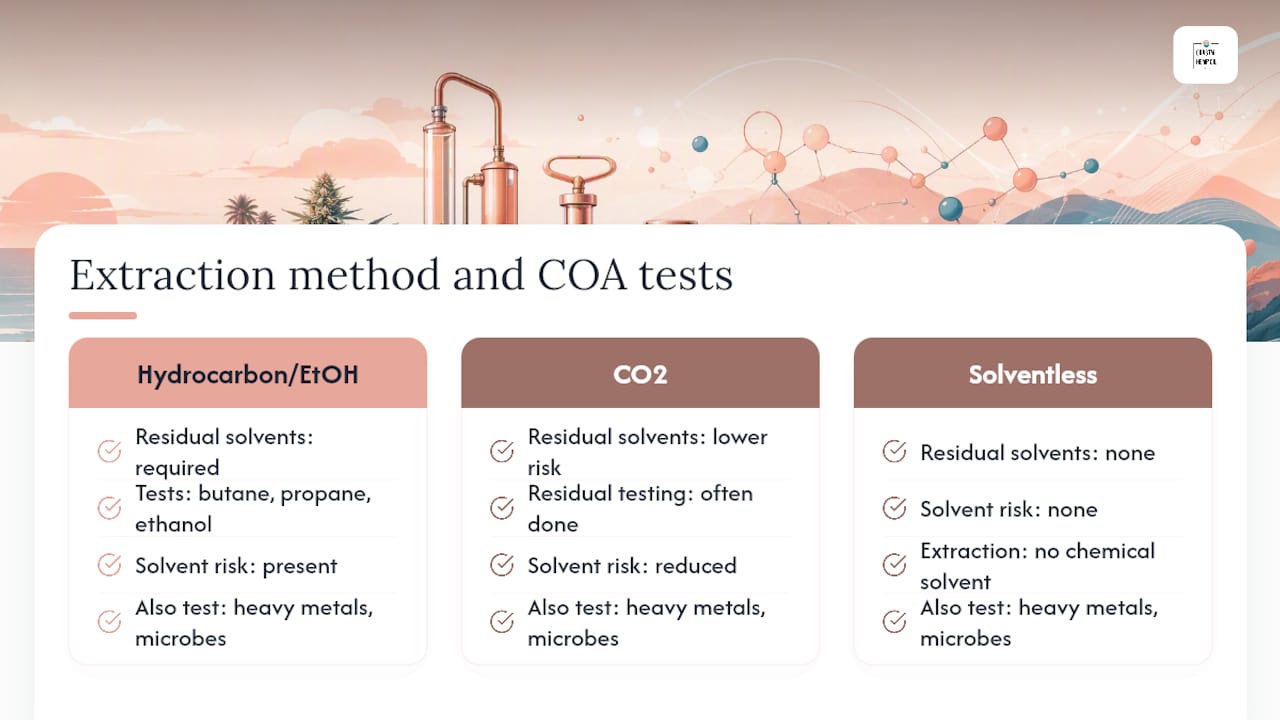
Extracts and concentrates usually list their extraction method somewhere near the top of the report or in the product description tied to the batch. Common methods include CO2 extraction, butane or propane hydrocarbon extraction (BHO/PHO), ethanol extraction, and solventless methods like rosin pressing.
The extraction method matters for one direct reason: it determines which safety panel becomes non-negotiable. Any product made with butane, propane, or ethanol needs a residual solvent panel showing those specific compounds tested and cleared. A CO2-extracted product carries less solvent risk by nature, since CO2 doesn’t leave the same chemical residue, but a legitimate lab will still often test for it as a standard practice.
Solventless concentrates, like rosin, skip the solvent risk entirely since no chemical solvent touches the plant material during extraction. That’s part of why solventless products often get marketed as a cleaner category, though it doesn’t excuse them from heavy metals or microbial testing.
If a COA for a vape cartridge or dab product doesn’t mention extraction method anywhere and also lacks a residual solvent panel, that’s worth treating as a gap, not an oversight. The method used during extraction is directly tied to what contaminants are realistically possible, so a report that skips this context is giving you a less complete safety picture than it should.
Reading moisture content and why it affects quality
Moisture content mostly applies to flower products, and it shows up on a COA as a percentage of total water weight. Most quality flower sits in the 8% to 12% moisture range, though acceptable ranges can shift slightly by state regulation.
Moisture matters for two separate reasons. Too much moisture creates ideal conditions for mold and microbial growth during storage, which is part of why a microbial panel becomes more important on flower that tests high on moisture. Too little moisture, on the other hand, dries the flower out, which affects burn quality, harshness, and how well the terpenes hold up over time.
A moisture reading isn’t a pass/fail metric on most COAs the way a heavy metals panel is. It’s more of a quality signal. Flower sitting well outside the typical range, either too wet or too dry, should raise a question about storage conditions even if every other panel comes back clean. This is one of the few numbers on a COA where the “ideal” answer sits in the middle rather than as low as possible, which trips people up if they assume every metric works like a contaminant threshold.
Putting contaminant results in context with regulatory limits
Regulatory action limits for pesticides, heavy metals, and residual solvents vary by state, and in some cases by product category within the same state. A limit that applies to inhalable products like vapes is often stricter than the limit for the same contaminant in edibles, since inhalation exposes the body differently than ingestion.
This is exactly why most consumer guides recommend leaning on the lab’s own Pass/Fail determination rather than trying to memorize numeric thresholds yourself. The lab already knows which limit applies to your specific product category and state, and their pass or fail marking reflects that comparison. Trying to cross-reference a raw parts-per-billion number against a general limit you found online risks applying the wrong standard entirely.
That said, context still matters when a number sits close to a limit rather than far below it. A pesticide result that passes but sits near the action limit is meaningfully different from one that comes back essentially undetectable. Neither fails the test, but they’re not equivalent in terms of margin. If a COA shows several contaminants sitting close to their limits simultaneously, even with a technical “Pass” across the board, that pattern is worth factoring into your decision, particularly for products you plan to use regularly rather than once.
A 90-second habit worth building
Reading a full COA line by line every single time isn’t realistic, and honestly, it isn’t necessary once you’ve built the right shortcut. Scan the QR code, check that the batch header matches your package, glance at the Total THC number against the label, and confirm the safety panels show clean Pass results. That’s the whole routine, and it takes less time than reading a nutrition label.
The habit matters more than any single check. Consumers who skip verification entirely aren’t usually skipping it out of trust, they’re skipping it because it feels like too much effort for a five-minute purchase. Saving a screenshot of the COA and the lab portal link the first time you verify a product removes that friction for every purchase after.
— John
Try Products With Verified Lab Results
Coastalhemp posts COAs by SKU on its lab test results page, so you’re never guessing whether a batch has actually been tested. That’s the real advantage over shopping brands that bury their results in a generic PDF or skip posting them altogether: you can pull up the exact report for the exact product before you buy, not after.

Several current SKUs have COAs posted and ready to check, including the FLOAT Mushroom Hard Candy, Jelly THCA Live Sugar Blend Gummies, and the NTRL Eclipse 25mg Delta-9 Gummies. Each product page links directly to its batch-specific report, so you can run the same verification routine covered in this guide before checkout, not after the package arrives. If you want a broader look at what’s tested and available, the THCA flower and concentrates collection is a good place to start.
If you ever have a question about a specific batch or can’t locate a report for something you bought, reach out to Coastalhemp’s support team with your batch number and they’ll point you to the exact lab record.
Sources
- How to Read a COA: Cannabis lab reports and red flags - USAWeed
- How to Read a Cannabis Certificate of Analysis (COA) Without a Lab Degree - MaryJanesPost
- PMC article on cannabis testing methods - NCBI
FAQ
What is a COA in cannabis products?
A COA, or Certificate of Analysis, is a lab report showing test results for one specific batch of a hemp or cannabis product, covering potency and safety panels like pesticides and heavy metals.
How do I know if a COA is fake?
Check whether the QR code resolves to a lab-hosted portal rather than a generic PDF or shortened link, and confirm the batch number, sample dates, and lab accreditation all match what’s on your package.
What does “ND” mean on a COA?
ND stands for “not detected,” meaning the lab found no measurable amount of that substance above its limit of detection.
Why do THCA and Total THC numbers differ on a COA?
THCA converts to active THC when heated, so labs calculate Total THC using the formula (THCA × 0.877) + THC to reflect that conversion accurately.
Should I trust a product if one safety panel shows a Fail?
No. A Fail result in a critical safety panel like heavy metals, residual solvents, or microbials is a strong reason to avoid that product regardless of how clean the potency numbers look.
Where can I find a COA for a Coastalhemp product?
Coastalhemp posts batch-specific COAs on its lab test results page, organized by SKU, so you can pull up the exact report for the product you’re considering.


Comments