
Before Nov 12, 2026: THCA Legal States and What Buyers Must Check
THCA legality depends on which state you’re standing in, and that map is about to shift under everyone’s feet. State law, not the 2018 Farm Bill alone, currently decides whether THCA flower or edibles land on a store shelf near you. Several states allow it broadly, many restrict it through total-THC testing or serving caps, and some ban it outright. All of that gets layered under a new federal standard once H.R. 5371 takes effect on November 12, 2026.
TL;DR:
- States that measure only delta-9 THC allow broader THCA access, but moving to total-THC testing or caps restrict or ban products earlier than federal changes.
- The federal law will require online retailers to limit products so total THC, including THCA, stays below 0.4 mg per serving by late 2026, affecting most current vapor and edible products.
- Regulated states like Alabama, Georgia, and North Carolina have implemented stricter registration, testing, and disclosure rules, signaling ongoing legislative tightening ahead of federal standards.
- Smokable hemp flower faces bans more often than concentrates or edibles, with many restricted states enforcing age verification and shipment restrictions that complicate online sales.
- Consumers should verify lab reports by checking delta-9 and THCA percentages and perform the total-THC calculation themselves to ensure compliance before purchase.
Table of Contents
- Where Is THCA Legal? The National Status Map
- Which States Have the Biggest THCA Legal Changes Right Now?
- What Does H.R. 5371 Change Nationally?
- How to Check If Your THCA Purchase Is Compliant
- The Federal Deadline Will Force a Retail Reset, Not a Ban
- Compliant THCA Products Worth Knowing About
- Where to Verify These Laws Yourself
- Sources
- FAQ
Where Is THCA Legal? The National Status Map
Every state sorts hemp products into one of three buckets, and the test a state uses to sort them matters more than most shoppers realize. Some states still measure only delta-9 THC content, the old Farm Bill standard that let THCA slide through untouched because raw THCA isn’t intoxicating until it’s heated. Others have already moved to a “total-THC” formula that accounts for THCA’s potential to convert into delta-9 when smoked or vaped, which closes that loophole at the state level months before the federal rule does the same thing nationally.
Restricted states permit some hemp-derived products but impose total-THC testing, per-serving milligram caps, age verification, or bans on smokable flower specifically. Illegal states treat THCA products as controlled substances outright, usually by defining “THC” broadly enough in state law to sweep in THCA regardless of how it was derived or labeled.
Cross-referencing state agency guidance against independent trackers gives a clearer picture than either source alone, since regulatory trackers update faster than some agencies publish revised rules.
| State | Status | Controlling Rule | Notes |
|---|---|---|---|
| Alabama | Restricted | Alabama hemp program, Dept. of Agriculture | Registration and testing required; enforcement active |
| Alaska | Restricted | Alcohol Beverage Control / AMCO licensing | Retail licensing required for intoxicating hemp |
| Arizona | Legal | Delta-9 dry-weight standard | No statewide THCA-specific ban as of 2026 |
| California | Restricted | Total-THC testing, DCC oversight | Serving caps on edibles |
| Colorado | Restricted | Total-THC standard | Hemp-derived intoxicants regulated separately from licensed cannabis |
| Florida | Restricted | Age and labeling rules | THCA flower generally tolerated, enforcement varies by county |
| Georgia | Restricted | Total-THC cap under state hemp program | Consumable hemp products registered with Department of Agriculture |
| Idaho | Illegal | Broad THC definition includes THCA | Any detectable THC treated as controlled substance |
| Kentucky | Legal | Delta-9 standard | Active hemp retail market |
| North Carolina | Restricted, evolving | SL2022-32 and follow-up bills | Legislature revisiting hemp intoxicant rules through 2026 |
| South Carolina | Restricted | Delta-9 standard, no comprehensive hemp retail law | Legal gray zone for smokable flower |
| Texas | Restricted, litigated | 25 TAC Rule 300.101, effective March 31, 2026 | Total-THC standard, under active litigation |
| Washington | Legal | Delta-9 standard | Hemp and licensed cannabis coexist under separate rules |
This is a representative sample, not the full fifty. Hemp legality trackers maintain interactive maps that update as legislatures act, and checking your specific state before ordering is worth the two minutes it takes.
A few practical patterns show up across nearly every restricted or illegal state:
- Smokable hemp flower gets banned more often than THCA extracts, tinctures, or gummies, since flower is the form regulators associate most with recreational use.
- Age verification (18 or 21, depending on the state) is now standard even where THCA itself remains unregulated.
- Shipping rules and in-person sale rules frequently diverge. A state can allow a local retailer to sell THCA while still blocking inbound shipments from an out-of-state online seller, which trips up more online buyers than any other single rule.
- Serving caps, where they exist, typically apply per package or per unit, not per bottle, so a multi-serving edible package can still trigger a violation if each serving exceeds the cap.
Which States Have the Biggest THCA Legal Changes Right Now?
Five states account for most of the legal movement worth watching in 2026, and each one tells a different story about how a state gets from “hemp is basically unregulated” to “hemp is a controlled substance” or somewhere in between.
Alabama treats THCA products as restricted rather than banned, but the restriction has teeth. The Alabama Department of Agriculture’s hemp program requires registration, testing, and labeling compliance for any consumable hemp product sold in the state. THCA flower is generally tolerated as long as delta-9 content stays under the federal threshold, but enforcement has tightened as more retailers enter the market. Edibles face similar registration requirements. There’s no active statewide litigation reshaping Alabama’s rules the way there is in Texas, which makes it one of the more predictable markets on this list.
Georgia runs a state hemp program that layers a total-THC cap on top of the federal delta-9 standard, meaning THCA counts toward the limit even though it isn’t intoxicating in its raw form. Consumable hemp products need to register with the Department of Agriculture before hitting shelves, and labeling has to disclose both delta-9 and THCA content separately. That dual disclosure requirement is actually ahead of where federal law sits right now. Once H.R. 5371 takes effect, Georgia’s approach will look less like an outlier and more like the national norm.
North Carolina has been in a slow-motion legislative rewrite since Session Law SL2022-32 first addressed hemp-derived products, and lawmakers have kept revisiting the issue through follow-up bills moving into 2026. The state hasn’t banned THCA outright, but it also hasn’t settled on a permanent framework, which leaves retailers and consumers working from a rule set that could change again before the year is out. If you’re buying in North Carolina, check for the most recent bill activity rather than assuming last year’s rules still apply.
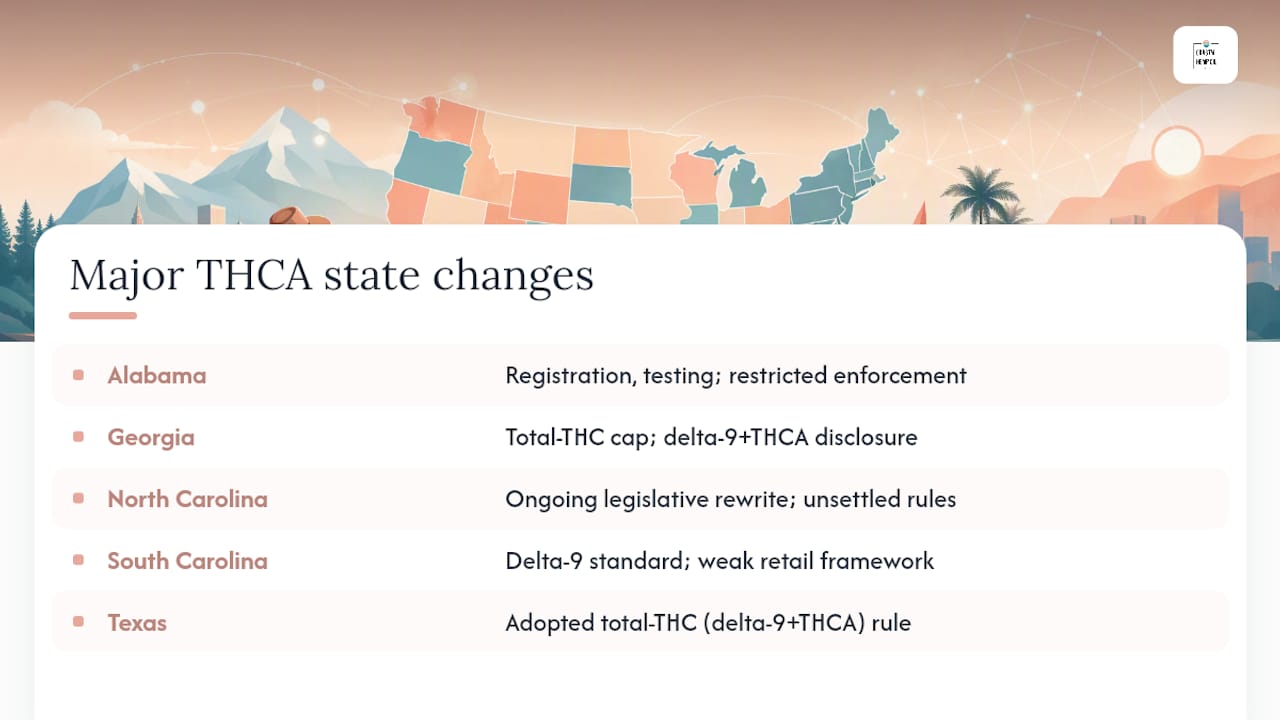
South Carolina sits in one of the true gray zones on this map. The state still uses the older delta-9 only standard, and it has no comprehensive hemp retail licensing law comparable to what neighboring states have built. That absence of a framework doesn’t mean anything goes; it means enforcement discretion varies more by county and by product type than in states with clear statutes. Smokable flower is the riskiest category here, since it draws the most law enforcement attention even without a specific statute naming it.
Texas is the state every hemp retailer in the country is watching closest. The Department of State Health Services adopted 25 TAC Rule 300.101, which redefines acceptable hemp THC to include both delta-9 and THCA on a dry-weight basis, effectively adopting the total-THC standard that H.R. 5371 will later impose federally. The rule took effect March 31, 2026, and it’s currently being challenged in Sky Marketing v. DSHS, with the litigation’s outcome still undetermined as of this writing. Separately, reporting from the Texas Tribune documents how the state’s broader classification changes swept THCA flower and related cannabinoids into Schedule I territory, narrowing what’s still legal to sell.
Texas didn’t just tighten a testing threshold. It moved THCA flower into the same enforcement category as marijuana itself, and it did so through an administrative rule rather than a full legislative vote, which is exactly why the litigation matters so much for the rule’s long-term survival.
For Texas consumers, the practical takeaway is blunt: smokable THCA flower is the riskiest purchase you can make right now, and even THCA-dominant vapes and edibles need to be checked against current total-THC limits before you buy. Georgia and Alabama shoppers have more breathing room, but registration and labeling compliance still matter if you want a product that will hold up under scrutiny.
What Does H.R. 5371 Change Nationally?
H.R. 5371 rewrites the federal definition of hemp to include THCA inside the total-THC calculation, and the math behind that change is simpler than it sounds. Total THC gets calculated as delta-9 THC plus THCA multiplied by 0.877, the conversion factor that accounts for how much delta-9 a given amount of THCA produces when decarboxylated through smoking or vaping. The law also sets a 0.4 mg per-serving cap, a number small enough that most current THCA vape cartridges and concentrates would fail to qualify as federally compliant hemp once the rule takes hold.
The statutory effective date is set for late 2026. Congress could still act to delay or adjust implementation before then, and nothing rules out further amendments, but as written, the deadline stands.
A few consequences follow directly from that change:
- Online hemp retailers who currently ship THCA products nationwide under the old delta-9 only standard lose the federal “hemp defense” for products that exceed the new total-THC math.
- Licensed, state-regulated dispensary channels are unaffected by this shift, since they already operate under their own state cannabis programs rather than the federal hemp exemption.
- Retailers selling through the hemp channel, meaning general online stores and non-dispensary retail rather than licensed cannabis dispensaries, face the sharpest compliance burden, since their entire legal basis for selling THCA products rested on the old delta-9 only test.
- States that have already adopted total-THC standards, like Texas, will see less disruption in November 2026 than states still relying on the delta-9 only test, since those states are effectively getting ahead of a rule change they’ll face anyway.
By the numbers: the shift from a delta-9 only test to a total-THC test (delta-9 + THCA × 0.877) against a 0.4 mg per-serving cap means a typical THCA vape cartridge, which can carry hundreds of milligrams of THCA per gram, would need to be reformulated or reclassified entirely to stay inside the new federal line after November 12, 2026.
The federal change doesn’t touch state-licensed dispensary programs at all. It closes the hemp-channel loophole that let non-dispensary retailers sell intoxicating THCA products in states without their own restrictive testing rules.
How to Check If Your THCA Purchase Is Compliant
Reading a lab report, or Certificate of Analysis (COA), is the single most useful habit you can build as a THCA shopper heading into 2026. Here’s the sequence worth running through every time:
- Find the delta-9 THC number first. It should sit well under 0.3% on a dry-weight basis for federal hemp compliance under the current standard.
- Find the THCA percentage separately. A COA that only lists delta-9 and omits THCA entirely is a red flag, not a good sign.
- Do the total-THC math yourself. Multiply the THCA number by 0.877, add it to delta-9, and compare that total against both the current federal threshold and, increasingly, your state’s own standard where one exists.
- Check the per-serving math on edibles and gummies, since a package-level number can hide a per-serving overage.
- Confirm the seller checks your shipping state before checkout. A reputable online retailer will flag restricted states rather than letting the order go through and leaving you holding the risk.
Pro Tip: Keep every COA and receipt from purchases made in 2026. If your state’s rules or a federal enforcement posture shift after November 12, documentation showing what you bought and when can matter if you’re ever asked to explain a product in your possession.
Avoid smokable flower entirely in any state coded restricted or illegal on the matrix above, and when in doubt about a specific situation, a quick conversation with a local attorney beats guessing.
The Federal Deadline Will Force a Retail Reset, Not a Ban
The November 2026 deadline reads like an ending, but it is closer to a sorting mechanism. Retailers who already built their catalogs around total-THC math, the way Texas forced its market to do early, will barely feel the transition. Retailers still leaning on the old delta-9 only loophole are the ones facing a real reset.
Watch state legislatures more than Congress this year. Most of the meaningful action between now and November is happening in statehouses and courtrooms, not on Capitol Hill. Keep an eye on the Sky Marketing v. DSHS docket in Texas and on whatever North Carolina’s legislature does next, since both will signal how aggressively other states copy the total-THC model before the federal deadline makes it mandatory anyway.
Coastalhemp’s position on all of this hasn’t changed: buy from sellers who show you the lab report before you ask for it, and do the total-THC math yourself rather than trusting a product label at face value.
— John
Compliant THCA Products Worth Knowing About
If you’re shopping in a state where THCA vapes and concentrates remain legal under current rules, three products from the Coastalhemp catalog cover most of what buyers are actually looking for right now.
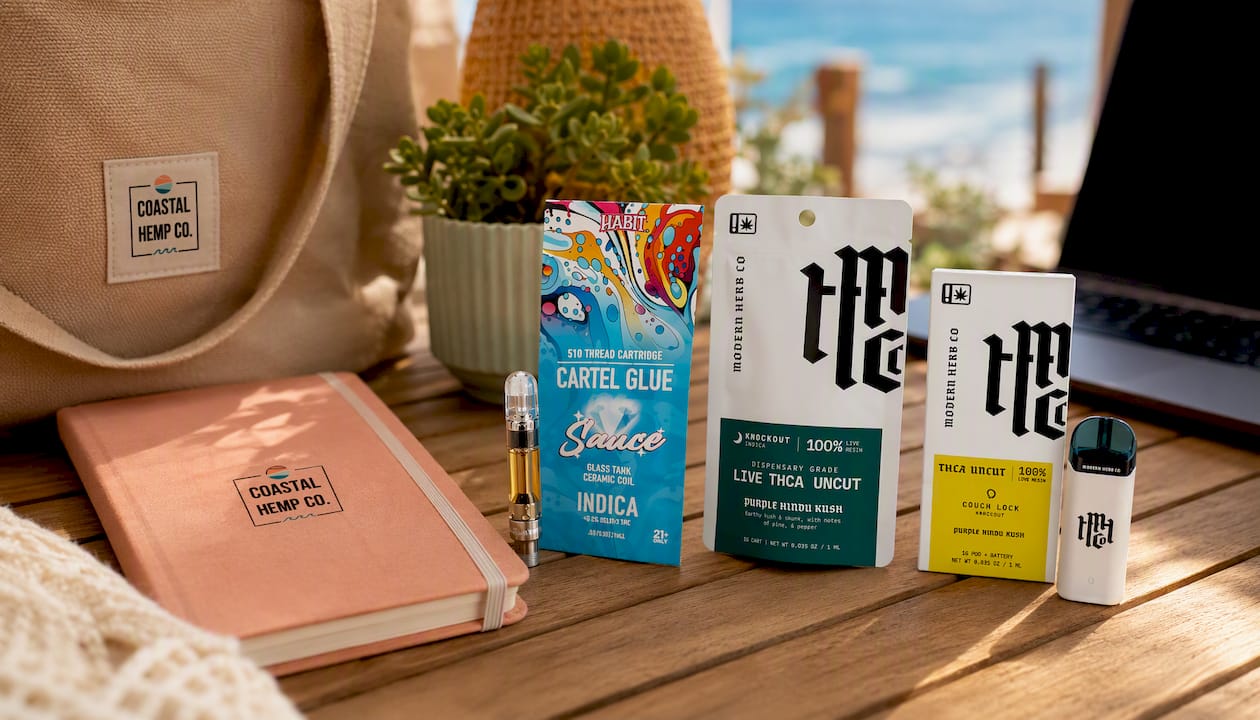
The Habit THCA Sauce Ceramic Coil Cartridge is built for vapers who want a straightforward 1-gram cartridge without a lot of extra hardware decisions. The ceramic coil gives a smoother draw than cheaper coil types, and it’s a solid entry point if you’re comparing cartridge options for the first time.
For anyone chasing higher potency, the Modern Herb THCA Live Resin Cartridge, labeled uncut, skips the added terpene dilution some cartridges used to stretch volume. It’s a better fit for experienced vape users who already know their tolerance and want the extract as close to its original concentration as possible.
New to live resin pods specifically? The Modern Herb Live Resin Pod Starter Kit bundles what you need to try the format without committing to a full setup you might not end up using.
None of these are legal to ship into every state on the matrix above. Restricted and illegal states, Texas and Idaho among them, may not permit these product types at all, so check your state’s status before you check out. When ready to order, online retailers often flag shipping restrictions at checkout to inform buyers before payment.
Where to Verify These Laws Yourself
Laws move faster than any single article can track, so verify directly before you buy or ship. Start with H.R. 5371’s text for the federal timeline, Texas DSHS guidance for the total-THC rule, and North Carolina’s enacted legislation for that state’s ongoing revisions.
Sources
The catalog spans THCA gummies, vape cartridges, and functional mushroom edibles reflecting a variety of product types instead of a single narrow line. That partnership model matters most at the testing stage.
- H.R. 5371 and THCA: What the 2026 hemp law change means | Elevated Guide
- Cannabisregulations
- What is still legal under Texas’ latest THC ban — Texas Tribune
FAQ
Is THCA Legal in All 50 States?
No. THCA legality varies by state, ranging from broadly legal under a delta-9 only test to fully banned under a total-THC standard, and the state matrix above breaks down where each state currently stands.
What State Has the Best THCA Access?
States using only the delta-9 only standard, like Arizona and Kentucky, currently offer the broadest access to THCA flower, vapes, and edibles without additional state-level testing hurdles, though that could tighten once the federal total-THC rule takes effect in November 2026.
Can I Order THCA Online?
Yes, but only if your state allows it and the seller ships there. Coastalhemp and other online retailers check shipping restrictions by state at checkout, since in-person sale rules and inbound shipping rules don’t always match.
What Happens to THCA Products After November 12, 2026?
Products that exceed the new total-THC calculation, delta-9 plus THCA times 0.877, against the 0.4 mg per-serving cap will lose their federal hemp exemption, which mainly affects online and non-dispensary hemp retailers rather than licensed cannabis dispensaries.
Is Texas’s THCA Rule Still Being Challenged in Court?
Yes. Texas’s total-THC rule, 25 TAC Rule 300.101, took effect March 31, 2026, and remains the subject of active litigation in Sky Marketing v. DSHS as of this writing.


Comments