
Hemp-Derived THC Legality Guide: 2026 Federal Update
Hemp-derived THC legality is defined by whether a product meets strict federal and state standards for THC content, manufacturing origin, and labeling. The 2018 Farm Bill set the original threshold at 0.3% delta-9 THC by dry weight, which created a legal framework that fueled rapid industry growth. That framework is changing. The Continuing Appropriations and Extensions Act of 2026 rewrites the federal definition of hemp, shifting to a “total THC” standard that includes THCA and delta-8 THC. This hemp-derived THC legality guide covers what those changes mean, how state laws differ, and what consumers and businesses need to do before november 12, 2026.
What defines hemp-derived THC legally under federal law?
The 2018 Farm Bill defines hemp as cannabis containing no more than 0.3% delta-9 THC by dry weight. That single threshold excluded hemp from the Controlled Substances Act and opened the door for a wide range of cannabinoid products, including delta-8 THC gummies, THCA flower, and high-potency edibles. The key insight is that the old rule only counted one form of THC, which allowed manufacturers to sell products with significant intoxicating potential while staying technically legal.
The new federal standard, effective november 12, 2026, replaces that single metric with a total THC calculation that adds THCA and delta-8 THC to the delta-9 count. This closes the loophole that allowed high-potency products to exist under the old 0.3% delta-9 limit alone. The law also sets a hard cap of 0.4 milligrams of total THC per finished product container.

Synthetic cannabinoids face an outright ban under the new rules. Products like delta-8 THC made through CBD isomerization, a chemical process that converts CBD into THC outside the cannabis plant, will be federally prohibited. The law limits legal hemp cannabinoids to those naturally produced by the cannabis plant.
The FDA is expected to publish lists of qualifying naturally occurring cannabinoids and clarify container definitions. Regulatory scope remains uncertain pending those FDA determinations. That uncertainty makes proactive compliance assessment critical right now.
| Standard | Old Rule (2018 Farm Bill) | New Rule (Effective Nov. 12, 2026) |
|---|---|---|
| THC measurement | 0.3% delta-9 THC by dry weight | 0.3% total THC (delta-9 + THCA + delta-8) |
| Container limit | Not specified | 0.4 mg total THC per container |
| Synthetic cannabinoids | Permitted if under delta-9 limit | Federally prohibited |
| Scope | Delta-9 only | All naturally occurring cannabinoids |
Pro Tip: Check a product’s certificate of analysis for total THC, not just delta-9 THC. A product showing 0.2% delta-9 may still exceed the new 0.3% total THC threshold once THCA is factored in.
How do state hemp THC laws vary across the country?
State law on hemp-derived THC is a patchwork, and that patchwork is getting more complex as the 2026 federal deadline approaches. As of june 2026, 24 states permit intoxicating hemp products but most impose restrictions including low THC limits per serving and a minimum purchase age of 21. That means even in permissive states, the product you can legally buy today may not meet the rules in the next state over.
Some states are moving to align with the new federal standard. Illinois, for example, is updating its laws to treat non-compliant hemp products as marijuana, which subjects them to marijuana licensing and tax rules. Ohio has taken a harder stance and banned intoxicating hemp products outright. South Dakota excludes synthetic cannabinoids like delta-8 THC from its industrial hemp definition entirely.
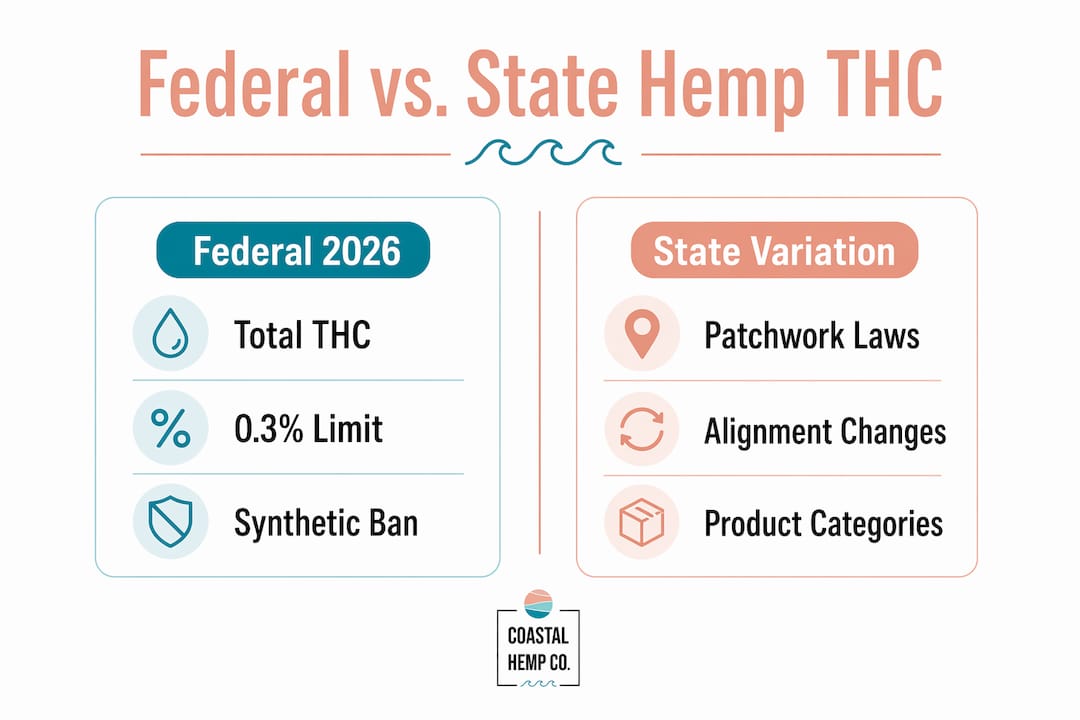
State-level variation creates real compliance risk for consumers who travel or order products online. A product that is legal to purchase in one state may be treated as a controlled substance in another. State laws are fragmenting with some adopting stricter or opt-out frameworks that differ significantly from federal law.
Key state regulatory variables to watch:
- Age restrictions: Most permissive states require buyers to be 21 or older.
- Potency limits: Some states cap THC per serving or per package below the federal container limit.
- Product type bans: Several states prohibit hemp-derived THC in beverages, edibles, or vape products specifically.
- Synthetic cannabinoid exclusions: States like South Dakota exclude isomerized cannabinoids from hemp definitions.
- Labeling requirements: State rules on lab testing disclosure, warning labels, and child-resistant packaging vary widely.
- Opt-out provisions: Some states have passed laws that allow local jurisdictions to ban hemp THC sales entirely.
For a closer look at how these rules apply to specific product categories, the hemp edibles regulations guide breaks down state-imposed restrictions on hemp cannabinoid foods and drinks.
What are the practical compliance steps for consumers and businesses?
Compliance starts with reading the certificate of analysis on every product. A certificate of analysis is a third-party lab report that lists cannabinoid concentrations, including total THC. Consumers should request this document before purchasing, and businesses should require it from every supplier. A product labeled “hemp-compliant” under the 2018 Farm Bill standard may not meet the 2026 total THC threshold.
Legal experts warn that “hemp-compliant” marketing is increasingly inaccurate as the november 12, 2026 deadline approaches. Many products currently carrying that label will not meet the new legal standards. Consumers who rely on that label alone face growing legal and safety risk.
For businesses, the compliance checklist is more detailed:
- Audit your product catalog. Calculate total THC for every SKU using the new formula: delta-9 + THCA + delta-8. Any product exceeding 0.3% total THC or 0.4 mg per container will be federally unlawful after november 12, 2026.
- Verify cannabinoid origin. Confirm that all cannabinoids in your products are naturally derived from the cannabis plant. Isomerized or synthetically produced cannabinoids are prohibited under the new law regardless of THC concentration.
- Review state law for every market you serve. Use the state-by-state breakdown above as a starting point, then consult legal counsel for each jurisdiction. Shipping non-compliant products across state lines carries federal risk. Review hemp shipping compliance rules before dispatching any order.
- Update labeling and packaging. Ensure labels reflect total THC content, include required warnings, and meet child-resistant packaging standards where required by state law.
- Set a compliance deadline of October 1, 2026. That gives you six weeks before the federal enforcement date to clear non-compliant inventory, update supplier contracts, and retrain staff.
Pro Tip: Ask your supplier for a batch-specific certificate of analysis, not a generic one. Cannabinoid concentrations vary between production runs, and a certificate from a different batch does not confirm your product’s compliance.
Consumers should also verify the legal status of hemp-derived THC in their state before purchasing online. Ordering a product that is federally compliant but state-restricted still carries legal risk at the point of delivery.
What is the anticipated impact of the 2026 federal hemp redefinition?
The scale of the coming change is significant. The U.S. Hemp Roundtable estimates that approximately 95% of existing hemp-derived cannabinoid products will become federally unlawful after november 12, 2026. That figure includes popular products like delta-8 THC gummies and high-THCA flower, which currently dominate the hemp retail market.
“The 2026 federal hemp redefinition is not a minor regulatory adjustment. It is a structural reset that will reclassify the vast majority of hemp-derived THC products as federally controlled substances, exposing consumers and businesses to legal risks they may not anticipate.” — Vicente LLP legal analysis
Federal enforcement priorities after november 12, 2026 remain uncertain. The FDA’s role in defining qualifying cannabinoids and container standards adds another layer of ambiguity. Some legal observers note that enforcement may be uneven in the short term, but relying on non-enforcement is not a compliance strategy.
Some experts criticize the new federal definition as regulatory overreach that will fragment state law further and increase litigation risk across the industry. That criticism reflects a real tension: the federal government is tightening rules while some states are moving in the opposite direction. Consumers caught between those two frameworks face the highest risk.
Consumer safety is a separate issue from legality. Consumers often conflate product legality with safety, but a product being legal today does not mean it is safe or that it will remain legal tomorrow. Post-november 2026, purchasing non-compliant products increases both legal exposure and the risk of consuming unregulated, mislabeled goods.
Key Takeaways
Hemp-derived THC legality shifts fundamentally on november 12, 2026, when the federal standard moves from 0.3% delta-9 THC to 0.3% total THC with a 0.4 mg per container cap, making approximately 95% of current hemp cannabinoid products federally unlawful.
| Point | Details |
|---|---|
| New federal THC standard | Total THC (delta-9 + THCA + delta-8) replaces the old delta-9-only threshold. |
| Container limit | Finished hemp products must contain no more than 0.4 mg total THC per container. |
| Synthetic cannabinoids banned | Isomerized cannabinoids like delta-8 THC made from CBD will be federally prohibited. |
| State law varies widely | 24 states permit intoxicating hemp products, but restrictions on potency, age, and product type differ significantly. |
| Compliance deadline | Businesses and consumers should assess product compliance before november 12, 2026. |
The regulatory shift no one is fully prepared for
The honest reality is that most consumers and many retailers are not ready for what november 12, 2026 actually means. I have watched this industry grow rapidly on the back of a single regulatory threshold, and the assumption that “hemp-compliant” is a stable category has become deeply embedded in how products are marketed and purchased.
What concerns me most is the gap between legal status and consumer awareness. The 95% product loss estimate is not a fringe prediction. It comes from the U.S. Hemp Roundtable, an industry body with every incentive to be optimistic. When even industry advocates acknowledge that scale of disruption, the urgency is real.
My practical advice: do not wait for enforcement to tell you what is compliant. Read the certificate of analysis on every product you buy or sell. Understand whether the cannabinoids in that product are naturally derived or synthetically processed. And check your state’s current law, because it may already be stricter than the incoming federal standard.
The brands that will survive this transition are the ones that built compliance into their sourcing and labeling before the deadline, not after. Coastalhemp’s approach of partnering with vetted growers and requiring transparent lab testing is exactly the kind of standard that positions consumers to make informed, lower-risk choices. For a deeper look at how the 2018 Farm Bill and 2026 amendments differ in practice, the hemp vs. marijuana differences guide is worth reading before you make your next purchase.
— John
Coastalhemp’s compliant hemp THC products for 2026
Coastalhemp sources products from trusted growers and brands that prioritize third-party lab testing and transparent cannabinoid disclosure. That commitment matters more now than at any point in the hemp industry’s history.
Coastalhemp’s THCA Live Sugar Blend Gummies and THCv Gummies are sourced with compliance and quality in mind, giving consumers a clear picture of what they are purchasing. As the november 2026 deadline approaches, choosing products backed by verifiable lab results is the most practical step any consumer can take. Browse Coastalhemp’s full selection of legal hemp THC edibles to find options that meet current federal and state standards.
FAQ
What is the new federal hemp THC limit in 2026?
The new federal standard, effective november 12, 2026, sets a 0.3% total THC limit by dry weight and a 0.4 mg total THC cap per finished product container. Total THC includes delta-9 THC, THCA, and delta-8 THC combined.
Why is hemp-derived THC federally legal right now?
The 2018 Farm Bill excluded hemp from the Controlled Substances Act by defining it as cannabis with no more than 0.3% delta-9 THC by dry weight. That definition made hemp-derived cannabinoids federally legal as long as they met that single threshold.
Is delta-8 THC still legal after november 2026?
Delta-8 THC made through CBD isomerization will be federally prohibited after november 12, 2026, because the new law bans cannabinoids not naturally produced by the cannabis plant. Naturally occurring delta-8 THC in trace amounts may still qualify, pending FDA guidance.
How do I know if a hemp product is compliant with the 2026 rules?
Request a batch-specific certificate of analysis from the manufacturer and calculate total THC by adding delta-9, THCA, and delta-8 concentrations. The combined total must not exceed 0.3% by dry weight or 0.4 mg per container.
Do state hemp THC laws override federal law?
State laws operate alongside federal law, not above it. A product legal under state law can still be federally unlawful. After november 12, 2026, non-compliant products face federal risk regardless of state permission, and some states are already adopting stricter standards than the new federal baseline.


Comments