
Hemp vs Marijuana Differences: What You Need to Know
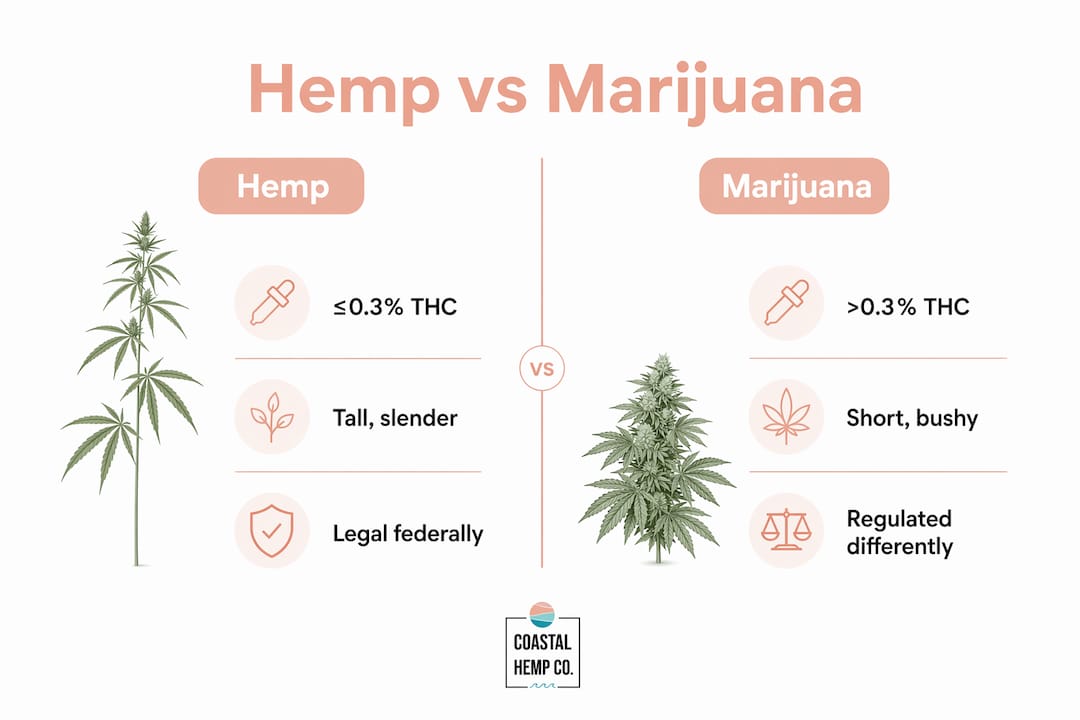
Hemp and marijuana are two distinct varieties of Cannabis sativa, separated not by species but by THC concentration and legal classification. The hemp vs marijuana differences come down to one defining threshold: hemp contains no more than 0.3% delta-9 THC by dry weight, while marijuana regularly tests between 15% and 30% THC. That single number determines whether a plant is a federally legal crop or a Schedule I controlled substance. Understanding this distinction matters more than ever in 2026, as new federal rules are reshaping what qualifies as legal hemp and how products can be sold.
What are the biochemical differences between hemp and marijuana?
Hemp and marijuana share the same genetic lineage but are bred for entirely different chemical profiles. Hemp’s THC concentration stays at or below 0.3%, which is far too low to produce intoxication. Marijuana, by contrast, is selectively cultivated to push THC levels between 15% and 30%, sometimes higher in concentrate form. That gap in cannabinoid content is what drives every downstream difference in effects, legality, and consumer use.
CBD, or cannabidiol, is the dominant cannabinoid in hemp. Hemp plants are specifically bred to maximize CBD content while keeping THC minimal, making them the primary source for CBD oils, tinctures, and wellness supplements. Marijuana strains can also contain CBD, but most commercial marijuana is bred for high THC or specific cannabinoid ratios tailored to medical or recreational outcomes.
Beyond THC and CBD, both plants contain terpenes, the aromatic compounds responsible for scent and flavor. Terpenes like myrcene, limonene, and pinene influence the overall effect profile of a product through what researchers call the entourage effect. This means two products with identical THC levels can feel noticeably different depending on their terpene composition.
- Hemp cannabinoid profile: High CBD, trace THC (≤0.3%), often rich in CBG and CBN
- Marijuana cannabinoid profile: High THC (15%–30%), variable CBD, diverse terpene blends
- Terpene overlap: Both plants share many of the same terpenes, but concentrations differ by strain and cultivation method
Pro Tip: When reading a hemp product label, look for a full-panel Certificate of Analysis (COA) from a third-party lab. This confirms both the CBD content and that THC stays within legal limits.
How do cultivation methods and physical characteristics differ?
Hemp and marijuana plants look different because they are grown for different purposes. Hemp plants grow tall and slender, often reaching 10 to 15 feet, with minimal branching and sparse foliage. Marijuana plants are shorter and bushier, with dense, resin-coated flowers that concentrate cannabinoids. These physical differences are a direct result of selective breeding over generations.
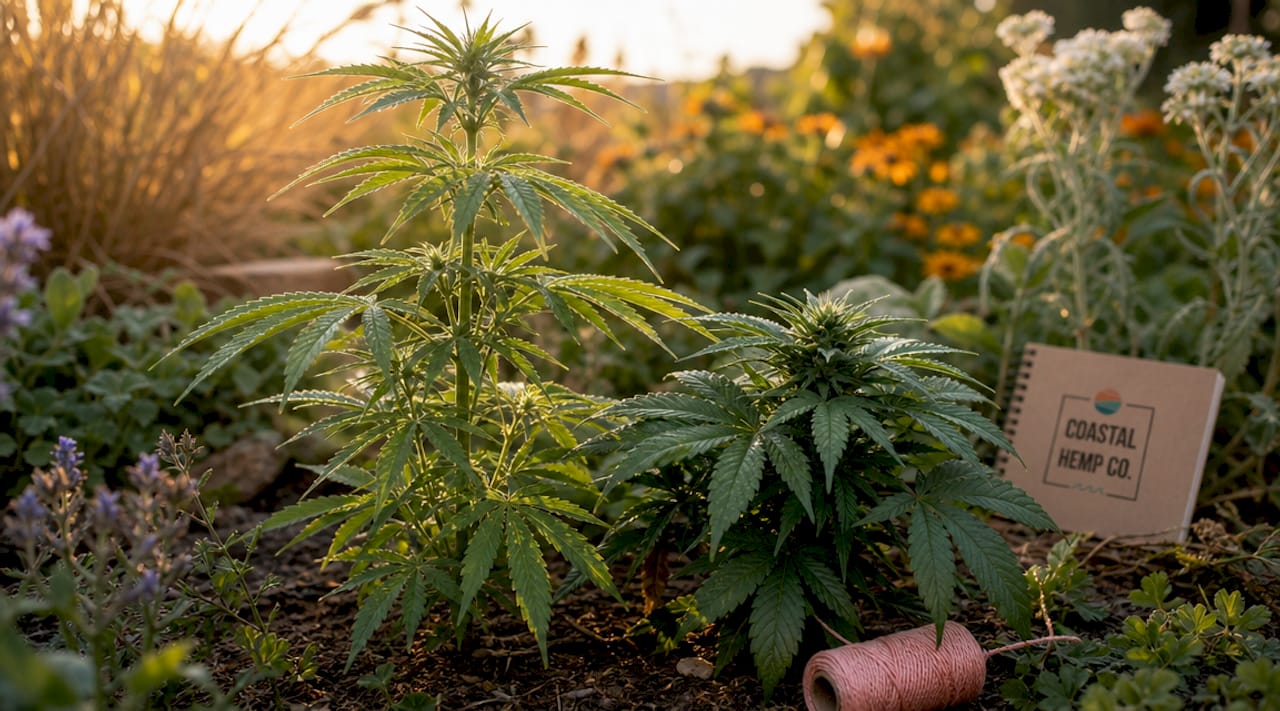
Hemp cultivation prioritizes yield and versatility. Farmers plant hemp densely, sometimes 100 to 150 plants per acre, to maximize fiber and seed output. Marijuana cultivation is the opposite: plants are spaced widely to allow airflow, light penetration, and maximum flower development. Controlled indoor environments with precise lighting schedules are common in marijuana production to optimize potency.
The industrial applications of hemp extend well beyond cannabinoids. Hemp fibers and seeds support textiles, construction materials like hempcrete, biodegradable plastics, and health foods such as hemp protein powder and hemp seed oil. Marijuana’s commercial value is concentrated almost entirely in its psychoactive and medicinal flower. This divergence in end use explains why hemp has been cultivated globally for thousands of years while marijuana’s modern commercial history is far more recent and legally constrained.
- Hemp growing conditions: Outdoors, high density, minimal intervention, adaptable to varied climates
- Marijuana growing conditions: Controlled environments, low density, precise light and humidity management
- Primary hemp outputs: CBD extract, fiber, seed oil, protein, construction materials
- Primary marijuana outputs: High-THC flower, concentrates, edibles, medical formulations
What are the legal distinctions between hemp and marijuana?
The 2018 Agriculture Improvement Act, commonly called the Farm Bill, established the federal legal definition of hemp as Cannabis sativa containing no more than 0.3% delta-9 THC by dry weight. Any plant exceeding that threshold is classified as marijuana and remains a Schedule I controlled substance under federal law. This legal divide created an entirely separate regulatory framework for hemp and its derivatives, including CBD products.
Starting November 12, 2026, that framework shifts significantly. New federal rules move from a percentage-based THC limit to a total milligram limit of 0.4 mg THC per final product container. This change directly targets intoxicating hemp edibles and beverages that technically complied with the 0.3% rule by using heavy base weights. A large gummy, for example, could stay under 0.3% THC by dry weight while still containing enough total THC to produce significant psychoactive effects. The 2026 rule closes that gap.
| Legal Category | Federal Status | THC Limit | Key Implication |
|---|---|---|---|
| Hemp (pre-Nov 2026) | Legal under Farm Bill | ≤0.3% by dry weight | Percentage-based, allowed heavier edibles |
| Hemp (post-Nov 2026) | Legal under updated rules | ≤0.4 mg total per container | Mass-based limit restricts intoxicating products |
| Marijuana | Schedule I controlled substance | No federal limit; varies by state | Illegal federally; legal in some states |
Synthetic cannabinoids are also excluded from the new hemp definition, meaning lab-created compounds that mimic THC effects will no longer qualify as legal hemp regardless of their source. This matters for consumers buying delta-8 or delta-10 products, many of which are synthesized from CBD.
State laws add another layer of complexity. Hemp-derived cannabinoid products exist in a federal gray area, with some states banning hemp-derived THC products entirely while others allow them freely. Before purchasing or transporting hemp products across state lines, checking current state regulations is not optional. You can review hemp shipping regulations to understand how these rules affect online purchases and delivery.
Pro Tip: The 0.3% THC rule applies to the plant at harvest, not necessarily to the final product. Always verify that the product you buy has a COA showing total THC in the final formulation, especially after the November 2026 rule change.
How do the effects and consumer products differ?
The delta-9 THC molecule is chemically identical whether it comes from hemp or marijuana. Effects depend on dose and formulation, not the plant’s legal classification. This is the most misunderstood aspect of the hemp and marijuana comparison. A hemp-derived gummy with 10 mg of delta-9 THC will produce effects comparable to a marijuana edible with the same dose. The plant source does not change the pharmacology.
Where hemp and marijuana diverge in consumer experience is in product intent and typical dosing. Hemp-derived products are generally formulated for wellness applications: stress relief, sleep support, focus, and general well-being. Marijuana products, particularly in dispensary markets, are formulated for stronger psychoactive experiences or targeted medical outcomes like pain management and appetite stimulation.
Here is how the product categories break down:
- Hemp-derived products: CBD oils, full-spectrum tinctures, topicals, CBD sleep gummies, hemp protein, fiber textiles, THCA concentrates
- Marijuana-derived products: High-THC flower, wax and shatter concentrates, dispensary edibles, medical cannabis formulations
- Overlapping products: Delta-9 THC edibles (legal hemp version vs. dispensary version), full-spectrum extracts, vaporizer cartridges
One critical consumer consideration is drug testing. Drug tests do not distinguish between hemp-derived and marijuana-derived THC. Both produce the same THC metabolites in the body, and both can trigger a positive result. Anyone subject to workplace or athletic drug testing should treat hemp-derived THC products with the same caution as marijuana. CBD isolate products carry lower risk, but full-spectrum hemp products with trace THC can still accumulate to detectable levels with regular use.
Hemp-derived cannabinoids tend to support systemic wellness through lower-dose, consistent use, while marijuana’s higher THC concentrations aim for more immediate psychoactive or targeted medical effects. This distinction shapes how consumers approach dosing, frequency, and product selection across both categories.
Key takeaways
Hemp and marijuana are the same species with different chemical profiles, and the 0.3% THC threshold is the single legal and functional dividing line between them.
| Point | Details |
|---|---|
| THC is the defining difference | Hemp contains ≤0.3% THC; marijuana ranges 15%–30%, determining legality and psychoactivity. |
| Same molecule, different doses | Delta-9 THC from hemp and marijuana is chemically identical; effects depend on total dose consumed. |
| 2026 rules change the market | Federal law shifts to a 0.4 mg total THC per container limit starting November 12, 2026. |
| Drug tests do not differentiate | Hemp-derived THC produces the same metabolites as marijuana THC and can cause positive test results. |
| State laws vary significantly | Hemp product legality differs by state; always verify local regulations before purchasing or transporting. |
Why the hemp vs. marijuana confusion actually matters for your wallet
I have watched consumers make expensive mistakes because they assumed “hemp-derived” meant “non-intoxicating” and “marijuana” meant “illegal everywhere.” Neither assumption holds up in 2026. The legal hemp market has quietly produced products with enough delta-9 THC to produce real psychoactive effects, all sold legally online and in gas stations. Meanwhile, marijuana remains federally illegal despite being fully legal for adult use in nearly half of U.S. states.
The 2026 milligram-based THC limit is the most significant regulatory shift since the 2018 Farm Bill, and most consumers have no idea it is coming. Brands selling heavy hemp edibles and beverages are reformulating right now. If you have a product you like, the version available after November 2026 may be noticeably different in potency. That is not a flaw in the regulation. It is the regulation working exactly as intended.
What I find most useful is treating hemp and marijuana as a spectrum rather than a binary. Low-dose hemp CBD products sit at one end, supporting wellness without any intoxication. High-THC marijuana concentrates sit at the other. Hemp-derived delta-9 edibles and THCA products occupy the middle ground, legally distinct from marijuana but functionally closer to it than most people realize. Understanding where a product falls on that spectrum, based on its cannabinoid content and total dose, is the only way to make genuinely informed choices.
The 2026 hemp edibles guide is worth reading if you want a full breakdown of how the new rules affect specific product categories.
— John
Explore hemp-derived products at Coastalhemp
Coastalhemp partners with leading hemp growers and brands to bring you a curated selection of compliant, lab-tested hemp products. Whether you are looking for high-potency THCA concentrates, full-spectrum CBD gummies, or functional wellness blends, every product on the site comes with third-party testing documentation.

From the Wildwood THCA Live Resin Cartridge to de-stress CBD gummies formulated with CBG and functional mushrooms, Coastalhemp’s catalog reflects the full range of what compliant hemp can deliver. The team stays current on evolving federal and state regulations so you do not have to. Visit Coastalhemp to browse products built for real wellness outcomes.
FAQ
What is the main difference between hemp and marijuana?
Hemp and marijuana are both Cannabis sativa varieties, but hemp contains no more than 0.3% delta-9 THC by dry weight while marijuana typically contains 15% to 30% THC. This THC threshold determines federal legal status and psychoactive potential.
Can hemp-derived delta-9 THC get you high?
Yes. The delta-9 THC molecule is identical regardless of plant source, and hemp-derived products with sufficient total THC can produce intoxicating effects comparable to marijuana edibles at the same dose.
Will hemp products show up on a drug test?
Drug tests do not differentiate between hemp-derived and marijuana-derived THC metabolites, so full-spectrum hemp products containing THC can produce a positive result. CBD isolate products carry lower risk, but regular use of any THC-containing hemp product can accumulate to detectable levels.
How does the 2026 hemp rule change affect consumers?
Starting November 12, 2026, legal hemp products must contain no more than 0.4 mg total THC per final container, replacing the previous percentage-based limit. This means many hemp edibles and beverages currently on the market will need to be reformulated or removed from sale.
Is hemp legal in all 50 states?
Federal law permits hemp under the 2018 Farm Bill, but individual states retain the right to restrict or ban hemp-derived cannabinoid products. Some states have banned delta-8 and delta-9 hemp products entirely, so state-level regulations must be verified before purchasing or transporting hemp products across state lines.


Comments