

Full Spectrum Hemp Products: Examples for Wellness Shoppers
A full-spectrum hemp product contains the complete range of naturally occurring hemp compounds — cannabinoids, terpenes, and flavonoids — with total THC at or below 0.3% by dry weight, the federal legal ceiling established by the 2018 Farm Bill. Common examples of full spectrum hemp products include:
- Oils and tinctures (sublingual drops)
- Gummies and edibles (chewable, pre-dosed)
- Capsules and softgels (measured servings)
- Topicals (creams, balms, lotions)
- Vape products (disposable pens, cartridges)
- Concentrates (wax, shatter, live resin)
- Beverages (hemp-infused drinks, shots)
Coastalhemp carries several of these forms, including organic full-spectrum oils, for shoppers who want verified options in one place.
Pro Tip: Before buying any full-spectrum product, download the Certificate of Analysis (COA) from the brand’s website. Confirm the THC reading is at or below 0.3% and that a third-party lab signed off on the cannabinoid panel.

Table of Contents
- What “full spectrum” actually means under U.S. standards
- Concrete examples of full-spectrum hemp products by form
- Common wellness uses and what the evidence says
- How to choose a quality full-spectrum product
- Legal status and safety notes for U.S. shoppers
- What practitioners say about full-spectrum formulations
- Key Takeaways
- Why full-spectrum deserves more than a label check
- Coastalhemp’s full-spectrum oil selection
- Useful sources
- FAQ
What “full spectrum” actually means under U.S. standards
The American Herbal Products Association (AHPA) defines a full-spectrum hemp extract as a resinoid extract that retains a wide range of naturally occurring hemp constituents, processed without the intentional removal of any compound, with final THC quantification not exceeding 0.3%. That definition matters because the term “full spectrum” has no FDA-enforced standard, so brands use it loosely.
The 2018 Farm Bill removed hemp (Cannabis sativa L. with less than 0.3% THC) from Schedule I, opening the door to legal hemp-derived CBD commerce nationwide. What it did not do is give the FDA a clear mandate to regulate nonprescription CBD as a dietary supplement, which is why labeling inconsistencies persist. A product called “full spectrum” on one shelf may be a selective hydrophobic extract; another may be a true whole-plant resinoid. The only way to know is the COA.
“Full-spectrum hemp extract” is used variably across the industry. AHPA recommends verifying COAs and precise cannabinoid and terpene content rather than relying on a single marketing term. — AHPA Hemp Lexicon
For a side-by-side breakdown of how full-spectrum compares to broad-spectrum and isolate, the Coastalhemp spectrum guide covers the key differences in plain language.
Concrete examples of full-spectrum hemp products by form
The table below maps each product form to its typical delivery format, primary wellness use, and the label details worth checking before you buy.
| Product Form | Delivery Format | Common Wellness Use | Key Label Checks |
|---|---|---|---|
| Oil / Tincture | Sublingual drops | Sleep, anxiety, general balance | mg CBD per serving, total cannabinoids, THC %, COA link |
| Gummies / Edibles | Chewable, pre-dosed | Stress, sleep, sustained relief | mg per piece, full-spectrum wording, COA |
| Capsules / Softgels | Swallowed, measured | Daily routine, consistent dosing | mg per capsule, extraction method, COA |
| Topicals | Cream, balm, lotion | Localized discomfort, skin support | mg per oz, full-spectrum vs. isolate, COA |
| Vape / Disposable Pen | Inhaled vapor | Fast-onset relief, stress | Cannabinoid panel, terpene profile, COA |
| Concentrates | Wax, shatter, live resin | High-potency use, experienced users | Total cannabinoid %, THC %, COA |
| Beverages | Infused drink, shot | Daytime wellness, hydration | mg per serving, bioavailability note, COA |
Two strong oil examples from Coastalhemp map directly to this table. The Celestial Wellness Full Spectrum CBD Oil is an organic sublingual tincture suited for sleep and daily stress support. The Pina Colada Full Spectrum CBD Oil offers the same full-spectrum cannabinoid profile in a flavored format, which works well for people who find unflavored hemp oils difficult to take consistently.
Pro Tip: Oils absorb sublingually in roughly 15–45 minutes and wear off faster than edibles. If you need relief that lasts 4–6 hours, a gummy or capsule is the better fit. For localized muscle or joint discomfort, a topical applied directly to the area skips systemic absorption entirely — see hemp beauty and topical benefits for more on how that works.
Common wellness uses and what the evidence says
Full-spectrum products are most commonly used for sleep support, anxiety management, pain and inflammation, and localized physical discomfort. Here is how product forms tend to align with those goals:
- Sleep: Oils and capsules taken 30–60 minutes before bed; the slower onset of capsules suits people who want gradual, sustained effects through the night.
- Anxiety and stress: Sublingual oils offer faster onset than edibles; vape pens provide the quickest effect for acute stress moments.
- Inflammation and pain: Topicals address localized areas directly; oils and capsules support systemic anti-inflammatory pathways. The science behind hemp and inflammation explains the proposed mechanisms in detail.
- General daily wellness: Capsules and gummies integrate easily into a morning or evening routine without measuring.
The entourage effect is the leading explanation for why full-spectrum formulations may outperform isolates: cannabinoids, terpenes, and flavonoids are thought to work together, amplifying each other’s effects. Clinical evidence is still developing, and most studies are preclinical or small-scale, so realistic expectations matter.
Pro Tip: Start with the lowest suggested serving on the label and hold that dose for at least a week before adjusting. Microdosing — taking smaller amounts more frequently — is a common approach for anxiety and daytime use without sedation.
How to choose a quality full-spectrum product
The single most important step is verifying a third-party Certificate of Analysis before purchasing. A COA from an accredited, independent lab confirms what is actually in the product, not just what the label claims.
A trustworthy COA should show: confirmed THC % at or below 0.3%; a full cannabinoid panel (CBD, CBG, CBN, CBC, and minor cannabinoids); terpene profile when available; and results for contaminants including pesticides, heavy metals, and residual solvents.
Beyond the COA, AHPA guidance recommends checking precise cannabinoid and terpene content rather than trusting the “full spectrum” label alone, since the term lacks a federally enforced definition.
Reading the label correctly matters. “CBD” listed in milligrams refers only to cannabidiol. “Total cannabinoids” is the broader figure and more accurately reflects what a full-spectrum product delivers. “mg per serving” tells you the dose per use, not the whole bottle. If a label says “full spectrum” but only lists CBD with no mention of other cannabinoids or terpenes, treat that as a yellow flag and check the COA.
Extraction method is worth a look too. CO2 extraction is widely regarded as the cleanest approach, preserving the cannabinoid and terpene profile without solvent residue. Ethanol extraction is also common and generally acceptable when residual solvents are tested and confirmed absent on the COA.
Legal status and safety notes for U.S. shoppers
Hemp-derived full-spectrum products with THC at or below 0.3% are federally legal under the 2018 Farm Bill. State law is a separate matter. A handful of states impose additional restrictions on hemp-derived THC products, so checking your state’s current rules before traveling with any hemp product is worth the two minutes it takes.
Key safety points to keep in mind:
- Drug testing: Trace THC below 0.3% can still accumulate with regular use and trigger a positive result on standard immunoassay drug screens. If your employer or sport organization tests for THC, full-spectrum products carry real risk.
- State variation: Some states restrict hemp-derived THC concentrations below the federal 0.3% ceiling. The Coastalhemp THC legality guide summarizes current state-level rules.
- FDA status: The FDA has not approved nonprescription CBD as a dietary supplement ingredient, meaning labeling standards are not uniformly enforced.
- Side effects: CBD is generally well tolerated, but reported effects at higher doses include drowsiness, dry mouth, and changes in appetite. Drug interactions are possible, particularly with medications metabolized by the CYP450 enzyme system.
Pro Tip: If you must avoid any detectable THC, choose a COA-verified broad-spectrum product rather than full-spectrum. The Natural Flavor CBD Oil Organic Broad Spectrum from Coastalhemp is a clean alternative with no THC and a third-party COA.
This article is general educational information, not medical or legal advice. Confirm current regulations with your state’s authority or a qualified professional before purchasing.
What practitioners say about full-spectrum formulations
Integrative nurse specialist Dominique Fontaine has noted that full-spectrum products may offer anti-inflammatory benefits because they retain multiple plant compounds that are lost during isolate processing. The reasoning connects directly to the entourage effect: a broader phytochemical profile gives the body more to work with than a single isolated cannabinoid.
“Full-spectrum CBD products may have anti-inflammatory properties due to the presence of multiple plant compounds that work together.” — Dominique Fontaine, BSN, RN, HNB-BC, via Healthline
For shoppers, this translates into a practical purchase cue: look for products that document not just CBD content but also minor cannabinoids (CBG, CBN, CBC) and terpenes on the COA. A product with a detailed terpene profile is more likely to be a genuine full-spectrum extract than one listing only CBD milligrams. The Coastalhemp terpene wellness guide explains which terpenes are most commonly associated with specific wellness outcomes.
Pro Tip: When comparing products, prioritize those whose COA includes a terpene panel alongside the cannabinoid panel. It is the clearest signal that the extract is genuinely full-spectrum rather than a CBD-dominant product with trace plant material.
Key Takeaways
Full-spectrum hemp products deliver the broadest cannabinoid and terpene profile legally available in the U.S., but a third-party COA confirming THC at or below 0.3% is the only reliable way to verify what you are buying.
| Point | Details |
|---|---|
| Legal THC ceiling | Federal law caps hemp-derived THC at 0.3%; always confirm this on a third-party COA. |
| COA is non-negotiable | Verify cannabinoid panel, terpene profile, and contaminant results before purchasing any product. |
| Match form to goal | Oils and capsules suit sleep and anxiety; topicals address localized discomfort; vapes offer the fastest onset. |
| Drug-test risk is real | Trace THC below 0.3% can still accumulate and trigger a positive screen; choose broad-spectrum if testing applies. |
| Coastalhemp options | Coastalhemp carries organic full-spectrum oils and a broad-spectrum alternative, all with COA access. |
Why full-spectrum deserves more than a label check
Most wellness content treats “full spectrum” as a quality badge. It is not. It is a starting point. The term is inconsistently applied across the industry, and a product labeled full-spectrum may be a selective extract that retains only the most abundant cannabinoids while losing the minor ones and terpenes that practitioners argue matter most.
What actually separates a well-made full-spectrum product from a mediocre one is the depth of the cannabinoid and terpene panel on the COA. A product showing CBD, CBG, CBN, CBC, and a documented terpene profile is a meaningfully different product from one that lists only CBD content. Shoppers who skip past the COA and buy on label claims alone are not getting the entourage effect they are paying for.
The other underappreciated point: bioavailability varies significantly by delivery method. Sublingual oils absorb faster and more efficiently than swallowed capsules or gummies. For people who are not seeing results from edibles, switching to a sublingual oil at the same milligram dose often changes the experience. That is not a marketing claim; it reflects basic pharmacokinetics of oral versus sublingual absorption routes.
Coastalhemp’s full-spectrum oil selection
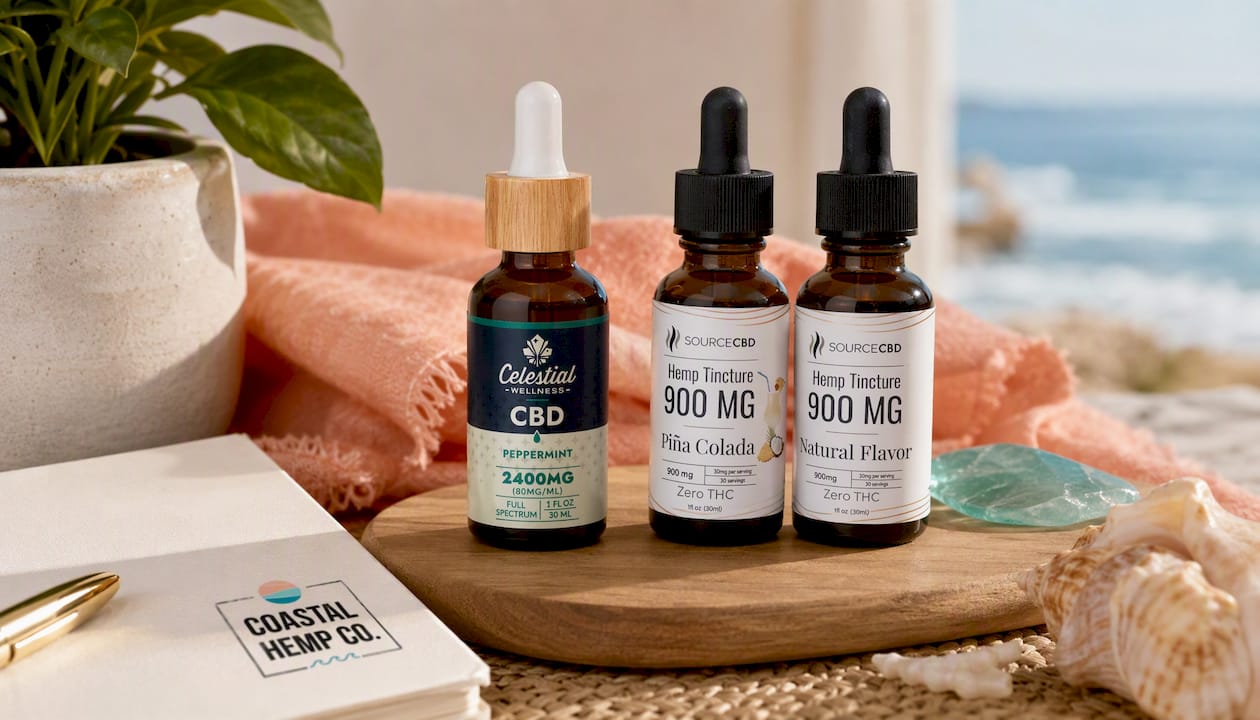
Coastalhemp sources organic full-spectrum and broad-spectrum oils from vetted growers, with COAs available for every product. Three options worth knowing:
- Celestial Wellness Full Spectrum CBD Oil | Organic: A sublingual tincture with a complete cannabinoid profile, third-party tested, and suited for sleep and daily stress support. Serving size and mg per serving are clearly labeled.
- Pina Colada Full Spectrum CBD Oil (Organic): The same full-spectrum formulation in a flavored format for easier daily use. COA available; organic-certified.
- Natural Flavor CBD Oil Organic Broad Spectrum: The THC-free alternative for people subject to drug testing. Third-party verified, organic, and unflavored for flexible use.
Browse the full selection at Coastalhemp and filter by spectrum type to find the right fit for your wellness goals.
Useful sources
- AHPA Hemp Lexicon: The authoritative industry definition of “full-spectrum hemp extract” and guidance on COA verification.
- PubMed — 2018 Farm Bill and CBD regulatory review: For readers who want the regulatory and policy context behind hemp commerce.
- Healthline — Full-Spectrum CBD overview: Accessible clinical overview of product forms, uses, and practitioner perspectives.
- Medical News Today — Types of CBD: Clear side-by-side explanation of full-spectrum, broad-spectrum, and isolate differences.
- Verywell Health — Full-Spectrum vs. other CBD types: Covers the entourage effect and drug-test risk in plain language.
- Coastalhemp THCA product examples guide: Brand-backed resource covering product category breadth and selection guidance.
FAQ
What is a full-spectrum hemp product?
A full-spectrum hemp product contains the complete range of naturally occurring hemp compounds, including cannabinoids, terpenes, and flavonoids, with THC at or below 0.3% per the AHPA definition and the 2018 Farm Bill.
What are common examples of hemp products by form?
Full-spectrum hemp products come in oils and tinctures, gummies, capsules, topicals, vape pens, concentrates, and beverages. Each form differs in onset speed, duration, and best-suited wellness use.
What is the best full-spectrum CBD product for pain management?
Topicals work well for localized discomfort applied directly to the area; oils and capsules are better suited for systemic support. Coastalhemp’s Celestial Wellness Full Spectrum CBD Oil is a third-party tested option for daily use.
What is the difference between full-spectrum, broad-spectrum, and isolate?
Full-spectrum contains trace THC alongside other cannabinoids and terpenes; broad-spectrum removes THC while retaining other compounds; isolate contains only CBD with no other plant material.
Can full-spectrum hemp products cause a positive drug test?
Yes. Trace THC below 0.3% can accumulate with regular use and trigger a positive result on standard drug screens. People subject to testing should use a COA-verified broad-spectrum product instead.


Comments