

Wait 2 Hours: Edible Onset Time and Safe Redosing
Most chewable edibles start working within 45 minutes to 2 hours, with peak effects between 1.5 and 3 hours after that first bite. Sublingual products and lozenges tend to kick in faster, often within 15 to 45 minutes. The rule that matters most: start with a low dose and wait a substantial amount of time before considering more to avoid premature redosing.
TL;DR:
- Onset times for chews range from 45 minutes to 2 hours, but sublingual and fast-acting formulas can produce effects within 15 to 45 minutes.
- Peak effects typically occur between 1.5 and 3 hours, with full effects lasting 4 to 8 hours, and longer for high doses or slow metabolizers.
- Factors like food intake, metabolism, body composition, and product formulation significantly influence how quickly and strongly edibles take effect.
- Delayed onset and impatience often lead to redosing, increasing the risk of overdose and discomfort; patience is the most effective strategy.
- Always wait at least 2 hours before redosing and treat the full 4 to 8 hour window as the safe period for activities like driving.
Table of Contents
- What Is the Typical Timeline for Edible Effects?
- Does the Type of Edible Change How Fast It Works?
- What Factors Change How Fast an Edible Kicks In?
- When Do Edibles Peak, and How Long Do They Last?
- How Should You Dose and Redose Safely?
- How Do You Time Edibles Around Your Schedule?
- Why Trust This Guide?
- What Actually Happens Inside Your Body After You Eat an Edible?
- Are CBD Edibles Faster or Slower Than THC Edibles?
- Why Do Some People React More Strongly to the Same Edible?
- Editorial Perspective: The Wait Is Underrated, and the Dose Chart Is Overrated
- Ready to Match a Product to Your Timing Needs?
- Sources
- FAQ
What Is the Typical Timeline for Edible Effects?
Edible onset time depends on your digestive system doing its job, and that job takes longer than most people expect. Chewable products like gummies and brownies commonly need 45 minutes to 2 hours before you feel anything, according to a 2016 pharmacokinetics review. Some people notice effects closer to the 30-minute mark, especially on an empty stomach, but that’s the early edge of the range, not the average.
Peak effects generally land between 1.5 and 3 hours after ingestion. From there, total duration commonly runs 4 to 8 hours, though heavier doses and certain metabolisms stretch that window further.
Here’s how the typical timeline breaks down:
- Onset: 45 minutes to 2 hours (sometimes as fast as 30 minutes)
- Peak: 1.5 to 3 hours after eating
- Total duration: 4 to 8 hours
- Full clearance of subjective effects: can extend past 8 hours for high doses or slow metabolizers
Pro Tip: If you don’t feel anything at the one hour mark, that’s normal, not a sign the product failed. Resist the urge to take more. The wait is the point.
The same review that supplies these ranges is also the basis for the most common cannabis emergency room story: someone eats a gummy, feels nothing after 45 minutes, eats another, and then gets hit with both doses at once right as the first one finally kicks in. That stacking effect, not the dose itself, is often what turns a manageable experience into an uncomfortable one.
Does the Type of Edible Change How Fast It Works?
Yes, and the difference comes down to how the product enters your bloodstream. Chewable edibles travel through your stomach and liver before THC reaches your brain, which is a slow route. Sublingual products, gummies, and tinctures held under the tongue skip part of that process by absorbing through the mucous membrane, landing in the 15 to 45 minute range according to pharmacokinetic comparisons across administration routes.
Quick comparison by form:
- Sublingual tinctures/lozenges: 15 to 45 minutes onset, partial bypass of liver processing
- Chewable gummies/brownies: 45 minutes to 2 hours, full digestive route
- Fast-acting engineered edibles (nanoemulsion or water-soluble formulas): often 15 to 30 minutes, despite being swallowed
- Inhaled products (for reference, not something Coastalhemp sells): effects within minutes, included here only to show the far end of the speed spectrum
A 2021 study comparing five commercial edible products standardized to the same 10 mg THC dose found time-to-peak plasma THC ranged from 35 to 90 minutes across brands. Same dose, same label, genuinely different timing. That’s formulation engineering at work, not marketing spin.
Pro Tip: Check the label for terms like “nanoemulsion,” “water-soluble,” or “fast-acting” if timing matters for your plans. These formulations are built to shorten onset, and the difference is measurable, not just a claim.
What Factors Change How Fast an Edible Kicks In?
Two people eating the exact same 10 mg gummy can have wildly different experiences, and dose is only part of the story. Food, metabolism, and body chemistry all shift the equation.
Eating a high-fat meal before or alongside an edible increases how much THC your body absorbs, according to research on fed versus fasted THC pharmacokinetics. That’s a real tradeoff: a fatty meal can raise peak intensity while also delaying when that peak arrives, so you get a stronger and slower experience at the same time.
Variables that shift both timing and intensity:
- Dose accuracy: homemade or poorly regulated products can vary from their labeled mg per serving
- Food and fat content: high-fat meals increase absorption but push peak time later
- Liver metabolism: the liver converts THC into 11-hydroxy-THC, a metabolite reported to be more potent at CB1 receptors than THC itself
- Tolerance and body composition: regular users and people with higher body fat often report different intensity curves
- Gut and enzyme differences: individual digestive speed changes when absorption actually happens
Because effects are so individualized, research on oral cannabinoid variability points to a consistent theme: pharmacodynamic effects for doses in the 10 to 50 mg range often don’t show up until 30 to 60 minutes after ingestion, sometimes longer. That’s the scientific backing behind “start low and go slow,” and it’s not a throwaway phrase. It’s the practical output of how unpredictable oral absorption really is.
When Do Edibles Peak, and How Long Do They Last?
Peak effects usually arrive 1.5 to 3 hours after you eat, which is different from onset. Onset is when you first notice something. Peak is when that something is strongest. Confusing the two is a common reason people redose too early, thinking the mild feeling at 45 minutes is as strong as it gets.
Total duration for most chewable edibles runs 4 to 8 hours. Higher doses, slower metabolisms, and the liver’s conversion of THC into 11-hydroxy-THC, described in the same cannabinoid metabolism review referenced earlier, all push that window longer.
Practical markers for when the intensity is genuinely easing off:
- Coordination and reaction time feel closer to normal
- Mental fog has lifted enough that focused conversation feels easy again
- You no longer notice a pull toward the couch or a “heavy” body feeling
- At least 6 to 8 hours have passed since ingestion for anything above a low dose
None of these markers are a substitute for the clock. If you’re unsure, treat the longer end of the duration range as your baseline for resuming driving or other tasks that require full attention.
How Should You Dose and Redose Safely?
Getting the dose right the first time avoids most of the problems people run into with edibles. Clinical guidance on oral cannabinoid variability backs a conservative approach, and public health data on edible-related emergency visits shows why: delayed onset combined with impatient redosing is a recurring pattern behind avoidable ER trips.
Follow these steps in order:
- Start at 2.5 to 5 mg if you’re new to edibles or have low tolerance.
- Take 5 to 10 mg if you’re an experienced adult user who knows how you respond.
- Wait a minimum of 2 hours before even considering more, regardless of how you feel at the 30 or 60 minute mark.
- Wait up to 24 hours before increasing your dose on a product you haven’t tried before, since formulation changes onset speed.
- Read the label carefully to confirm whether the stated mg is per serving or per package. Many products contain multiple servings in one piece.
- If you feel too high, stay hydrated, sit somewhere comfortable, and remember the feeling passes within hours even when it’s uncomfortable in the moment.
- Seek medical help if you experience chest pain, severe confusion, or breathing difficulty. Rare, but worth knowing the line.
Pro Tip: If you’re genuinely unsure whether you’ve waited long enough, the answer is almost always yes, wait longer. The cost of patience is a slightly later high. The cost of impatience is a much stronger one than you planned for.
Avoid driving or operating machinery for the full duration window, not just the peak. Impairment can linger past the point where you feel “back to normal,” particularly at higher doses.
How Do You Time Edibles Around Your Schedule?
Working backward from a target time is simpler than it sounds once you know the ranges. If you want peak effects around 9:00 PM, and peak lands 1.5 to 3 hours after eating, taking your edible between 6:00 and 7:30 PM puts you in range. Build in a buffer, since onset alone can eat up half that window before you feel anything at all.
For daily routines, the no-driving rule applies for the entire duration estimate, not just until you feel the peak fade. That means blocking off 4 to 8 hours if you have anywhere to be.
Microdosing works on a different clock entirely. Instead of chasing a peak, you’re testing your baseline response with 1 to 2.5 mg doses over several days, adjusting slowly based on how you feel rather than how fast you feel it. Coastalhemp’s guide to study session hemp edible options walks through practical serving sizes for exactly this kind of low, steady approach.
- Plan backward from your target time using the 1.5 to 3 hour peak window
- Add a buffer for slower-than-average onset
- Block off the full 4 to 8 hour duration for anything requiring driving or focus
- Titrate microdoses gradually rather than jumping doses day to day
Why Trust This Guide?
This guide comes from Coastalhemp’s John, who covers cannabinoid timing and dosing topics regularly, including a deeper look at avoiding an edible hangover for readers who overshoot their dose. The ranges cited throughout draw on peer-reviewed pharmacokinetic studies measuring actual Tmax and Cmax values in commercial products, not marketing estimates.
A few grounding points worth restating:
- Coastalhemp partners with established growers and brands rather than manufacturing a single house formula, which means product selection spans multiple onset profiles
- Product examples like Wana Fast-Acting THC Gummies and Crumble Scratched Baked Delta-9 Edibles represent two different ends of the timing spectrum discussed in this guide
- Coastalhemp’s metabolism explainer covers the liver conversion process in more depth for readers who want the full digestive breakdown
What Actually Happens Inside Your Body After You Eat an Edible?
Swallowing an edible sets off a multi-step process that explains almost everything about why onset takes so long. THC first has to survive your stomach acid, then move into the small intestine where absorption into the bloodstream actually begins.
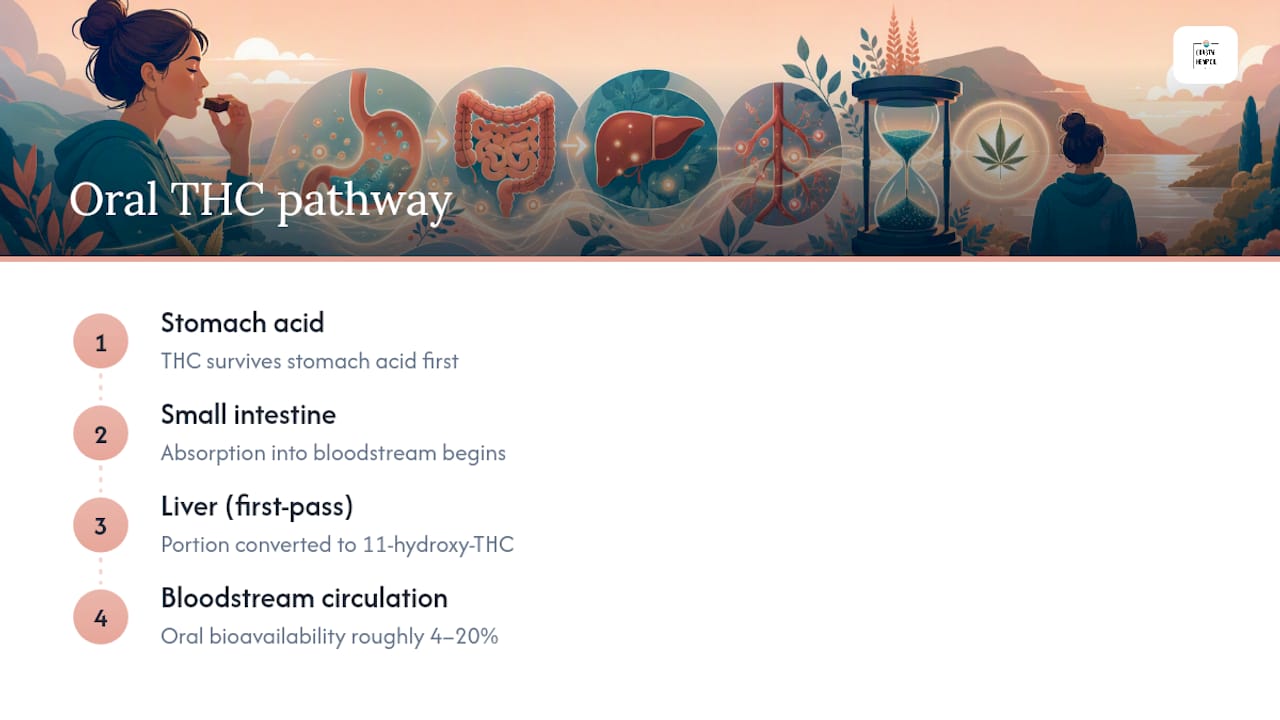
From there, everything absorbed from the gut passes through the liver before reaching general circulation, a step called first-pass metabolism. The liver converts a portion of that THC into 11-hydroxy-THC, the metabolite linked to a stronger, longer psychoactive effect than THC delivers on its own. This is the biological reason edibles feel different from smoking or vaping, not just slower. You’re not experiencing a delayed version of the same high. You’re experiencing a chemically distinct one, built from a metabolite your body only produces when THC goes through digestion first.
Oral bioavailability, meaning how much of the THC you swallow actually makes it into your bloodstream, sits lower and more variable than inhaled routes. Comparative pharmacokinetic research estimates oral bioavailability at roughly 4 to 20 percent, compared to inhalation reaching peak plasma levels within 3 to 10 minutes at higher concentrations. That gap is why the same labeled dose can feel wildly different depending on how it’s consumed, and why patience with edibles isn’t optional advice. It’s a direct consequence of digestion itself.
Are CBD Edibles Faster or Slower Than THC Edibles?
CBD edibles generally follow a similar digestive path to THC edibles, meaning onset times land in a comparable range of 45 minutes to 2 hours for most chewable products. The core absorption mechanics, stomach and intestinal processing followed by liver metabolism, work the same way regardless of which cannabinoid you’re consuming.
The meaningful difference isn’t speed. It’s what you feel once onset happens. THC edibles produce psychoactive effects tied to that 11-hydroxy-THC conversion described earlier, while CBD doesn’t produce intoxication regardless of how it’s metabolized. That means the “wait and see” caution matters less for accidental overconsumption with CBD, since there’s no impairment risk driving the same urgency around redosing.
That said, CBD’s lack of intoxicating effects doesn’t mean dose doesn’t matter. Higher CBD doses can still cause drowsiness or digestive discomfort, and combination products containing both CBD and THC follow THC’s timing and safety rules, since the psychoactive component is what determines your redosing window. If a product blends the two, treat its onset and wait time the same way you would a THC-only edible.
Why Do Some People React More Strongly to the Same Edible?
Genetics play a bigger role in edible strength than most people realize. Variants in the CYP2C9 enzyme, responsible for metabolizing THC in the liver, can slow that conversion process down in a meaningful minority of users, according to comparative pharmacokinetic research on cannabinoid metabolism. People carrying certain CYP2C9 variants, such as the *3 allele, process THC more slowly, which can lead to both stronger peak effects and a longer overall duration compared to someone with typical enzyme function.
This matters practically because it explains a common frustration: two friends eat the same 10 mg gummy, and one feels fine after 4 hours while the other is still noticeably affected at hour 7. That’s not one person being “more sensitive” in some vague sense. It’s a measurable metabolic difference in how fast the liver clears the compound.
There’s no home test that tells you your CYP2C9 status before trying a product, so the practical takeaway is behavioral rather than diagnostic. If you’ve consistently found edibles hit harder or last longer than labels and friends’ experiences suggest, treat that as useful personal data. Start lower than the standard recommendation, and extend your wait time before redosing beyond the usual 2 hours. Your own track record is a better guide than any generic dosing chart once you’ve used edibles enough times to spot a pattern.
Editorial Perspective: The Wait Is Underrated, and the Dose Chart Is Overrated
The dosing chart gets all the attention, but the real lever in this whole topic is patience, not milligrams. Most bad edible experiences aren’t caused by taking too much. They’re caused by taking a reasonable dose, feeling nothing at 45 minutes, and taking more before the first dose has even started working.
Conventional advice loves to hand people a number, 5 mg here, 10 mg there, as if the mg count is the whole story. It isn’t. The pharmacokinetic data makes clear that identical doses behave differently across products, bodies, and meals. That variability means the clock matters as much as the dose, maybe more.
If there’s one thing worth prioritizing over everything else in this guide, it’s building in a real buffer before deciding whether to take more. Set a timer. Walk away from the product. The version of you at the 45 minute mark doesn’t have enough information to make a good decision about redosing, and the version of you at 2 hours does.
— John
Ready to Match a Product to Your Timing Needs?
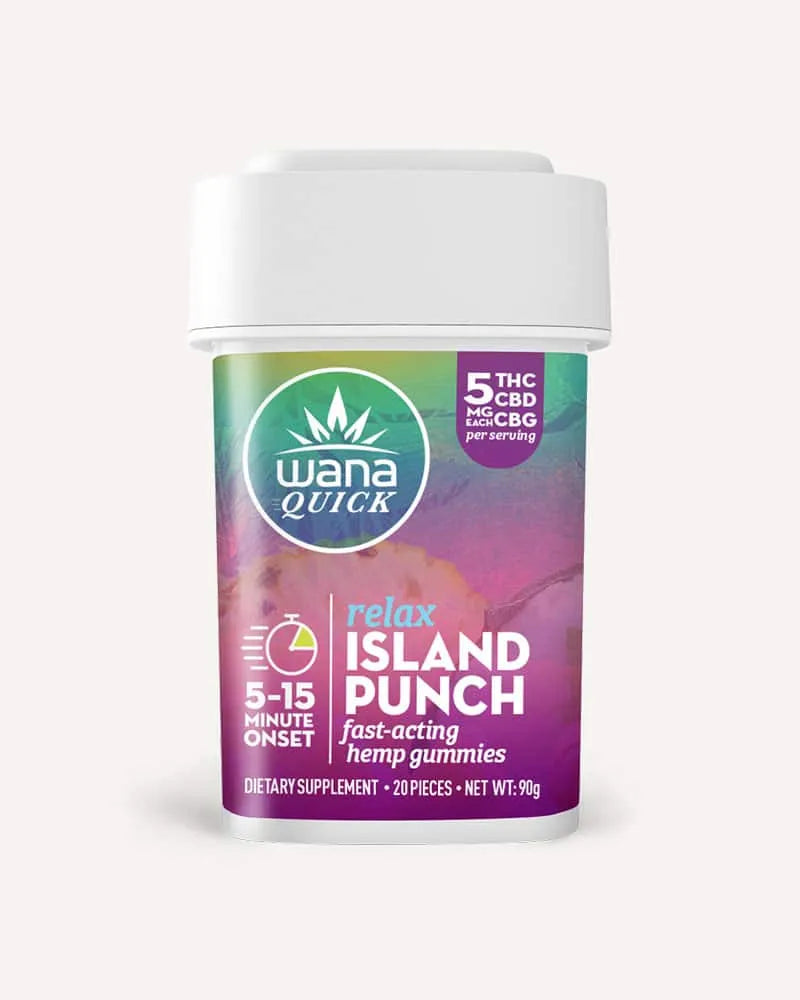
This guide helps you match the right edible to the timing you actually need, instead of guessing off a generic label. If you want a faster path to feeling effects, the Wana Fast-Acting THC Gummies are formulated around the shorter onset window covered above, with a suggested starting serving that still respects the “start low” rule even on a fast-acting product.

If you’re after the more traditional digestive-route experience with a longer, steadier curve, the Crumble Scratched Baked Delta-9 Edibles follow the standard 45 minute to 2 hour onset profile detailed throughout this piece. Both product pages list serving sizes clearly, so you can plan your evening, your redose window, and your wait time before you ever open the package. Browse either product page now and pick the timing profile that fits your plans.
FAQ
How Long Does It Take for an Edible to Start Hitting You?
Most chewable edibles take 45 minutes to 2 hours to produce noticeable effects, while sublingual products and fast-acting formulations can work in 15 to 45 minutes.
How Strong Is a 10 mg Edible Compared to a Joint?
A 10 mg edible dose is generally considered a moderate, full dose for an experienced user, and it tends to feel stronger and longer-lasting than a comparable amount of inhaled THC because of the 11-hydroxy-THC metabolite your liver produces during digestion.
Will a 20 mg Gummy Get Me High?
Yes, 20 mg is above the standard single serving for most new or low-tolerance users and will likely produce a strong, extended effect. It’s roughly double the recommended experienced-user starting range of 5 to 10 mg, so it’s best reserved for those with established tolerance.
How Long Will a 5 mg Edible Last?
A 5 mg dose typically falls within the standard 4 to 8 hour duration range for edibles, though lighter doses often sit toward the shorter end of that window for most people.


Comments