

5 Checks Before Buying Delta 9 in U.S. States in 2026
Federal law allows hemp-derived Delta-9 THC under the 2018 Farm Bill, but whether the gummy in your cart is legal depends entirely on the state you’re standing in. Some states welcome hemp-derived Delta-9 with open shelves, others cap the milligrams or restrict sales to licensed dispensaries, and a handful ban it outright. Before you buy, carry, or ship anything, check your state’s current rules and confirm the product’s lab report backs up its hemp-derived status.
TL;DR:
- States vary widely in their regulation of hemp-derived Delta-9 THC, with some allowing sales freely, others restricting doses, and some banning it outright.
- Federal law considers hemp containing no more than 0.3% Delta-9 THC by dry weight as legal, but this threshold may change if laws shift to total THC measurement.
- Always verify if a product is hemp-derived or marijuana-derived, and check that lab reports show separate THC and THCA levels to ensure compliance.
- Never ship hemp-derived Delta-9 into states that prohibit it, and keep a copy of lab results available when traveling or questioned by authorities.
- Expect increasing regulation moving forward, including stricter dosage caps, more total THC accounting, and tighter retail controls in future legislation.
Table of Contents
- Which States Allow Delta 9 THC?
- How Does Federal Law Affect Delta 9 THC?
- What Should You Check Before Buying or Traveling With Delta 9?
- How Coastalhemp Verifies Compliance and Quality
- Compliant Delta 9 Products Worth Knowing About
- Where Is This Headed Next?
- Sources
- FAQ
Which States Allow Delta 9 THC?
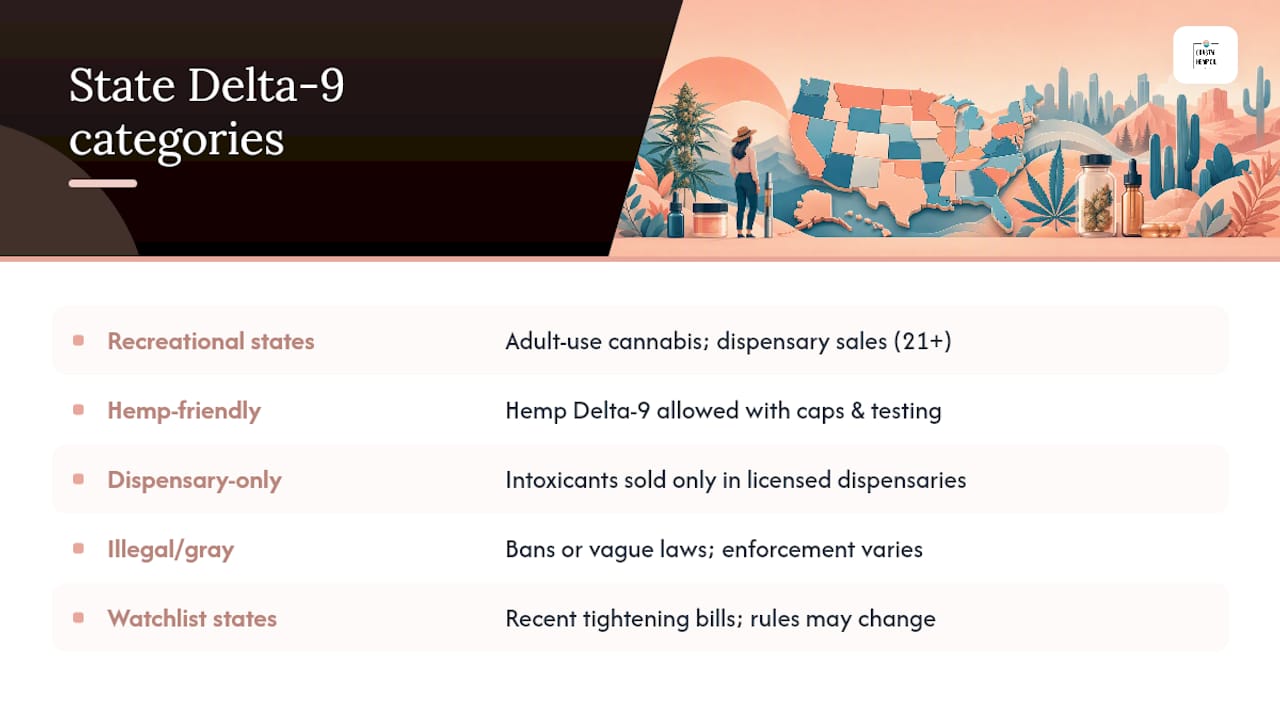
Delta-9 legality in the U.S. sorts into five rough categories, and knowing which bucket your state falls into tells you almost everything you need before you shop. Policy researchers who track hemp regulation across the country describe a genuinely fragmented map. No two states regulate hemp-derived Delta-9 quite the same way.
Recreational marijuana states. States like California, Colorado, Michigan, and Illinois allow adult-use cannabis, which means marijuana-derived Delta-9 is legal through licensed dispensaries, and hemp-derived versions often circulate more freely too. Age limits (usually 21+) and dispensary licensing still apply.
Hemp-friendly states with restrictions. This is the largest and messiest category. States including Texas, Ohio, and Georgia permit hemp-derived Delta-9 edibles and beverages but layer on their own guardrails: milligram caps per serving or container, age verification at checkout, and testing requirements that flag total THC content rather than delta-9 alone.
Heavily restricted or dispensary-only states. A few states, including parts of the Northeast, funnel all intoxicating cannabinoids, hemp-derived or not, through the licensed dispensary system. New York is the clearest example: hemp-derived Delta-9 products sold outside licensed cannabis retailers face aggressive enforcement even though the same compound is legal a few states over on an open shelf.
Illegal or mixed-enforcement states. States like Idaho and parts of the Deep South either ban intoxicating hemp products outright or leave the statute vague enough that retailers operate in a gray zone. Some of these states specifically outlaw “artificially derived” or chemically converted cannabinoids, a category that can sweep in certain Delta-9 conversion processes even when the starting material was legal hemp.
A few states deserve a second look regardless of which bucket they’ve historically sat in. Legislatures in Texas, Louisiana, and Tennessee have all introduced or passed hemp-tightening bills in recent sessions, and enforcement priorities shift faster than most retailers update their shipping policies. If your state passed hemp legislation in the last year, don’t rely on last year’s blog post. Pull up the actual state statute or call the regulator’s office directly.
How Does Federal Law Affect Delta 9 THC?
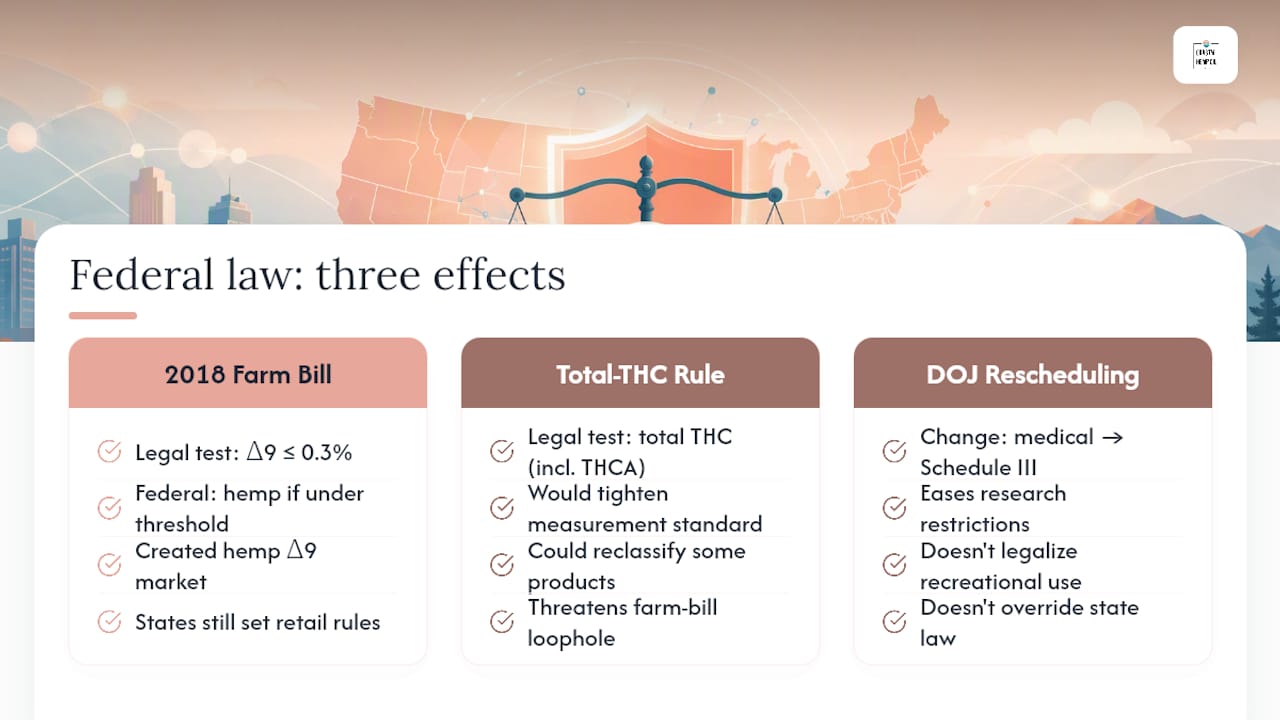
The 2018 Farm Bill defined hemp as cannabis containing no more than 0.3% Delta-9 THC by dry weight. Anything under that line counts as legal hemp at the federal level; anything over it counts as marijuana, a Schedule I substance in states without legalization. That single number created the entire hemp-derived Delta-9 industry, from vape cartridges to seltzers.
Manufacturers realized they could formulate potent edibles and beverages that stayed under the delta-9 threshold while packing in other cannabinoids, a workaround commonly called the “farm bill loophole.” Congressional Research Service materials document a real legislative push to close that gap by counting total THC, including THCA, instead of delta-9 alone. Watch for a shift toward total-THC accounting rather than delta-9-only measurement as the rule that could redefine which products stay legal, since a product perfectly fine under the 2018 standard might fail a stricter total-THC test.
Federal rescheduling adds another layer of confusion people misread constantly. DOJ’s move to reschedule medical marijuana to Schedule III in April 2026 eases research restrictions, but it does not legalize recreational hemp THC nationwide and it doesn’t override any state’s retail rules. State statutes still decide what you can buy and where.
What Should You Check Before Buying or Traveling With Delta 9?
Run through this before any purchase, especially if the product is crossing state lines:
- Confirm the source. Is the product hemp-derived (federally legal baseline) or marijuana-derived (state-legal-only)? The label should say plainly.
- Pull the Certificate of Analysis (COA). A legitimate seller posts lab results showing total THC, delta-9 content, and THCA separately, not lumped together.
- Check your state’s milligram caps. Some states cap servings at 5mg, others allow much higher doses through licensed channels only.
- Look at the retail channel. Regulators often permit intoxicating cannabinoids through licensed dispensaries while banning identical products in gas stations or smoke shops, so the same gummy can be legal in one store and not the next.
- Never ship into a banned state. Mailing hemp-derived Delta-9 into a state that bans it exposes both buyer and seller to real legal risk, regardless of how the product was legally purchased.
Pro Tip: Save a screenshot of the product’s COA to your phone before you travel. If a border agent, TSA officer, or curious state trooper asks questions, showing lab documentation on the spot beats trying to explain the Farm Bill from memory.
When a state’s language is ambiguous, a quick call to the state’s cannabis or hemp regulatory office settles more questions than an hour of forum reading. For situations with real financial or legal stakes, loop in local counsel before you buy in bulk. Our guide on flying with Delta-9 breaks down the airport-specific side of this in more detail.
How Coastalhemp Verifies Compliance and Quality
Coastalhemp works with vetted growers and brands rather than sourcing wherever is cheapest, and every product listed goes through the same basic quality filter before it reaches the shelf. Our team, led by author John, treats lab documentation as non-negotiable, not optional marketing.
Here’s what gets checked before a product earns a spot in our catalog:
- Current COA confirming hemp-derived origin and dry-weight delta-9 percentage
- Milligram-per-serving accuracy matching the label
- Child-resistant packaging where state law requires it
- Labeling that states total THC and delta-9 content separately, not blended into a vague “cannabinoid blend” figure
For a deeper explainer on how hemp-derived Delta-9 differs from marijuana-derived THC and non-intoxicating CBD, read our guide to hemp-derived Delta-9 THC.
Compliant Delta 9 Products Worth Knowing About
Not every Delta-9 product fits every situation, and dosage matters as much as legality. If you’re easing in for the first time or just want something snack-sized, the Hometown Hero Delta 9 Cereal Bites deliver a microdose format that’s easy to portion and track.
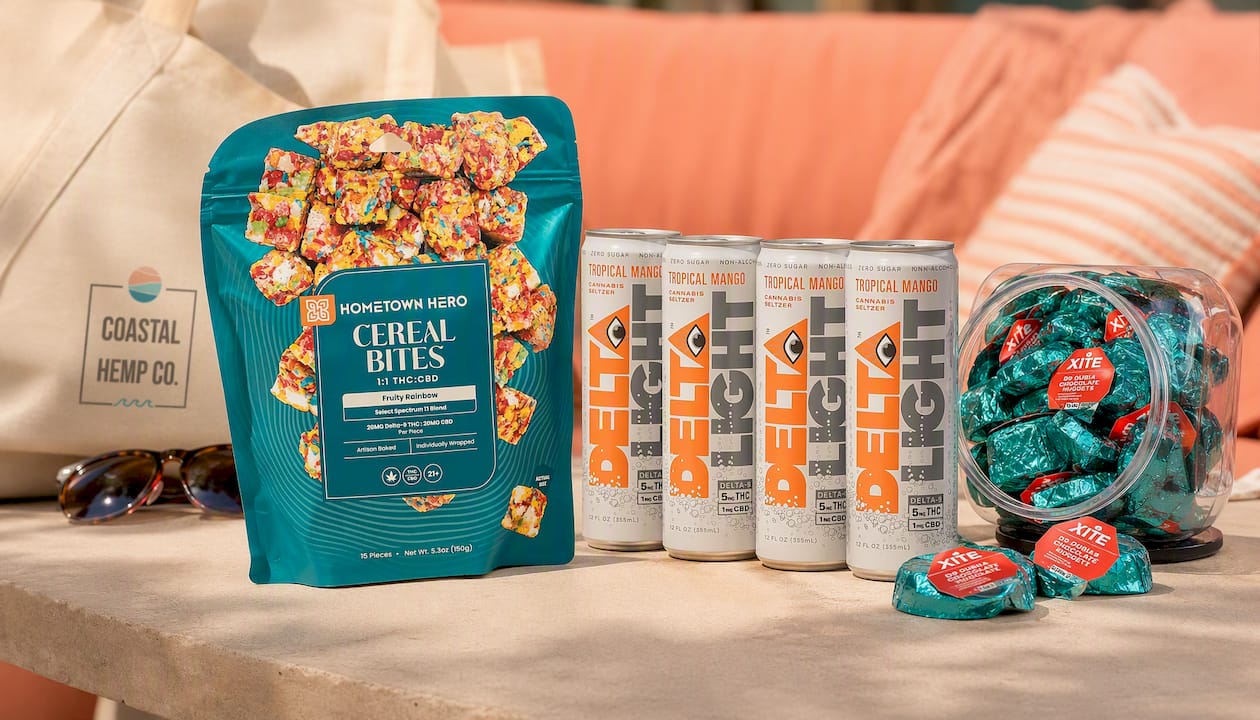
Prefer something you sip rather than chew? The Delta LIGHT Seltzer comes in at 5mg THC per can, a dose that aligns with the lower milligram limits that some hemp-friendly states have established. It’s the kind of low-dose beverage that’s easier to stay compliant with no matter where a state’s cap sits.
For readers who’ve built up some tolerance and want a stronger option, the Xite D9 Dubia Chocolate Nuggets pack a notably higher dose per serving. It’s important to check your state’s per-serving cap before ordering, as some hemp-friendly states set limits below this level.
Every one of these products ships with lab documentation available on request, but lab reports don’t override state law. Confirm your state’s current rules before you check out, especially if you’re having it delivered somewhere other than home. Ready to see what fits your state and your dose preference? Browse the full Delta-9 THC collection and check the COA on any product before adding it to your cart.
Where Is This Headed Next?
The trend line points toward tighter, not looser, regulation. Expect more states to adopt total-THC accounting instead of delta-9-only math, more milligram caps written into statute, and slow consolidation of intoxicating hemp sales into licensed retail channels in states that currently allow open sales.
The practical takeaway hasn’t changed: verify your state’s current rules before buying, keep a copy of the lab report, and never ship a hemp-derived product into a state that bans it. Rules shift fast enough that “legal last year” isn’t good enough. Check the official state source before you act.
— John
Sources
- Mapping Hemp Products’ Legal Status Across US States — Baker Institute
- Changes to the Statutory Definition of Hemp and Issues for Congress — CRS
- Public Law 115-334 (2018 Farm Bill)
- MPP: DOJ reschedules medical marijuana to Schedule III — questions and answers
FAQ
Is Delta 9 THC Legal in All 50 States?
No.
What’s the Difference Between Hemp-Derived and Marijuana-Derived Delta 9?
Hemp-derived Delta-9 comes from cannabis plants with 0.3% or less delta-9 THC by dry weight, making it federally legal under the 2018 Farm Bill; marijuana-derived Delta-9 comes from plants above that threshold and is legal only in states with medical or recreational marijuana programs.
Can I Travel Across State Lines With Delta 9 Products?
You can in many cases, but only if the product is genuinely hemp-derived and your destination state doesn’t ban it; carrying a marijuana-derived product across state lines, or any product into a state that restricts converted cannabinoids, carries real legal risk.
Does the 2026 Federal Rescheduling Change Delta 9 Legality?
Not directly. Rescheduling medical marijuana to Schedule III reduces research barriers but doesn’t legalize recreational hemp THC nationwide or override any state’s existing retail rules.
How Do I Know If a Delta 9 Product Is Lab Tested?
Look for a Certificate of Analysis (COA) from a third-party lab showing separate figures for total THC, delta-9, and THCA. Some brands post this documentation for every product rather than a generic “tested” claim.


Comments