

Hemp Mood Regulation: What It Is and How It Works
Hemp mood regulation is the process by which cannabidiol (CBD), the primary non-intoxicating compound in hemp, modulates anxiety and emotional balance through interactions with the body’s endocannabinoid system and related neurochemical receptors. CBD does not produce the high associated with marijuana because hemp contains no more than 0.3% delta-9 THC by federal law. This distinction matters enormously for anyone exploring natural approaches to emotional well-being. The science behind hemp for mood support has advanced considerably, with clinical trials now offering clearer evidence on what CBD can and cannot do for your mental health.
What is hemp mood regulation and how does CBD work biologically?
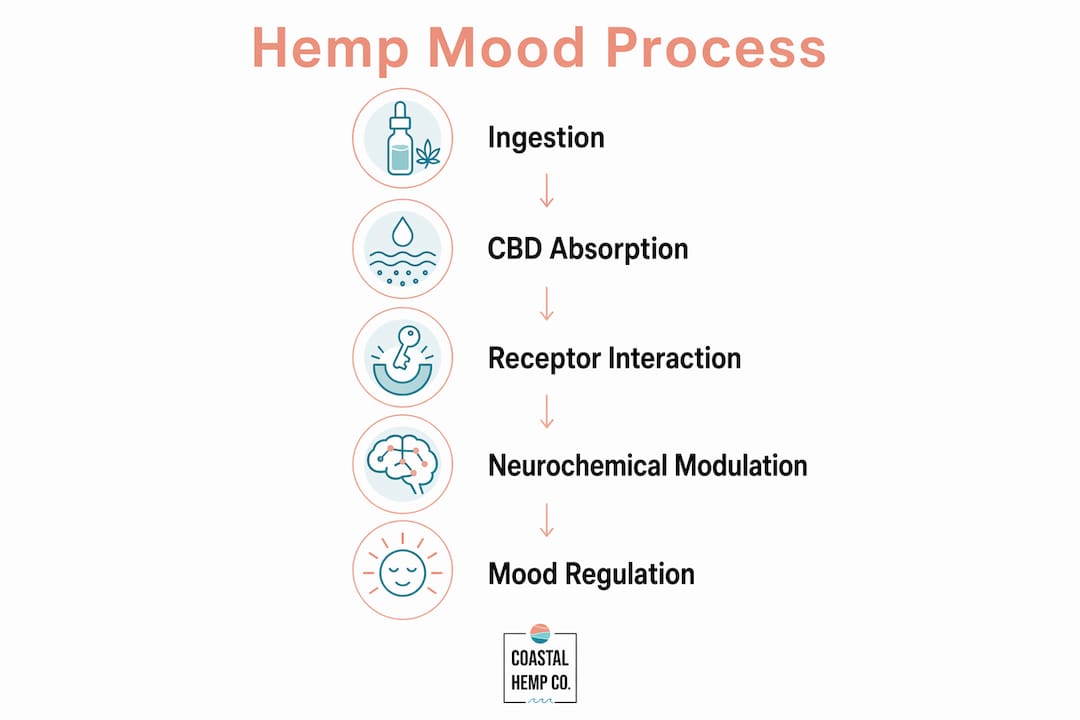
CBD regulates mood through multiple receptor pathways, not a single “mood switch.” CBD acts on serotonin receptors and G-protein-coupled receptors, creating a network of neurochemical effects that influence how you feel, respond to stress, and process anxiety. This multi-pathway action is why CBD’s effects feel different from pharmaceutical antidepressants, which typically target one neurotransmitter system.

The endocannabinoid system (ECS) is the body’s internal regulatory network for mood, sleep, appetite, and stress response. CBD does not bind directly to the ECS’s primary receptors (CB1 and CB2) the way THC does. Instead, it modulates them indirectly, which is why it supports emotional balance without causing intoxication. Think of it as fine-tuning rather than overriding your brain’s natural chemistry.
CBD also affects GABA, the brain’s primary calming neurotransmitter, and modulates cortisol and insulin levels tied to stress response. Lower cortisol means a reduced physiological stress reaction. That hormonal effect helps explain why people using hemp-derived CBD often report feeling less reactive to daily stressors, not just calmer in the moment.
- Serotonin receptor activation: CBD activates 5-HT1A receptors, the same target as many anti-anxiety medications, without the dependency risk.
- GABA modulation: CBD increases GABAergic activity, reducing neural excitability linked to anxious thought patterns.
- Cortisol reduction: CBD’s influence on cortisol levels supports a calmer stress response over time.
- Endocannabinoid tone: CBD slows the breakdown of anandamide, a naturally occurring mood-stabilizing compound in the body.
Pro Tip: If you want to understand how hemp calming effects translate into real-world outcomes, the science behind hemp’s calming properties breaks down these mechanisms in plain language.
What does the evidence say about hemp for anxiety and mood disorders?
The clinical evidence for CBD in anxiety relief is stronger than for depression. A meta-analysis of 8 studies with 316 participants found significant anxiety reduction with a Hedges’ g of -0.92, which represents a large effect size in clinical terms. That number puts CBD’s anxiety impact in the same category as many first-line treatments, though the research base is still smaller.
A 6-week pilot study with 12 moderate-anxiety patients taking 30 mg daily of hemp-derived CBD reported significant improvements in anxiety, mood, sleep quality, and overall quality of life, with minimal side effects. The open-label design limits how broadly the results apply, but the consistency of outcomes across participants is notable. Thirty milligrams twice daily appears to be a practical starting benchmark based on current pilot data.
A separate randomized trial of 33 PTSD patients found that 300 mg CBD improved mood scores on the Visual Analogue Mood Scale compared to placebo after just 3 days. Anxiety symptoms in that trial showed no significant difference, which illustrates an important point: CBD’s effects on mood and anxiety do not always move together. The mechanism for acute mood improvement may differ from the mechanism for sustained anxiety relief.
| Condition | Evidence Strength | Key Finding |
|---|---|---|
| Generalized anxiety | Strong | Large effect size (Hedges’ g = -0.92) across 8 studies |
| PTSD-related mood | Moderate | 300 mg CBD improved mood scores vs. placebo in 3 days |
| Major depressive disorder | Limited | No consistent clinical evidence of effectiveness |
| Sleep and quality of life | Emerging | Improvements reported alongside anxiety reduction in pilot data |
The evidence clearly favors hemp CBD for anxiety relief over depression treatment. Practitioners who work with CBD consistently note that hemp’s benefits for anxiety are the most clinically supported, while its role in depression remains unproven. Setting realistic expectations based on this evidence protects you from disappointment and helps you use hemp products appropriately.
How does hemp mood regulation differ from marijuana’s effects?
Hemp and marijuana come from the same plant species but produce very different effects on emotional health. The legal and chemical dividing line is THC content. Hemp contains 0.3% or less delta-9 THC under the 2018 Farm Bill. Marijuana contains significantly higher THC levels, which produce intoxication and, in frequent users, can actively worsen emotional regulation.
Frequent high-THC cannabis use disrupts emotional regulation, increasing the risk of anxiety, paranoia, and mood instability. Hemp’s low-THC, high-CBD profile avoids these risks. This is not a minor distinction. For people already managing anxiety or mood sensitivity, high-THC products can trigger or amplify the very symptoms they are trying to address.
Pro Tip: If you are new to hemp and want a clear breakdown of why hemp alternatives feel less intense than THC-dominant products, that resource explains the pharmacology in accessible terms.
CBD and THC interact with the ECS in opposite ways. THC binds directly to CB1 receptors in the brain, producing euphoria but also anxiety at higher doses. CBD modulates those same receptors without binding directly, which is why it does not produce a high and does not carry the same risk of emotion dysregulation. For mood support specifically, that difference is the entire argument for choosing hemp over marijuana.
Consumers sometimes assume that more THC means stronger mood benefits. The research says the opposite. High-THC cannabis products can worsen emotion dysregulation, particularly with regular use. Hemp-derived CBD, by contrast, supports a calmer emotional baseline without the volatility that high-THC exposure can introduce.
What should you know before using hemp products for mood support?
Product selection determines how much of CBD’s mood-regulating potential you actually access. Full-spectrum hemp extracts contain CBD alongside minor cannabinoids, terpenes, and trace THC (within legal limits), which work together in what researchers call the entourage effect. Broad-spectrum products remove THC while retaining other cannabinoids. Isolates contain CBD alone. Understanding the differences between CBD spectrum types helps you match the product to your specific needs and sensitivities.
Dosage consistency is the most overlooked factor in hemp mood support. Mood benefits require standardized twice-daily dosing over weeks, not occasional use. Sporadic or low-dose use rarely replicates the outcomes seen in clinical trials. If you try hemp CBD for two days and feel nothing, the issue is almost certainly dosage discipline, not the compound itself.
- Start with a consistent dose: 25–30 mg daily is a reasonable starting point based on pilot trial data. Adjust gradually based on your response.
- Choose third-party tested products: Certificate of Analysis (COA) documents from independent labs confirm actual CBD content and verify THC levels stay within legal limits.
- Give it time: Clinical improvements in anxiety and mood typically emerge after several weeks of consistent use, not days.
- Avoid high-THC products for mood: Products marketed for recreational use often contain THC levels that can increase anxiety rather than reduce it.
- Pair with other wellness practices: Hemp CBD works best alongside sleep hygiene, regular movement, and stress management, not as a standalone fix.
One underappreciated risk: hemp-derived products that contain minor cannabinoids can convert to psychoactive compounds when heated. If you are vaping or cooking with hemp extracts, choose products specifically formulated for those uses and verify the cannabinoid profile on the COA. For straightforward mood support, oils and gummies are the most predictable delivery formats.
Key Takeaways
Hemp CBD regulates mood through multiple neurochemical pathways, with the strongest clinical evidence supporting anxiety relief rather than depression treatment.
| Point | Details |
|---|---|
| CBD’s mechanism is multi-pathway | CBD acts on serotonin, GABA, and cortisol systems, not a single receptor. |
| Anxiety evidence is strong | A meta-analysis of 316 participants showed a large effect size for anxiety reduction. |
| Depression evidence is limited | No consistent clinical data supports CBD as a treatment for major depressive disorder. |
| Dosage consistency matters | Twice-daily dosing over several weeks produces outcomes that sporadic use cannot replicate. |
| Hemp differs legally from marijuana | Federal law caps hemp at 0.3% THC; higher THC levels increase the risk of emotion dysregulation. |
What I’ve learned from watching hemp mood research evolve
The most common mistake I see is people treating hemp CBD as a fast-acting mood fix. That expectation sets them up to quit before the compound has had time to work. The clinical data is clear: benefits emerge over weeks of consistent use, not after a single dose. The people who report the strongest outcomes are the ones who treat CBD like a daily supplement, not a rescue remedy.
What genuinely surprises me about the research is how specific the evidence is. CBD shows real, measurable effects on anxiety. The effect size in the meta-analysis is not marginal. But the evidence for depression is almost nonexistent at the clinical level. That gap matters. If you are managing depression, hemp CBD is not a substitute for professional care. If anxiety is your primary concern, the science gives you a reasonable basis for trying it.
The hemp versus marijuana confusion still causes real harm. People try a high-THC product, feel worse, and conclude that “cannabis doesn’t work for mood.” That conclusion is wrong, but it is understandable given how poorly the distinction is communicated in most retail environments. Hemp’s value for emotional wellness depends entirely on keeping THC exposure low. The best CBD options for anxiety are the ones that prioritize CBD concentration and verified THC limits, not the ones with the most aggressive marketing.
My honest advice: start with a full-spectrum or broad-spectrum oil, commit to a consistent daily dose for at least four weeks, and track your anxiety and sleep alongside your mood. You will have real data to work with instead of guesswork.
— John
Coastalhemp’s picks for natural mood and stress support
Coastalhemp carries a curated selection of hemp products built specifically for mood and stress relief, sourced from trusted growers and tested for quality.
The Enjoy De-Stress Gummies combine CBD, CBG, and functional mushrooms in a single daily format designed for stress relief and emotional balance. For those who prefer oils, the SourceCBD Mellow Mint CBD Oil delivers organic broad-spectrum CBD in a clean, easy-to-dose format. The CBD + CBG Full-Spectrum Oil adds CBG to the mix, a cannabinoid with its own emerging evidence for mood support. All products stay within the federal 0.3% THC limit and come with third-party lab verification.
FAQ
What is hemp mood regulation?
Hemp mood regulation is the process by which CBD, the primary cannabinoid in hemp, influences anxiety and emotional balance through the endocannabinoid system, serotonin receptors, and cortisol pathways. It does not produce intoxication because hemp contains 0.3% THC or less by federal law.
Can hemp CBD actually improve mood?
Clinical evidence shows CBD reduces anxiety symptoms significantly and can improve mood in PTSD patients, but evidence for treating major depressive disorder remains limited. Consistent daily dosing over several weeks produces the best outcomes.
How long does hemp take to support mood?
A 6-week pilot study using 30 mg daily CBD showed meaningful improvements in anxiety and mood. Most clinical data suggests at least four to six weeks of consistent use before evaluating results.
Is hemp safe for anxiety relief without getting high?
Hemp-derived CBD is non-intoxicating and does not carry the anxiety-provoking risks associated with high-THC cannabis. High-THC products disrupt emotional regulation, while hemp’s low-THC profile makes it a safer option for mood support.
What is the difference between full-spectrum and broad-spectrum hemp for mood?
Full-spectrum hemp retains trace THC alongside CBD and other cannabinoids, supporting the entourage effect. Broad-spectrum removes THC while keeping other cannabinoids. Both formats outperform CBD isolate for mood support based on current understanding of how cannabinoids work together.


Comments