

How Hemp Topicals Work for Localized Relief and Skin Benefits
Yes, hemp topicals work, and they work locally rather than throughout your entire body. When formulated correctly, cannabinoids like CBD interact with the skin’s own cannabinoid system, easing inflammation and discomfort at the site where you apply them.
- Your skin runs its own “cutannabinoid” network, separate from the receptors that trigger a high.
- Small clinical trials and observational studies show measurable improvements in skin conditions, though larger studies are still needed.
- Formulation, not the milligram number on the label, tends to decide whether a product actually delivers.
Key Takeaways
Hemp topicals relieve localized discomfort by engaging the skin’s own cannabinoid receptors and inflammatory pathways, with formulation quality determining how well that mechanism actually plays out.
| Point | Details |
|---|---|
| Local, not systemic | Standard topicals act on skin receptors and rarely produce a high or reach the bloodstream in meaningful amounts. |
| Mechanism is real but evolving | CB1/CB2, TRPV, and NF-κB/MAPK pathways explain the effect, but human trials are still small. |
| Formulation beats milligrams | Carrier oils, terpenes, and delivery tech affect results more than the number printed on the label. |
| Consistency matters | Anti-inflammatory benefits often build over days to weeks of regular use, not a single application. |
| Coastalhemp offers vetted options | Products like the Organic CBD Balm and Celestial Wellness Relief Salve include lab-verified COAs for transparency. |
This article is general information, not a substitute for advice from a qualified doctor. Consult a qualified healthcare professional about your own circumstances before acting on anything here.
Table of Contents
- What Are Hemp Topicals, and What Forms Do They Come In?
- How Do Hemp Topicals Work at the Skin Level?
- Topical vs. Transdermal: Which One Actually Reaches Your Bloodstream?
- Why Do Carrier Ingredients Matter So Much in Hemp Formulations?
- Does a High Milligram Count Actually Mean a Better Product?
- What Does the Clinical Evidence Actually Show?
- How Should You Apply Hemp Topicals for the Best Results?
- What Are the Risks and Who Should Be Cautious?
- Which Coastalhemp Topicals Fit These Use Cases?
- Sources
- FAQ
What Are Hemp Topicals, and What Forms Do They Come In?
Hemp topicals are products applied directly to skin for localized effect rather than swallowed or inhaled. That distinction matters for how, and how fast, they act.
You’ll find them in several formats, each built for a slightly different job:
- Balms and salves: thick, oil-based, good for targeted spots like joints or sore muscles.
- Creams and lotions: lighter, water-blended, easier to spread over larger areas.
- Gels: often water-based with a cooling or warming sensation layered in.
- Transdermal patches: designed to push cannabinoids past the skin into your bloodstream over hours.
- Bath oils and soaks: dispersed across the skin’s surface, more diffuse in effect.
Balms, salves, creams, and gels are built for local action. Patches are the outlier. They’re engineered for systemic delivery, which we’ll get into shortly.
How Do Hemp Topicals Work at the Skin Level?
Your skin isn’t just a barrier. It’s an active, signaling organ with its own local cannabinoid system, sometimes called the “cutannabinoid” system, that helps regulate everything from oil production to inflammation and wound repair. Research on cannabinoid signaling in skin shows that when this system falls out of balance, conditions like acne, psoriasis, and atopic dermatitis tend to follow.
Phytocannabinoids like CBD interact with several receptor families in the skin. CB1 and CB2 receptors help modulate immune response and inflammation. TRPV channels, the same family involved in sensing heat and pain, respond to cannabinoids in ways that can ease discomfort. PPARs influence sebum production and cellular differentiation, which is part of why CBD gets attention for acne-prone skin.
At the molecular level, cannabinoids appear to dial down activity in the NF-κB and MAPK pathways. These are the signaling routes your cells use to ramp up inflammation. Suppressing them can mean fewer pro-inflammatory cytokines circulating in irritated tissue.
Here’s the important caveat: this mechanistic picture is well-supported in preclinical and in vitro research, but human clinical trials confirming these exact pathways in living skin are still catching up. The biology is convincing. The clinical proof is still being built.
- CB1/CB2 receptors: immune and inflammatory modulation
- TRPV channels: pain and sensation signaling
- PPARs: sebum regulation and cell turnover
- NF-κB/MAPK suppression: reduced inflammatory signaling
Topical vs. Transdermal: Which One Actually Reaches Your Bloodstream?
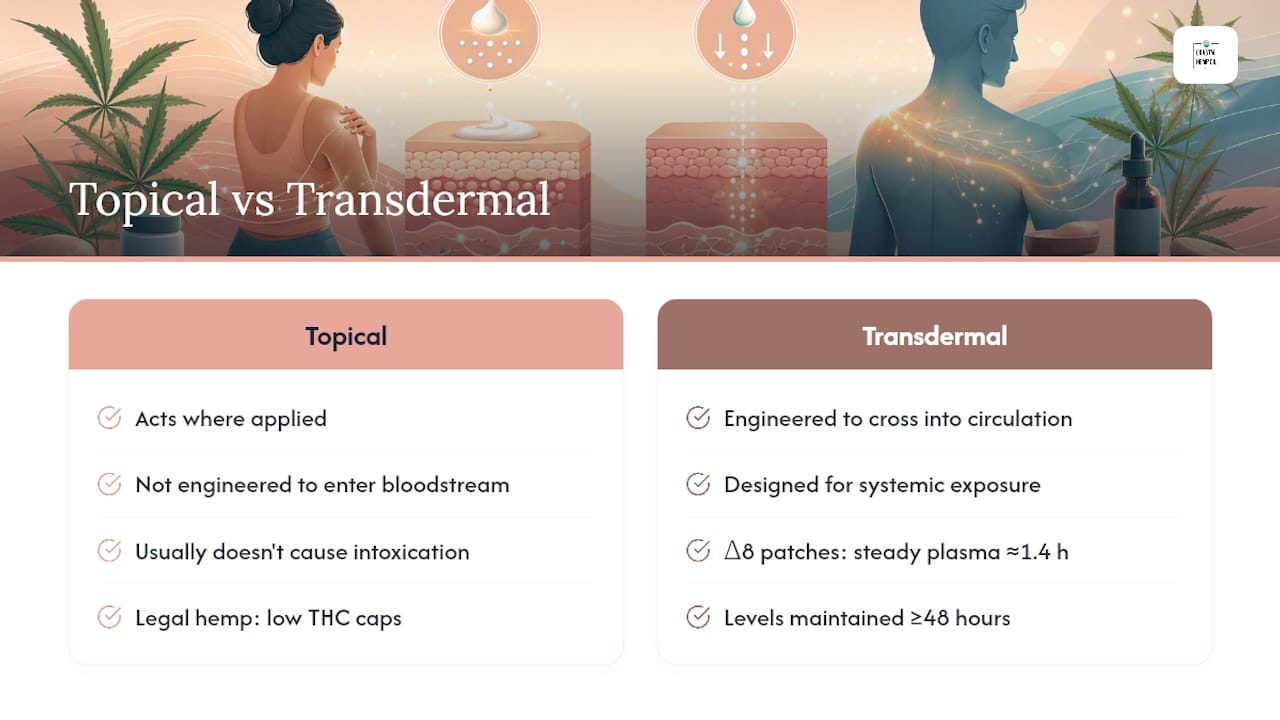
A topical product acts where you put it. A transdermal product is engineered to cross through skin layers into circulation, producing effects elsewhere in the body. That’s the whole difference, and it changes what you should expect.
Several factors determine how far a cannabinoid travels once it hits your skin: the formulation itself, whether penetration enhancers are included, and the molecule’s own lipophilicity and weight. Cannabinoids are fat-loving and don’t dissolve well in water, which is exactly why delivery researchers have to work so hard on carrier systems.
Do topical CBD or THC products get you high? Usually not. A well-formulated balm or cream applied to skin isn’t designed to reach the bloodstream in meaningful amounts, and legal hemp topicals are capped at low THC levels anyway. Transdermal patches are the exception. Some Δ8-THC patch formulations have reached steady plasma concentrations within about 1.4 hours and held those levels for at least 48 hours, according to transdermal delivery research, which is a genuinely different exposure profile than rubbing on a salve.
Pro Tip: If a label mentions “systemic,” “patch,” or lists specific penetration enhancers, that product is built to enter your bloodstream, not just soothe the surface. Read the intended use before you buy.
Why Do Carrier Ingredients Matter So Much in Hemp Formulations?
The cannabinoid itself is only half the story. Cannabinoids are highly lipophilic, meaning they dissolve readily in fats and oils but resist water, and manufacturers have to design around that.
Common carrier systems include:
- Oil-based salves: simple, but prone to oxidation over time if not stabilized.
- Water-in-oil and oil-in-water emulsions: blend both worlds for better skin feel and spreadability.
- Hydrogels: water-based, cooling, often used for lighter daily application.
- Nanoemulsions and liposomal systems: shrink cannabinoid particles down for deeper, more consistent skin penetration.
Formulation science reviews show these delivery systems genuinely change how much cannabinoid reaches target tissue and how long it stays active there. On a label, look for named carrier oils, any mention of nanoemulsion or liposomal technology, and clarity around what penetration enhancers, if any, are included.
Does a High Milligram Count Actually Mean a Better Product?
Not necessarily. A tube boasting 1,000mg of CBD means little if the formulation can’t get that cannabinoid into skin tissue where it can act. Product quality research suggests that extract type, carrier choice, and the presence of supporting terpenes often matter more for real-world results than the number on the front of the package.
A few label cues are worth checking before the milligram count:
- Full-spectrum or broad-spectrum extract versus an isolate
- Named carrier oils and any stability or delivery technology
- Terpene content, which can influence both feel and effect
- A current third-party Certificate of Analysis (COA)
- Batch number and expiration date
Hemp-derived topicals in the United States generally fall under the 2018 Farm Bill framework when Δ9-THC stays below 0.3% by dry weight, but these products aren’t FDA-approved. A verified COA is the only real way to confirm what’s actually in the jar.
What Does the Clinical Evidence Actually Show?
The research is promising, not settled. In one observational study on eczema, a topical CBD gel dropped patient-reported severity scores from 16 down to 8.1, a statistically significant shift according to research on cannabinoids and skin disease. Separate small trials have reported improvements in transepidermal water loss and clinical severity scores for atopic dermatitis using CBD ointments.
Mechanistic lab studies back this up at the cellular level, showing cannabinoids can dial down NF-κB and MAPK inflammatory signaling and modulate TRPV channel activity tied to itch and pain sensation.
Where the evidence gets thinner is scale. Most human studies here are small, several are observational rather than randomized, and dermatology researchers still call for larger randomized controlled trials before drawing firm conclusions. Notably, surveys of dermatologists show many are already open to recommending topical cannabinoid formulations, largely because the risk of psychoactive effects is so much lower than with systemic products.
- Eczema severity score improved from 16 to 8.1 in one observational study (p < 0.001)
- Mechanistic support is strong in lab studies; human trial sizes remain small
- Regulatory oversight is inconsistent, making third-party testing essential
How Should You Apply Hemp Topicals for the Best Results?
Start with clean skin. A light exfoliation beforehand can help if the area allows it, since removing dead skin cells gives the product a more direct path to living tissue. Apply a thin, even layer and rub it in until it’s absorbed rather than sitting on the surface.
What you feel first, often a cooling or warming sensation, isn’t the cannabinoid working yet. That’s usually a menthol or capsaicin-style ingredient doing its job instantly. The deeper anti-inflammatory effects tend to build over days to weeks of consistent use, as local skin biochemistry gradually shifts.
Follow the product’s stated frequency, and resist the urge to overapply just because relief feels slow at first. Daily, consistent use tends to outperform occasional heavy applications.
Pro Tip: Apply before activity if you want a warming sensation during movement, and after activity if you’re targeting post-exercise soreness. Always patch-test a new product on a small area first and stop immediately if you notice irritation.
What Are the Risks and Who Should Be Cautious?
The most common issues are skin irritation, allergic reaction, and photosensitivity, particularly with products containing added essential oils. Patch-testing before broader use catches most of these early.
Topical use rarely causes systemic drug interactions since so little reaches the bloodstream. Transdermal patches are a different story. If you’re on blood thinners like warfarin or other systemic medications, talk to a clinician before using any product engineered for systemic absorption.
- Patch-test new products on a small skin area for 24 hours before wider use
- Consult a clinician before use if pregnant, breastfeeding, or treating a child
- Stop immediately and seek medical attention for severe rash or systemic symptoms
Pregnancy, breastfeeding, and pediatric use all warrant a conversation with a healthcare provider first. Hemp topicals aren’t automatically risk-free just because they’re applied to skin rather than swallowed.
A publisher’s note on realistic expectations
The goal here was to explain mechanisms honestly, not oversell them. Coastalhemp exists to connect people with vetted, tested topical options and the education to use them well.
Which Coastalhemp Topicals Fit These Use Cases?
If you’re dealing with sore joints, tight muscles, or skin that needs calming rather than covering up, formulation is what separates a product that works from one that just smells nice. Coastalhemp’s lineup was built with exactly that mechanism-first approach in mind.
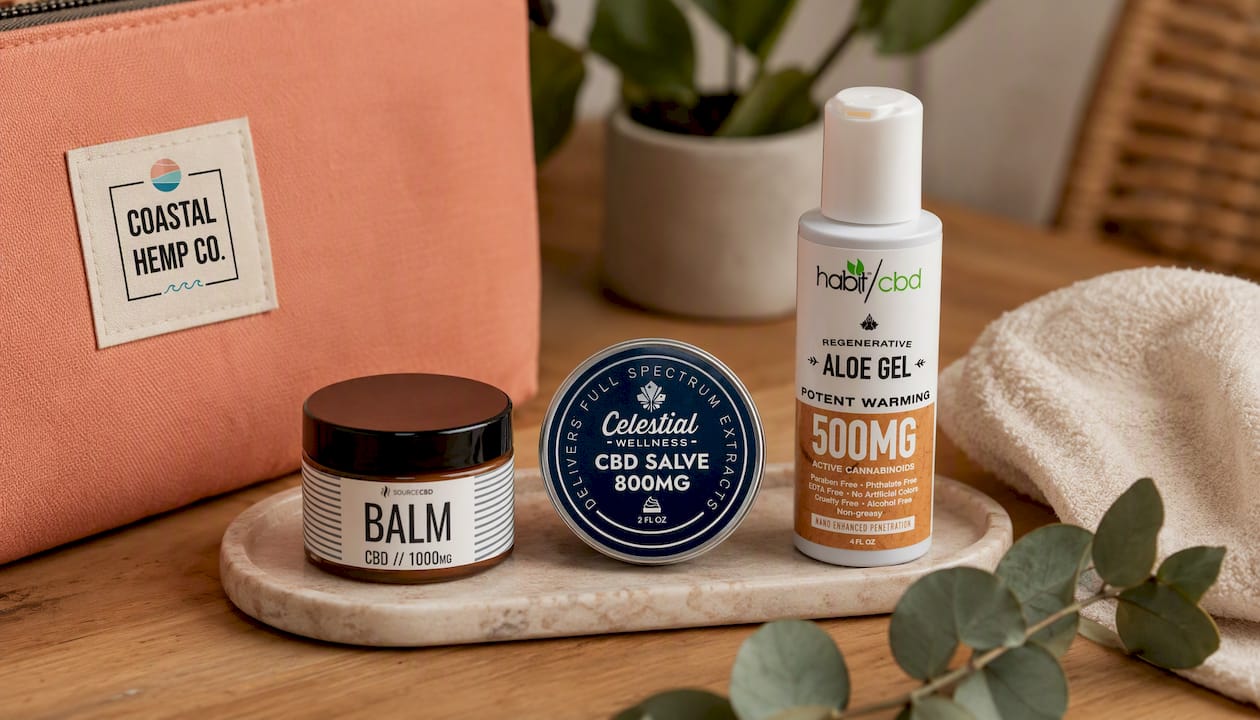
For everyday localized relief, the Organic CBD Balm with Lavender and Eucalyptus uses an oil-based carrier suited to targeted spots like elbows, knees, and shoulders. If you want something formulated specifically around inflammation and recovery, the Celestial Wellness CBD Relief Salve is worth checking against your own routine. And for a warming sensation layered over a regenerative aloe base, the Habit Regenerative Aloe Gel Warming 500mg pairs well with post-activity soreness.
Every product page lists its Certificate of Analysis and usage directions, so you can verify potency and THC compliance before you buy, not after. Check the full topical lineup and match the formulation to your specific need rather than the biggest milligram number on the shelf.
Sources
- Cannabidiol in Skin Health: A Comprehensive Review of Topical Applications in Dermatology and Cosmetic Science
- Skin applications of cannabidiol: sources, effects, delivery systems, marketed formulations and safety | Phytochemistry Reviews
FAQ
Do Hemp Creams Really Work?
What Is the Downside of Hemp Topicals?
The main risks are skin irritation, allergic reactions, and photosensitivity, and inconsistent regulation means product quality and labeling accuracy can vary widely between brands.
How Long Do Hemp Topicals Take to Work?
Cooling or warming sensations are often immediate, but the deeper anti-inflammatory benefits typically build over days to weeks of consistent daily use.
Does Topical CBD Cream Get Into Your Bloodstream?
Standard topicals are designed for local action and generally produce minimal systemic absorption; transdermal patches are the exception and are built specifically to reach the bloodstream.
How Do I Know if a Product Is High Quality?
Check for a current third-party Certificate of Analysis, a named carrier system, and clear THC compliance rather than relying on the milligram count alone.


Comments