
Role of Synergistic Ingredients in Hemp Explained
Some hemp compound pairings genuinely change how a product feels and works. THC combined with CBD tends to produce a milder, more manageable high than THC alone, and a small human study found that vaporized d-limonene reduced THC-induced anxiety without touching THC’s blood levels or its other effects. That’s real, replicated evidence. Plenty of other combinations you’ll see marketed as “entourage-boosting” have never been tested in any human trial.
Here’s what the evidence actually supports right now:
- Well-supported: THC paired with CBD for moderating intoxication and side effects; inhaled d-limonene reducing THC-related anxiety in controlled human testing.
- Promising but preclinical only: CBD combined with the terpene β-caryophyllene, which produced measurable synergistic pain relief in mouse models using isobolographic analysis, a statistical method that distinguishes true synergy from simple additive effects.
- Mostly speculative: broad claims that any full-spectrum product automatically outperforms an isolate because of “the entourage effect.” A 2024 systematic review found the clinical evidence for terpene-driven synergy thin and inconsistent.
One safety note before you go further: some of these interactions happen at the liver, not just at the receptor. High-dose CBD can inhibit the enzymes that break down THC, raising THC’s active metabolites in the bloodstream. If you take prescription medications, especially blood thinners, seizure medications, or immunosuppressants, talk to your prescriber before combining hemp products, since these enzyme interactions can affect how your other medications work too.
Key Takeaways
Synergistic effects in hemp are real for specific, tested compound pairs like THC with CBD or CBD with certain terpenes, but the science does not yet support broad claims that all full-spectrum products outperform isolates.
| Point | Details |
|---|---|
| Strongest evidence | THC-CBD pairings and vaporized d-limonene reducing THC-related anxiety have real human data behind them. |
| Weakest evidence | Most terpene-driven “entourage” claims rest on animal studies, not human trials. |
| Mechanism matters | Pharmacodynamic synergy (receptor-level) differs from pharmacokinetic synergy (blood-level enzyme effects), and only one softens intensity. |
| Safety first | CBD can inhibit liver enzymes that process common medications; check with a prescriber before combining. |
| Coastalhemp’s approach | The store prioritizes lab-verified COAs with full terpene panels, including options like broad-spectrum oils and multi-cannabinoid gummies. |
This article is general information, not a substitute for advice from a qualified doctor. Consult a qualified healthcare professional about your own circumstances before acting on anything here.
Table of Contents
- What Is the Role of Synergistic Ingredients in Hemp?
- Which Hemp Compounds Actually Matter
- How Could Synergy Actually Work in the Body?
- What the Research Actually Shows
- Drug Interactions and Who Should Be Cautious
- Does Product Form Change Whether Synergy Happens?
- A Practical Path to Trying Synergistic Hemp Products Safely
- Where the Science Needs to Catch Up
- An Editor’s Take on Evidence Versus Expectation
- How Coastalhemp’s Lineup Reflects These Ingredient Principles
- Sources
- FAQ
What Is the Role of Synergistic Ingredients in Hemp?
The “entourage effect” is the working name for this idea: cannabinoids, terpenes, flavonoids, and other hemp compounds may interact to produce effects that no single molecule delivers on its own. It’s a hypothesis, not a settled fact, and the distinction matters more than most product labels let on.
Ethan Russo’s widely cited 2011 paper gave the concept its modern shape. Russo mapped out plausible phytocannabinoid-terpenoid interactions and argued that THC’s psychoactive risks might be “tamed” by the presence of other plant compounds. He was careful to frame it as a testable theory. Marketing departments were less careful, and the phrase spread through the hemp industry faster than the science backing it did.
The entourage effect proposes that cannabinoids, terpenes, and other plant compounds interact to produce combined outcomes that isolated molecules don’t replicate on their own. Evidence for certain cannabinoid-cannabinoid pairings is fairly solid; evidence for most terpene contributions is still developing.
The idea’s path from lab hypothesis to store shelf followed a fairly predictable arc:
- Early preclinical work (2000s): Animal and cell studies started identifying how individual terpenes interact with cannabinoid receptors and enzymes.
- Clinical signals from THC-CBD products (2010s): Prescription products combining THC and CBD showed measurable benefits for conditions like spasticity, lending real-world weight to the idea that ratios matter.
- Targeted terpene studies (2020s): Human trials, still few in number, began isolating specific terpenes like d-limonene to test whether they change THC’s effects in controlled conditions.
That last phase is where the field stands today: more curiosity than consensus, but with a handful of findings solid enough to build on. For a deeper look at how individual terpenes function, Coastalhemp’s terpene guide walks through the aromatic compounds behind these effects.
Which Hemp Compounds Actually Matter
Not every molecule on a certificate of analysis is doing meaningful work in your body. Here’s a practical breakdown of what’s likely relevant and what’s mostly along for the ride.
Major cannabinoids. THC is the primary psychoactive compound in cannabis and hemp-derived products; CBD is non-intoxicating and is the compound most associated with calming, anti-inflammatory, and anti-anxiety effects in existing research.
Minor cannabinoids. CBG (cannabigerol) is often called the “mother cannabinoid” because other cannabinoids are synthesized from it during plant growth; early research suggests it may have its own distinct anti-inflammatory properties. CBC (cannabichromene) shows up in smaller concentrations and is being studied for mood and pain pathways, though human data remain sparse.
Terpenes. These aromatic compounds do more than shape smell and flavor. Based on current preclinical and early human research:
- Myrcene is associated with sedative, relaxing effects and is one of the most abundant terpenes in many hemp strains.
- Linalool, also found in lavender, is linked to calming and anti-anxiety properties.
- D-limonene carries a citrus aroma and showed measurable anxiety-reducing effects when paired with THC in controlled human testing.
- Beta-caryophyllene is unusual among terpenes because it can directly bind CB2 receptors, and it paired with CBD to produce synergistic pain relief in animal models.
- Alpha-humulene and pinene have both shown cannabimimetic activity in preclinical research, meaning they can produce cannabinoid-like behaviors on their own in animal studies.
Flavonoids and fatty acids. Hemp contains flavonoids like cannflavin A and fatty acids including omega-3 and omega-6 compounds. Both classes are biologically active in isolation, but they tend to have low bioavailability in typical hemp product formulations, meaning much of what’s on the label may not reach your bloodstream in meaningful amounts. Their contribution to whole-product effects is plausible but far less studied than cannabinoid or terpene interactions.
Pro Tip: When you read a certificate of analysis, pay closest attention to the terpene panel’s total percentage and which specific terpenes dominate. A product listing “may contain trace terpenes” without percentages is telling you almost nothing. A COA showing myrcene at 0.4% and beta-caryophyllene at 0.3% is telling you something real about what you’re buying.
For readers who want to go deeper on reading these panels, Coastalhemp’s terpene profile breakdown covers this in more detail.
How Could Synergy Actually Work in the Body?
Two different biological mechanisms get lumped under the “entourage effect” umbrella, and they work in completely different ways.
Pharmacodynamic synergy happens when compounds act together at the same receptors or on complementary pathways, changing the effect without necessarily changing how much of each compound is in your blood. Think of it as two keys turning the same lock slightly differently.
Pharmacokinetic synergy happens when one compound changes how another is absorbed, metabolized, or cleared, altering blood levels rather than receptor activity directly. This is the mechanism behind drug interaction warnings, because it involves liver enzymes shared with many prescription medications.
A comprehensive 2024 review stresses that these two mechanisms need to be reported separately, since a compound that boosts subjective effects through pharmacodynamics is a very different safety story than one that spikes blood levels through pharmacokinetics.
Possible mechanisms researchers are currently investigating include:
- CBD acting as a negative allosteric modulator at the CB1 receptor, which may soften some of THC’s more intense effects.
- Terpenes like alpha-humulene and linalool interacting with receptor targets beyond CB1 and CB2, producing effects that overlap with cannabinoid activity without being cannabinoids themselves.
- CBD inhibiting liver enzymes in the CYP450 family, which slows the breakdown of THC and other compounds metabolized by the same pathway.
- Certain terpenes potentially improving the absorption of cannabinoids across cell membranes, though this remains one of the least-studied claims in the space.
Picture it this way: pharmacodynamic synergy is like two musicians playing complementary notes on the same stage at the same volume. Pharmacokinetic synergy is like one musician turning up the volume knob on the other’s amplifier, whether or not that was the intended effect.
High-dose CBD’s enzyme-inhibiting effect on THC metabolism is a textbook pharmacokinetic interaction, and it’s one of the clearest examples of why “more compounds together” doesn’t automatically mean “gentler effects.” Sometimes it means the opposite.
This is where a lot of marketing language quietly skips a step. “Whole-plant synergy makes for a smoother experience” might be describing pharmacodynamic softening, or it might be describing a pharmacokinetic effect that’s actually intensifying and prolonging THC’s impact. Those are opposite outcomes wearing the same label.
What the Research Actually Shows
The evidence for hemp compound synergy splits cleanly into three tiers: human clinical signals, preclinical animal data, and speculation that has outrun both.
The strongest human data comes from THC-CBD combination products developed for conditions like multiple sclerosis-related spasticity, where the combined formulation showed clinical benefit in trials, adding real-world support to the idea that ratios matter, not just total cannabinoid content. Separately, observational data from epilepsy patients has repeatedly suggested that some patients respond better to whole-plant extracts than to purified CBD, though these are observational reports rather than head-to-head randomized trials, which limits how much weight they can carry.
On the preclinical side, the CBD plus beta-caryophyllene mouse study used isobolographic analysis, a method that plots dose-response curves for two compounds together against their individual curves to mathematically confirm whether an effect is truly synergistic rather than simply additive. That study found genuine synergy for inflammatory pain relief in mice. It’s compelling groundwork, but mouse pain models don’t always translate directly to human outcomes.
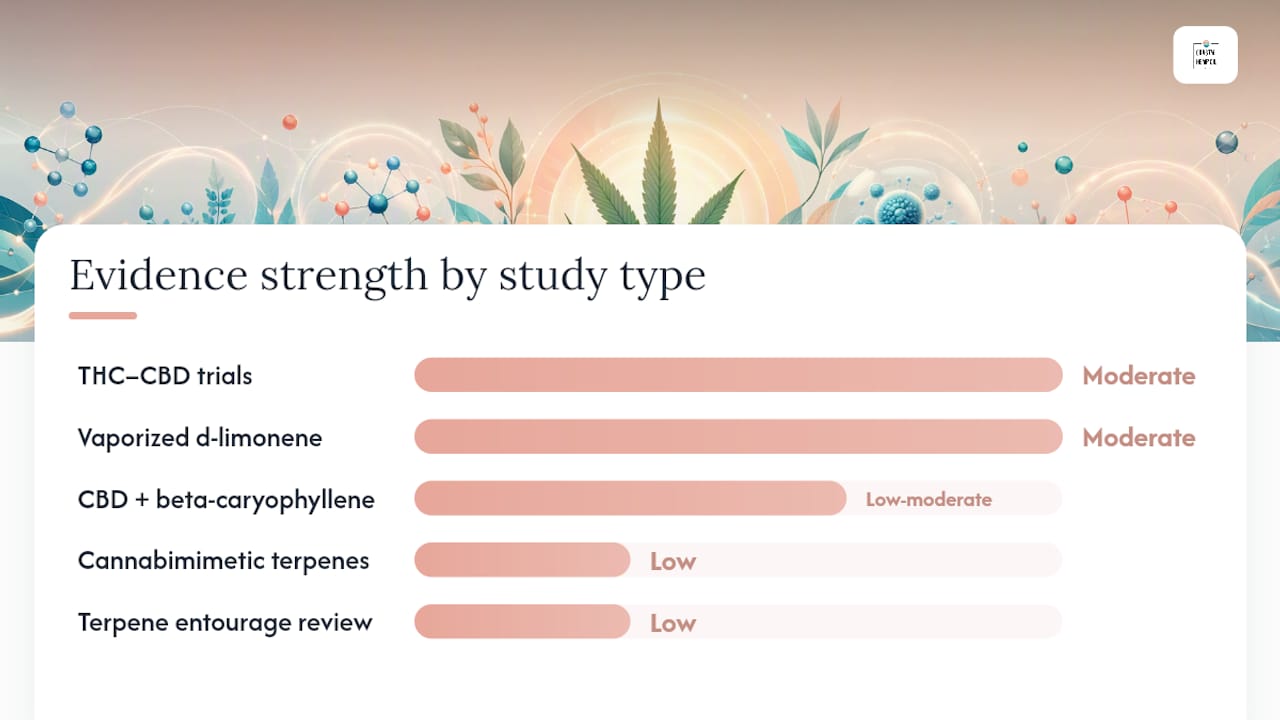
| Study | Design | Main Finding | Confidence Level |
|---|---|---|---|
| THC-CBD combination trials | Human clinical | Combined formulation eased spasticity symptoms | Moderate, condition-specific |
| Vaporized d-limonene study | Human, controlled | Reduced THC-induced anxiety without changing THC blood levels | Moderate, small sample |
| CBD + beta-caryophyllene | Preclinical (mouse) | Isobolographic analysis confirmed synergistic pain relief | Low to moderate, not yet in humans |
| Cannabimimetic terpenes (humulene, linalool, pinene) | Preclinical (animal/in vitro) | Terpenes independently activated cannabinoid-like behaviors | Low, mechanistic only |
| Terpene entourage effect broadly | Systematic review | Clinical evidence limited and inconsistent | Low, more RCTs needed |
The gap between “animal study shows synergy” and “this gummy will work better because of synergy” is enormous, and it’s exactly the gap that most product marketing skips over. When you see a claim citing “entourage effect research,” ask whether it’s pointing to a human trial or an animal model, and whether it’s describing the specific compounds actually in the product you’re looking at. A lot of copy borrows credibility from Russo’s original hypothesis without connecting it to the specific formulation being sold.
Drug Interactions and Who Should Be Cautious
Hemp compounds share metabolic pathways with a long list of prescription medications, and that overlap is where synergy stops being a wellness bonus and starts being a genuine safety issue.
CBD and, to a lesser extent, other cannabinoids can inhibit liver enzymes in the CYP450 family, particularly CYP3A4 and CYP2C9. These same enzymes process a wide range of common medications, so combining hemp products with certain drugs can raise or lower their effective blood levels without any change in the prescribed dose.
Drug classes worth flagging to your pharmacist or prescriber before you combine them with hemp products include:
- Anticoagulants like warfarin, since altered metabolism can change bleeding risk in either direction.
- Antiepileptic medications, because some are metabolized through the same enzyme pathways CBD affects.
- Certain antidepressants, particularly those processed by CYP2C9 or CYP3A4.
- Immunosuppressants, where even small blood-level shifts can have outsized clinical consequences.
- Other CNS depressants, including some sleep aids and anti-anxiety medications, due to additive sedation risk rather than enzyme competition.
Beyond drug interactions, certain populations should be more cautious with any hemp product, synergistic formulation or otherwise:
- Pregnant and breastfeeding individuals, given limited safety data on cannabinoid exposure during these periods.
- Young children, outside of specific medically supervised formulations.
- People with severe liver disease, since impaired liver function changes how cannabinoids are metabolized and cleared.
Contamination is a separate but related concern. Hemp is a bioaccumulator, meaning it readily absorbs whatever is in its growing soil, including heavy metals, pesticides, and residual solvents from poor extraction processes. A synergistic formulation built on contaminated biomass doesn’t become safer because it has an appealing terpene profile.
Before trying a new multi-compound hemp product, run through this quick checklist: confirm a current certificate of analysis exists, verify it comes from a third-party lab rather than the manufacturer’s in-house testing, check that the cannabinoid and terpene panel matches what’s on the label, and scan the contaminant panel for pesticide, heavy metal, and residual solvent results. None of this replaces a conversation with your prescriber or pharmacist if you take any regular medication, and that conversation is worth having before you start, not after you notice something feels off.
Does Product Form Change Whether Synergy Happens?
Extraction method and delivery form both determine whether the compounds responsible for potential synergy survive from plant to product, and this is where a lot of formulations quietly fall short of their marketing.
Full-spectrum products retain the widest range of cannabinoids, terpenes, and flavonoids, including trace THC. Broad-spectrum products aim to preserve that same range of minor cannabinoids and terpenes while removing THC. Isolates contain a single purified cannabinoid, typically CBD, with everything else stripped away.
Terpenes are volatile compounds, meaning they evaporate easily under heat, which is exactly why extraction method matters so much. Harsh solvent extraction or high-heat processing can burn off a meaningful share of a plant’s original terpene content before it ever reaches a bottle. A product labeled “full-spectrum” that went through a rough extraction process may carry far less terpene diversity than a well-processed broad-spectrum alternative.
Delivery form matters just as much. Inhaled products preserve terpenes closest to their natural state and deliver them to the bloodstream almost immediately, which is why vaporized terpene studies like the d-limonene research show effects within minutes. Oral oils and tinctures held under the tongue get some direct absorption but also pass partly through the digestive system. Edibles and capsules go through full digestion and liver metabolism before reaching systemic circulation, a process that can degrade some terpenes and delay onset by one to two hours.
If you’re chasing an acute, fast-acting effect where terpene-cannabinoid timing matters, inhalation offers the clearest mechanistic case for synergy given current human data. If you’re building a long-term wellness routine, oils and sublingual products offer more consistent dosing over time even if some terpene content is lost to slower absorption. Coastalhemp’s spectrum comparison guide breaks down these tradeoffs product category by product category, and the formulation explainer covers how extraction choices shape the final compound profile.
When you’re comparing products, the certificate of analysis should show a full terpene profile with actual percentages, current cannabinoid potency testing, and a residual solvent and pesticide panel. A COA that only lists total cannabinoids without a terpene breakdown tells you almost nothing about whether synergistic compounds survived the manufacturing process.
A Practical Path to Trying Synergistic Hemp Products Safely
Turning the science into a real decision doesn’t require a chemistry background. It requires a checklist and some patience.
- Pull the certificate of analysis before you buy, not after. Confirm it’s dated recently, comes from an independent lab, and matches the batch number on your product.
- Check the cannabinoid and terpene profile against the label claims. If the product advertises “full-spectrum with entourage benefits” but the COA shows only trace terpenes, that’s a mismatch worth noting.
- Start with a low dose and hold it steady for several days before increasing, especially with multi-compound products where you can’t predict individual response as easily as with a single-cannabinoid isolate.
- Track your response in simple terms, noting dose, time, and effect, so you can identify whether a specific formulation is doing anything measurable for you.
- Consult your prescriber or pharmacist if you take regular medications, particularly anything metabolized by the liver, before adding any hemp product to your routine.
Pro Tip: Run a simple n-of-1 test on any new product: establish a baseline week without it, introduce one variable at a time (one new product, one dose level), and keep a short daily log. Changing your product, your dose, and your routine all in the same week makes it impossible to know what actually caused any change you notice.
If predictable dosing matters more to you than chasing possible synergy, an isolated cannabinoid gives you a cleaner variable to work with and fewer interaction risks. If you’re comfortable with more variables in exchange for a potentially broader effect, a full or broad-spectrum formulation with a verified terpene profile is the more reasonable starting point. Coastalhemp’s dosage guide and tolerance explainer both go deeper into how these decisions play out over weeks and months of regular use.
Where the Science Needs to Catch Up
The honest gap in this field is that most of the compelling synergy data comes from animal models, cell cultures, or very small human samples, and the industry has outpaced the research by years.
Specific questions that remain genuinely open include head-to-head randomized trials comparing full-spectrum extracts against matched isolates in the same condition and population, dose-response mapping for specific cannabinoid-terpene pairs beyond the handful that have been tested, and basic human pharmacokinetic studies tracking how terpene presence changes cannabinoid absorption and blood levels over time, not just subjective effect.
Coastalhemp’s approach to this uncertainty is straightforward rather than flashy: prioritize products from growers and brands that provide current, independent certificates of analysis with full terpene panels, not just cannabinoid totals. That means favoring formulations where the terpene content is actually documented rather than assumed, and being direct with customers about which claims have real research behind them and which are still working hypotheses.
For researchers and buyers alike, the practical takeaway is the same: watch for studies that specify exact compound ratios and dosing, since a synergy finding at one ratio doesn’t necessarily hold at another. A product’s terpene diversity means little if the concentrations are too low to plausibly do anything.
An Editor’s Take on Evidence Versus Expectation
The gap between what “entourage effect” promises in marketing copy and what the research actually supports is the single biggest source of confusion I see in this space. Coastalhemp’s approach has been to lean into that gap honestly rather than paper over it: we favor brands and growers who provide full terpene panels on their COAs, not just cannabinoid totals, because a documented profile is the only way to know whether a product’s synergy claims have anything real behind them.
Not every full-spectrum product is automatically better than a well-made isolate, and that’s worth saying plainly. A full-spectrum oil with a degraded terpene profile from poor extraction offers less real synergy potential than a clean, well-tested isolate with a clear dose. The compound list on a label matters less than whether that list was verified by an independent lab and whether the concentrations are high enough to plausibly matter. Buyers who learn to read a COA critically end up making better choices than buyers who trust the word “full-spectrum” on its own.
How Coastalhemp’s Lineup Reflects These Ingredient Principles
Reading the research is one thing. Finding products where the label actually matches the science is another, and that’s the gap Coastalhemp works to close for every item in the store.

Coastalhemp is built around one practical idea: if synergy claims matter to you, the certificate of analysis should back them up before the marketing copy does. Every product listing points to lab-verified cannabinoid and terpene data so you’re not guessing at what’s actually in the bottle.
A few examples that map directly to the guidance above:
- Hometown Hero Natural Agave THC Syrup 120mg is a multi-compound edible formulation, useful for readers who want flexible, adjustable dosing in liquid form rather than a fixed-dose gummy or capsule.
- Natural Flavor CBD Oil Organic Broad Spectrum preserves the non-THC cannabinoid and terpene range discussed throughout this article, making it a solid starting point for anyone who wants broad-spectrum benefits without THC.
- Enjoy De-Stress Gummies - CBD + CBG + Mushroom Blend pairs two cannabinoids with functional mushroom ingredients, a practical example of how formulators combine cannabinoid synergy with other wellness-oriented compounds outside the cannabis plant entirely.
If you’re ready to put the “start low and go slow” approach into practice, browse the full lineup and check the COA on any product before it goes in your cart. Every listing on Coastalhemp links directly to current lab results, so you can verify the terpene and cannabinoid profile before you buy, not after.
Sources
- Taming THC: potential cannabis synergy and phytocannabinoid-terpenoid entourage effects
- The Entourage Effect in Cannabis Medicinal Products: A Comprehensive Review
- Cannabidiol and Beta-Caryophyllene in Combination: A Therapeutic Functional Interaction (preclinical study PDF)
- Vaporized d-limonene selectively mitigates the acute anxiogenic effects of THC (Johns Hopkins study)
- Cannabis sativa terpenes are cannabimimetic and selectively enhance cannabinoid activity | Scientific Reports
FAQ
What is the term for cannabinoids and terpenes working together?
It’s called the “entourage effect,” a hypothesis proposing that cannabinoids, terpenes, and other hemp compounds interact to produce combined outcomes beyond what any single molecule delivers alone.
What drugs should not be taken with hemp products?
Anticoagulants, antiepileptic medications, certain antidepressants, and immunosuppressants all carry interaction risk because CBD can inhibit the liver enzymes that metabolize them, so check with a pharmacist before combining.
Is hemp seed high in estrogen?
Hemp seeds contain lignanamides and phytoestrogens in small amounts, but current evidence does not support the idea that typical hemp seed consumption meaningfully raises estrogen levels in the body.
What is the downside of hemp?
The main downsides are inconsistent regulation leading to contamination risks in poorly tested products, potential drug interactions through liver enzyme inhibition, and marketing claims about synergy that often outpace the actual clinical evidence.
Should I choose a full-spectrum or isolate product if I want synergy benefits?
Choose a broad-spectrum or full-spectrum product with a verified terpene panel on its certificate of analysis, like Coastalhemp’s broad-spectrum CBD oil, if documented compound diversity matters more to you than the simpler dosing of an isolate.


Comments