

Hemp Product Formulation: What It Is and How It Works
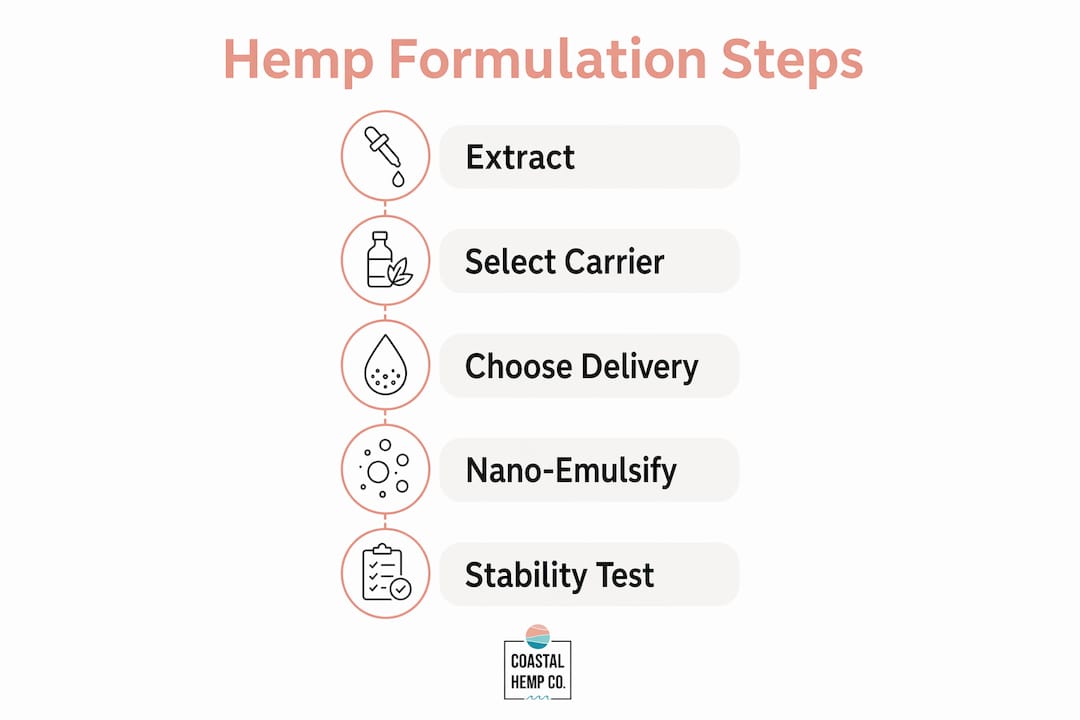
Hemp product formulation is the specialized science of transforming raw cannabinoid extracts into stable, bioavailable consumer wellness products by combining those extracts with carrier systems, excipients, and delivery formats. The process covers everything from oil tinctures and softgel capsules to gummies and topicals. Industry benchmarks in 2026 target a potency assay variance of no more than 5% and bioavailability rates of 60–80% through advanced technologies like nano-emulsification. The FDA regulates hemp-derived cannabinoids in food and supplement categories, and formulators must navigate those rules at every stage of hemp product development.
What is hemp product formulation, and why does it matter?
Hemp product formulation is defined as the structured process of selecting a delivery form, identifying compatible carrier ingredients, and validating potency and stability before a product reaches consumers. Raw cannabinoid extracts have no fixed form. Without formulation, they cannot be dosed accurately, absorbed efficiently, or stored safely. The formulation process is what turns a crude hemp extract into a product that delivers a consistent, predictable wellness experience.
The process matters because each delivery method carries its own manufacturing requirements, bioavailability profile, regulatory pathway, and shelf-life considerations. A gummy requires a gelatin or pectin matrix, a precise pH range, and heat-stable cannabinoids. A tincture requires a lipid-soluble carrier and an airtight amber bottle. These are not interchangeable decisions. Getting formulation right is what separates a product that works from one that sits on a shelf and fails.

Formulators also work within a regulatory framework shaped by the FDA and state-level industrial hemp programs. THC isolate cannot be added as a direct food additive under current federal rules. That constraint alone shapes which cannabinoid profiles are viable in certain product categories, making regulatory awareness a core formulation skill, not an afterthought.
What are the primary delivery forms used in hemp product formulation?
The four dominant delivery formats in hemp product development are oil tinctures, softgel capsules, gummies, and topicals. Each format solves a different consumer need and creates a different set of formulation challenges.
| Format | Bioavailability | Ease of Use | Stability | Typical Carrier |
|---|---|---|---|---|
| Oil tincture | Moderate | High | Good | MCT oil, hemp seed oil |
| Softgel capsule | Moderate | High | Excellent | Lipid fill, gelatin shell |
| Gummy | Lower (oral) | Very high | Moderate | Gelatin or pectin matrix |
| Topical | Localized | High | Good | Shea butter, emollient base |
Oil tinctures are the most established format. They use lipid-based carriers that dissolve cannabinoids effectively and allow sublingual absorption, which bypasses first-pass liver metabolism. Softgel capsules offer precise dosing and excellent shelf stability, making them a preferred format for consumers who want a supplement-style experience. Gummies are the fastest-growing segment because they combine palatability with portability, though their oral delivery route means lower systemic absorption compared to sublingual formats. Topicals deliver cannabinoids locally to skin and muscle tissue without entering the bloodstream, which suits consumers focused on targeted relief rather than systemic effects.
Pro Tip: Match the delivery format to the consumer’s primary wellness goal before selecting any ingredient. A consumer seeking fast stress relief benefits more from a sublingual tincture than a gummy, which can take 45–90 minutes to act.
Understanding product variety and formulation helps consumers make better purchasing decisions and helps formulators design products that actually get used.
How do ingredients and carriers affect hemp formulation effectiveness?
Cannabinoids are lipophilic compounds. That means they dissolve in fats, not water. This single chemical property drives most of the ingredient decisions in hemp product formulation.
The most important carrier choices include:
- MCT oil: Caprylic acid MCT oil, such as CAPTEX 8000, achieves up to 40% solubility for CBD and is the most widely used carrier in tinctures and softgels. It is flavorless, stable, and well-tolerated.
- Emulsifiers: Water-based products like beverages require emulsifiers such as lecithin or polysorbate 80 to keep cannabinoids dispersed. Without them, the extract separates and dosing becomes inconsistent.
- Terpenes: Terpene blends affect taste, aroma, and potentially bioactivity through the entourage effect. They also affect formulation compatibility. A terpene blend that works in MCT oil may fail entirely in a water-based or glycerin carrier.
- Flavor-masking agents: Hemp extracts carry a resinous, bitter taste. Bitter blockers and flavor-masking systems are not optional in gummies or beverages. They are a core formulation ingredient.
- Full-spectrum considerations: Full-spectrum extracts contain additional bioactives beyond CBD, including minor cannabinoids and plant waxes. These affect solubility and taste in ways that isolate-based formulas do not, requiring tailored delivery systems.
Terpenes present a specific challenge during manufacturing. They are volatile compounds that degrade under heat. Hot-fill gummy processes and pasteurization steps can destroy terpene profiles before the product is even sealed. Formulators address this by adding terpenes post-cooling or using encapsulation to protect them during processing.
Pro Tip: Always validate carrier compatibility during R&D at bench scale before committing to a commercial batch. A carrier system that looks stable in a 100ml trial can fail completely under the shear forces of a 500-liter commercial mixer.
What technological advances are improving hemp product bioavailability?
Nano-emulsification is the most significant technology advance in hemp formulation over the past five years. The process breaks cannabinoid oil droplets into particles measuring 100–200 nanometers, which are small enough to be absorbed directly through intestinal cell walls. Nano-emulsified products achieve 60–80% bioavailability, a substantial improvement over conventional oil-based delivery.
That improvement matters practically. A consumer taking a 25mg CBD gummy made with standard oil extraction absorbs a fraction of that dose. The same dose in a nano-emulsified format delivers meaningfully more active compound to the bloodstream. For wellness products targeting specific outcomes like stress relief or sleep support, that difference is the gap between a product that works and one that does not.
Advanced formulation technologies also enable entirely new product categories:
- Functional beverages: Nano-emulsified cannabinoids can be blended into water-based drinks without separation, opening a category that standard oil-based formulas cannot enter.
- Fast-onset gummies: Nano-emulsification reduces onset time in edibles from 45–90 minutes to as little as 15–30 minutes in some formulations.
- Precision topicals: Lipid nanoparticle carriers improve skin penetration depth in topical products, increasing localized effectiveness.
Stability testing runs alongside every technology advance. Stability protocols monitor potency, taste, smell, and packaging interactions across both accelerated and real-time conditions. Without this data, a label claim of “25mg CBD per serving” cannot be defended at the end of a product’s shelf life. Regulatory compliance depends on stability data, not just initial batch testing.
Formulators also use stability data to validate controlled dosing standards across a product’s full shelf life, which is a growing expectation from both regulators and consumers.
What are best practices for hemp product R&D?
A structured R&D process is what separates a product that scales successfully from one that fails at commercial production. The following sequence reflects current industry best practice for hemp product development.
- Define the dose and delivery form. Set the target cannabinoid dose per serving and select the delivery format before any bench work begins. These two decisions determine every downstream ingredient and process choice.
- Run bench trials targeting ≤5% assay variance. Potency variance targets of no more than 5% are the industry standard for homogeneous dosing. Test multiple points within each batch, not just the finished product.
- Validate carrier compatibility early. Carrier system failures are the most common cause of scale-up problems. Test the full ingredient system under commercial mixing conditions before finalizing the formula.
- Run accelerated and real-time stability protocols. Accelerated testing uses elevated temperature and humidity to predict shelf life quickly. Real-time testing confirms those predictions. Both are required for label claim validation.
- Conduct sensory evaluations. Flavor matrix testing and consumer panel sessions identify bitterness, off-notes, and texture problems before launch. Sensory failures are the leading cause of repeat-purchase drop-off in wellness edibles.
- Establish critical control points in manufacturing. Mixing time, temperature, and pH are the three variables most likely to affect potency and homogeneity. Document acceptable ranges and test at each stage.
- Issue a transparent certificate of analysis (COA). Every finished lot requires a COA from an accredited third-party lab. The COA must confirm cannabinoid potency, residual solvents, heavy metals, and microbial counts. Lot traceability links each COA to a specific production run.
Understanding hemp product certifications helps consumers verify that a brand follows these R&D standards before purchasing.
Key Takeaways
Hemp product formulation requires matching the right delivery format, carrier system, and technology to the target wellness outcome, then validating every variable through structured R&D and stability testing.
| Point | Details |
|---|---|
| Formulation defines bioavailability | Nano-emulsification achieves 60–80% bioavailability, far above standard oil delivery. |
| Carrier compatibility is critical | Validate carrier systems at bench scale to prevent costly commercial scale-up failures. |
| Potency variance must stay ≤5% | Test at multiple production stages to meet regulatory standards and build consumer trust. |
| Delivery format shapes the product | Each format, from tinctures to topicals, requires unique ingredients, processes, and testing. |
| Stability data protects label claims | Accelerated and real-time testing confirm potency and sensory quality across the full shelf life. |
What I’ve learned separates successful hemp formulations from failures
After spending years watching hemp brands launch and stumble, the pattern is consistent. Brands that succeed treat formulation as a science. Brands that fail treat it as a recipe.
The most common failure point is carrier validation. A formulator runs a successful bench trial in MCT oil, then hands the formula to a contract manufacturer who uses a different mixing system at 10 times the volume. The emulsion breaks. The batch fails. That failure was preventable. Validating the carrier system under commercial conditions before signing a production contract is not optional. It is the single most cost-effective step in the entire R&D process.
The second pattern I see consistently is underinvestment in sensory work. Formulators spend months on potency and stability, then ship a product that tastes like a hemp field in August. Consumers do not care about your COA if the product is unpleasant. Bitter blockers and flavor-masking systems are not a luxury. They are the difference between a one-time purchase and a loyal customer.
The third lesson is about terpenes. Brands add terpene blends because they want the entourage effect and a differentiated flavor profile. Both are legitimate goals. But terpenes are volatile, heat-sensitive, and carrier-dependent. A terpene profile that performs beautifully in a tincture can degrade completely in a hot-fill gummy process. Test the full formula under actual manufacturing conditions, not just ideal lab conditions.
The brands that get formulation right share one trait: they invest in R&D before they invest in marketing. A well-formulated product sells itself through repeat purchases. A poorly formulated one burns through marketing budget and earns one-star reviews.
— John
Coastalhemp’s approach to formulated hemp wellness products
Coastalhemp partners with top growers and brands to bring rigorously formulated hemp products to wellness-focused consumers. Every product in the catalog reflects the formulation standards covered in this article, from potency testing to carrier selection.

The Celestial Wellness THCv Gummies are a strong example of formulation done right, delivering 200mg of THCv in a precisely dosed gummy matrix with transparent lab testing. For consumers who want to see the full range of formulated hemp formats, Coastalhemp’s catalog covers tinctures, edibles, topicals, and functional mushroom products. Every product ships with third-party COA documentation. Visit Coastalhemp to find a formulated hemp product matched to your wellness goals.
FAQ
What is hemp product formulation in simple terms?
Hemp product formulation is the process of combining raw cannabinoid extracts with carriers, excipients, and delivery formats to create stable, accurately dosed wellness products like tinctures, gummies, or topicals.
How does nano-emulsification improve hemp products?
Nano-emulsification breaks cannabinoid droplets into 100–200nm particles, which the body absorbs more efficiently, achieving bioavailability of 60–80% compared to lower rates from standard oil-based formulas.
Why is MCT oil used in hemp formulations?
MCT oil, particularly caprylic acid variants, solubilizes up to 40% CBD by weight, making it the most effective and widely used carrier for tinctures and softgel capsules.
What does ≤5% assay variance mean for hemp products?
A potency variance of no more than 5% means every serving in a batch contains a consistent cannabinoid dose. Hitting this target requires testing at multiple production stages, not just on the finished lot.
How do terpenes affect hemp product formulation?
Terpenes influence flavor, aroma, and potentially cannabinoid bioactivity, but they are volatile and heat-sensitive. They require carrier validation and often need to be added post-cooling to survive manufacturing without degrading.


Comments