

Hemp Relaxation Without Sedation: What Actually Calms You
Hemp relaxation without sedation means getting the calming, anxiolytic benefits of CBD and related hemp compounds while staying clear-headed, alert, and fully functional. It is not a sleep aid effect, and it is not the fog that comes with THC-heavy products or benzodiazepines. The mechanism behind it is endocannabinoid modulation: CBD helps bring an overactive stress response back toward baseline instead of forcing the central nervous system to shut down. Clinical work on CBD for public speaking anxiety, including the research lines associated with Zuardi and Shannon, found moderate doses reduced stress-induced anxiety without the heavy drowsiness seen with drugs like diazepam.
If you want to try this yourself, here is the starting snapshot:
- Look for CBD-forward tinctures or capsules with clear mg-per-serving labeling
- Start with a microdose (5 to 25 mg) and take it earlier in the day, not at night
- Skip products marketed for sleep, which usually add CBN or higher THC for a reason
Key Takeaways
Non-sedative relaxation from hemp comes down to choosing CBD-forward, terpene-balanced products at moderate doses and reserving CBN or THC-heavy formulas strictly for sleep.
| Point | Details |
|---|---|
| CBD restores baseline, doesn’t sedate | It buffers stress reactivity rather than depressing the central nervous system. |
| Dose response is U-shaped | Moderate doses often outperform very low or very high ones in studies. |
| Terpenes shape the feel | Linalool and beta-caryophyllene lean calming; CBN and myrcene lean toward drowsiness. |
| Start low, time it early | Titrate over two to three weeks and dose earlier in the day for alertness. |
| Coastalhemp separates daytime and sleep lines | CBD-forward products support calm; CBN and THC gummies like the Enjoy Sleep line are built for sleep, not daytime use. |
Table of Contents
- What Is Hemp Relaxation Without Sedation, Biologically Speaking?
- Which Cannabinoids and Terpenes Calm You Without Making You Drowsy?
- How to Dose and Time Hemp for Calm Without Drowsiness
- Which Product Forms Keep You Calm and Functional?
- How Coastalhemp’s Product Lineup Fits Daytime Calm vs. Sleep Support
- The Gap Between Hemp Marketing and Hemp Evidence
- Get Daytime Calm Without the Guesswork
- Sources
- FAQ
What Is Hemp Relaxation Without Sedation, Biologically Speaking?
Your body has a stress set point, a baseline level of arousal it tries to return to after a stressful event. CBD appears to act as a buffer that helps restore that baseline rather than pushing the nervous system down below it. Researchers describe this as CBD “enhancing endocannabinoid control of stress,” which is a more precise way of saying it helps you recover your calm instead of numbing you into it, according to research on endocannabinoid stress regulation.
That distinction, restoration versus depression of the central nervous system, is the entire reason CBD and THC feel so different in practice. CBD is not psychotomimetic. It typically will not produce euphoria, intoxication, or the psychomotor slowdown that heavier THC doses can cause, according to a clinical review on cannabinoid medicines. THC, by contrast, interacts directly with CB1 receptors in ways that can impair coordination and reaction time at higher doses, which is why a THC-heavy gummy and a CBD-forward tincture can produce completely different afternoons.
What the studies actually found: In Zuardi and Shannon-style public speaking trials, 300 to 400 mg doses of CBD reduced anxiety symptoms comparably to established anti-anxiety medications, but participants did not report the sedation typically associated with those drugs, per the capstone review of CBD clinical evidence.
A few caveats matter here:
- Effects vary by individual body chemistry, weight, and existing stress load
- Some clinical contexts do report mild mental sedation, mostly at higher doses or early in treatment
- “Non-sedating” describes a tendency, not a guarantee, for every person and every dose
For a deeper look at how this stress-buffering process works day to day, Coastalhemp’s guide on hemp calming effects breaks down the mechanism further.
Which Cannabinoids and Terpenes Calm You Without Making You Drowsy?
Not every hemp compound behaves the same way, and reading a label with this in mind changes what you buy.
Cannabinoids worth knowing:
- CBD — non-intoxicating, the primary driver of calm-without-fog effects
- CBG and CBC — minor cannabinoids thought to support CBD’s effects without adding sedation
- Low-dose THC — mixed results; a small amount can round out a formula, but effects climb fast with dose
- CBN — strongly associated with drowsiness and is the compound most sleep-focused products lean on
Terpenes shape the experience just as much as cannabinoids do. Linalool and myrcene are associated with a calming, almost sedative-adjacent sensory profile, while limonene tends to feel brighter and more uplifting, and beta-caryophyllene contributes an anti-inflammatory, grounding quality without weighing you down, based on terpene interaction research. A “relax” label built around linalool and beta-caryophyllene will feel different from one leaning on myrcene alone.
Full-spectrum products carry the complete range of minor cannabinoids, terpenes, and fatty acids from the plant, which many people report as a more rounded, sustained calm. Isolate products contain CBD only, which is more predictable but loses that entourage effect. Coastalhemp’s breakdown of terpene profiles walks through how to match a blend to your goal.
Pro Tip: Check the certificate of analysis (COA) for the terpene panel, not just the cannabinoid milligrams. Two products with identical CBD content can feel completely different depending on which terpenes ride along with it.
How to Dose and Time Hemp for Calm Without Drowsiness
The relationship between CBD dose and anxiolytic effect is not a straight line. It is U-shaped: very low doses often underperform, moderate doses tend to hit the sweet spot, and very high doses can either lose effectiveness or introduce side effects that were not there at a lower amount, according to U-shaped dose-response research. That is the opposite of “more is better,” and it is the single most misunderstood part of hemp dosing.
Here is a practical sequence to follow:
- Start with a low daily dose, often under 150 mg per day, and hold there for a few days.
- Watch for mild fatigue in the first week. It is common and usually temporary.
- Titrate upward slowly over two to three weeks, adjusting based on how alert you feel, not just how calm.
- Time your dose for mornings or early afternoons if daytime function matters most.
- Avoid driving or operating machinery until you know how your body responds.
Onset varies by delivery method. Sublingual tinctures act within 15 to 45 minutes and are easiest to titrate. Gummies take longer, often 60 to 90 minutes, because they pass through digestion first. Capsules offer the most consistent dosing but the slowest onset. Vapes act fastest of all but wear off soonest, which makes them harder to use for sustained daytime calm.
One safety note that applies across every format: CBD is metabolized through CYP450 liver enzymes, the same pathway many prescription medications use, so interactions are a real possibility if you take blood thinners, certain antidepressants, or seizure medications, per clinical guidance on CBD safety. Talk to a clinician before adding hemp products if you take anything metabolized by the liver. Coastalhemp’s microdosing guide covers titration schedules in more depth.
Which Product Forms Keep You Calm and Functional?
The delivery method you choose matters almost as much as the compound blend inside it.
- Tinctures — fast onset, easiest to titrate drop by drop, best for fine-tuning your dose
- Gummies — convenient and consistent, but slower onset makes timing less precise
- Capsules — the most consistent dose per unit, good for people who dislike guessing
- Vape pens — fastest onset, shortest duration, better suited to acute stress spikes than steady daytime calm
When you are shopping, run through a short checklist: does the label show clear milligrams per serving, is there a linked COA you can actually check, and does the terpene or cannabinoid profile lean calming (linalool, beta-caryophyllene, CBD-forward) rather than sedating (CBN-heavy, high THC)?
If you are cautious about THC or want to keep your tolerance low, a CBD-forward blend is the safer starting point. If you have already established tolerance and specifically want sleep support rather than daytime calm, a CBN-inclusive product is a different tool for a different job, not an upgrade. Coastalhemp’s buyer’s guide to relaxation products walks through more label-reading detail.
How Coastalhemp’s Product Lineup Fits Daytime Calm vs. Sleep Support
Coastalhemp works with a curated set of growers and formulators specifically so customers aren’t stuck guessing which compound does what. That curation shows up directly in how the catalog is organized: daytime-friendly, CBD-forward options sit separately from sleep-focused blends built around CBN and THC.
The Enjoy Sleep Gummies CBD+CBN 220 mg 2-pack is the gentlest of the three sleep-oriented products in the lineup, built for people who want CBN’s calming pull without introducing intoxicating THC. The Enjoy Sleep Gummies THC + CBN 2-pack and the higher-dose Enjoy Sleep Gummies Delta 9 THC + CBN, 625 mg, 25-count both combine CBN with Delta 9 THC, which makes them appropriate for nighttime use and not for anyone who needs to stay alert afterward.
- Sourcing partnerships with established growers, not anonymous bulk suppliers
- Educational content built to help you match compound profile to use case
- A catalog split by intent (daytime calm, sleep support, energy) rather than one generic “relaxation” bucket
The Gap Between Hemp Marketing and Hemp Evidence
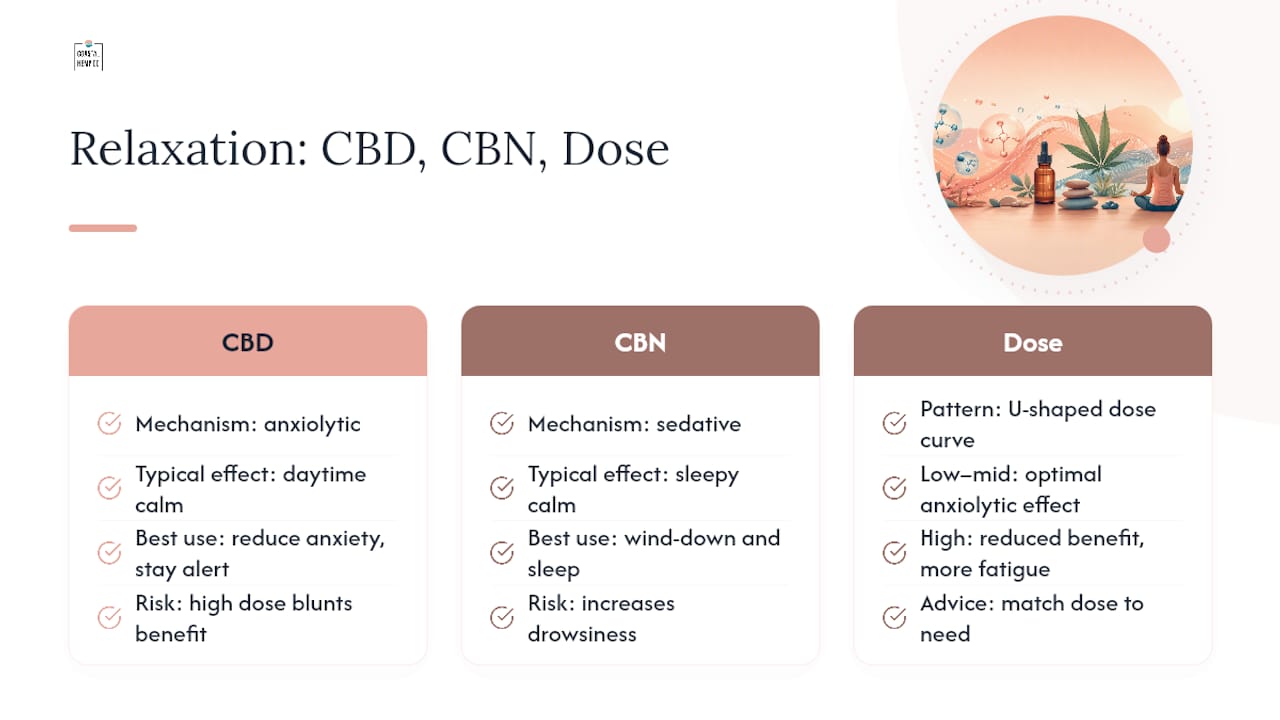
Most hemp marketing treats “relaxing” as a single feeling, as if every product produces the same soft, sleepy calm. The actual research says something more specific: CBD’s anxiolytic effect and CBN’s sedative effect are different mechanisms entirely, and conflating them is why so many people try a “relaxation” gummy expecting daytime ease and end up drowsy on the couch.
The U-shaped dose curve is the part conventional wisdom gets wrong most often. The instinct is to assume a bigger dose means a stronger calming effect. The evidence says otherwise. Overshooting your dose can blunt the anxiolytic benefit and introduce fatigue you didn’t need.
If you want calm without the fog, prioritize the label over the marketing copy. Check the cannabinoid breakdown, check the terpene panel, and match the product to what you actually need that day, energy for work or wind-down for sleep, rather than trusting a single word like “relax” to mean the same thing on every package.
Get Daytime Calm Without the Guesswork
Coastalhemp’s catalog is built around exactly this distinction: CBD-forward products for daytime calm sit apart from CBN and THC blends made for sleep, so you’re not stuck reading fine print to figure out which gummy will keep you sharp and which one will knock you out.
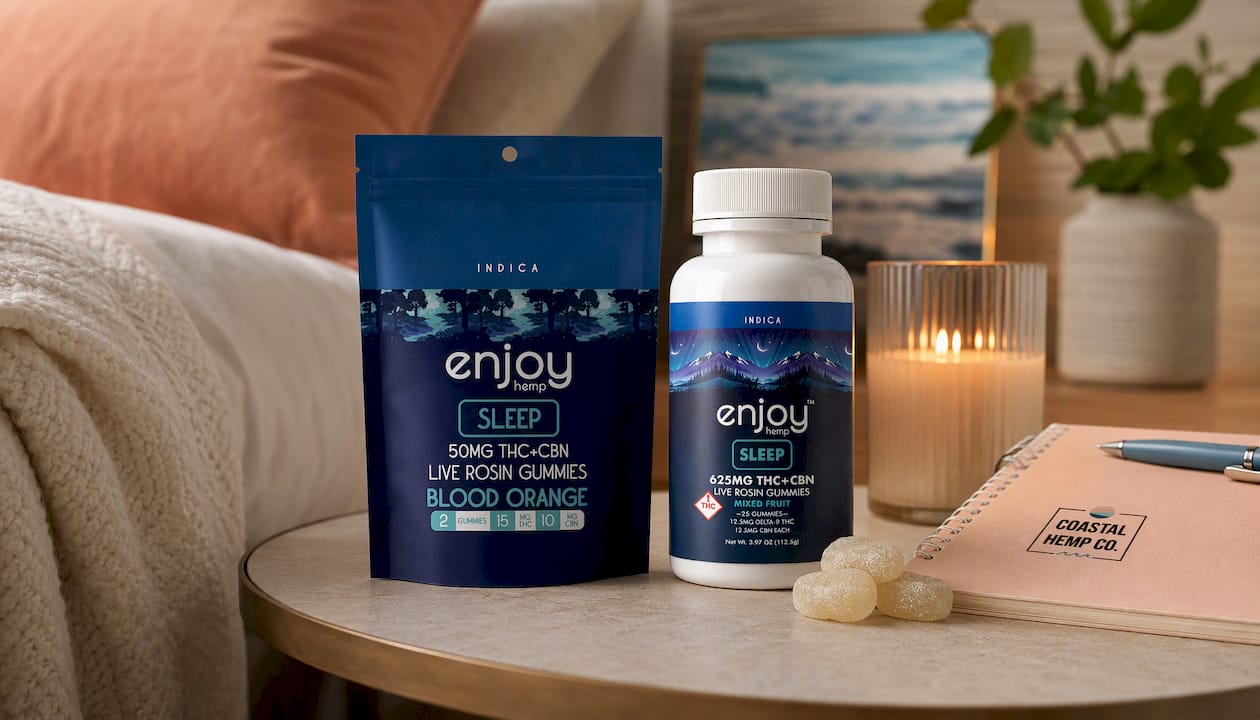
If sleep support is actually what you’re after, the Enjoy Sleep Gummies CBD+CBN 220 mg 2-pack offers a gentler entry point than the THC-inclusive options, while the Enjoy Sleep Gummies Delta 9 THC + CBN 625 mg 25-count suits people who already know their tolerance and want a stronger nighttime formula. For daytime calm specifically, browse Coastalhemp’s curated selection and check the terpene panel on each listing before you buy, that single habit will tell you more about how a product will feel than the front label ever will.
This article is general information, not a substitute for advice from a qualified doctor. Consult a qualified healthcare professional about your own circumstances before acting on anything here.
Sources
- Capstone project — CBD clinical evidence (Zuardi/Shannon references)
- Tetrahydrocannabinol and cannabidiol medicines for chronic pain and mental health conditions | Inflammopharmacology
- Cannabidiol (CBD) in Clinical Care - StatPearls
FAQ
Does hemp make you feel relaxed without getting you high?
CBD-forward hemp products can produce a calming, anxiolytic effect without the intoxication associated with THC, since CBD is not psychotomimetic and does not typically cause euphoria.
What is the downside of hemp?
The most common downsides are mild fatigue or somnolence, especially early in use or at higher doses, along with possible drug interactions through the CYP450 liver pathway that matter if you take other medications.
Can hemp actually calm anxiety?
Clinical research on CBD, including public speaking anxiety studies using moderate doses around 300 to 400 mg, found meaningful reductions in stress-induced anxiety without the heavy sedation seen with anti-anxiety medications.
Does hemp calm dogs down the same way it calms people?
The endocannabinoid system exists across mammals, so hemp’s calming mechanism is biologically similar in dogs, though dosing, safety data, and product formulation for pets differ significantly from human products and should follow veterinary guidance.
How do I know if a hemp product will sedate me or just relax me?
Check the cannabinoid and terpene panel on the certificate of analysis. CBD-forward, linalool, or beta-caryophyllene-rich blends tend toward daytime calm, while CBN or high-THC formulas, like Coastalhemp’s Enjoy Sleep line, are formulated for sedation.


Comments