
Hemp Sourcing Transparency: What Consumers Need to Know
Hemp sourcing transparency is the clear, verifiable disclosure of where hemp is grown, how it is processed, and what testing confirms its safety and potency. Understanding what is hemp sourcing transparency matters because it directly determines whether a product is safe, accurately labeled, and produced under ethical conditions. The industry term for this practice is supply chain transparency, and it works alongside traceability to give consumers a complete picture. Key tools include the Responsible Hemp Standard (RHS), Certificates of Analysis (COAs), and USDA Domestic Hemp Production Program reporting. Without these mechanisms, quality claims are unverifiable and sustainability statements are just marketing copy.
What is hemp sourcing transparency, and why does it matter?
Hemp sourcing transparency is defined as verifiable disclosure about hemp origins and auditable documentation through chain-of-custody or certification systems. That definition has real weight. A brand can claim its hemp is “clean” or “sustainably grown,” but without documentation tied to specific farms, lots, and lab results, those claims cannot be confirmed.
Transparency affects three things directly: product safety, sustainability credibility, and consumer confidence. On safety, it means a buyer can confirm that a product’s cannabinoid levels match the label and that it passed testing for heavy metals, pesticides, and microbials. On sustainability, it means environmental claims are backed by audit data, not just brand messaging. On confidence, it means consumers can make informed choices rather than guessing.

Consumers increasingly demand to know the story behind hemp products, including environmental footprint and social responsibility. That demand is reshaping how brands source and document their supply chains. Brands that cannot produce verifiable records are losing ground to those that can.
What mechanisms and certifications ensure hemp sourcing transparency?
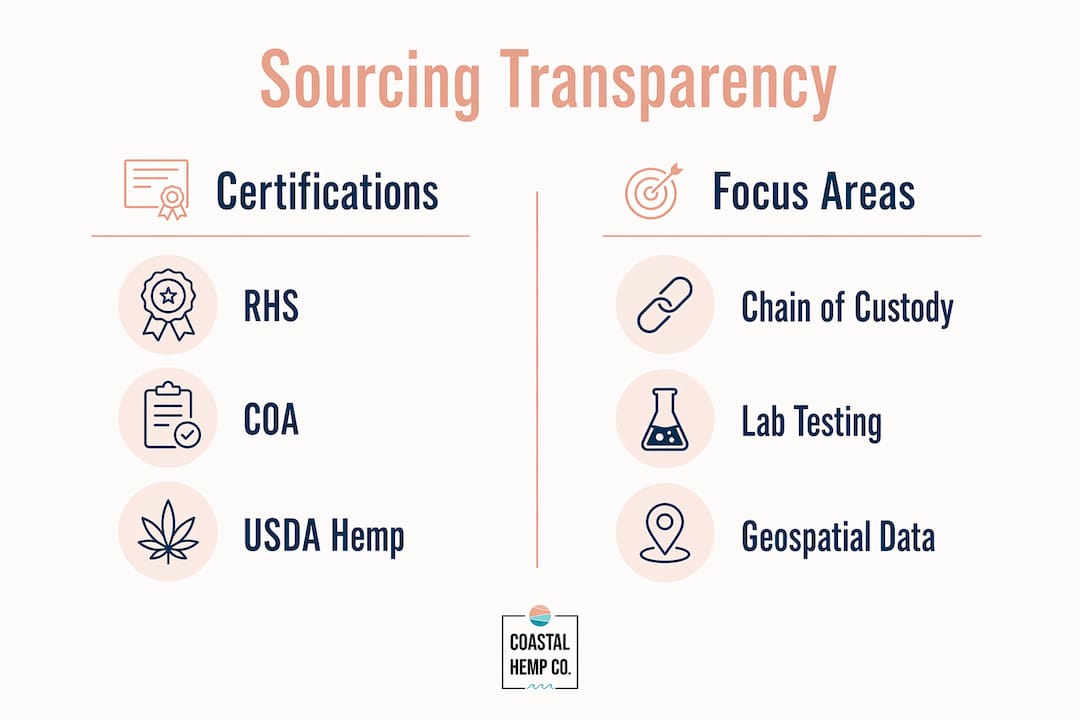
Three primary tools define credible hemp supply chain transparency: RHS certification, Certificates of Analysis, and USDA reporting.
Responsible Hemp Standard (RHS)
The Responsible Hemp Standard offers a chain-of-custody certification that traces hemp from seed to finished product. RHS certification operates across multiple hemp sectors, including textiles and pharmaceutical ingredients, and integrates sustainability, social compliance, and regenerative agriculture into one framework. A brand carrying RHS certification has passed third-party audits at each stage of production. That is a meaningful distinction from self-reported sustainability claims.
Certificate of Analysis (COA)
A COA is a lab report tied to a specific batch or lot of hemp product. A complete hemp COA includes potency panels and contaminant testing covering heavy metals, pesticides, residual solvents, and microbials. Every result must be verifiable and tied to the exact product you are purchasing. A COA without a matching lot number is not evidence of transparency. It is a document that cannot be connected to what is in the package.
USDA Domestic Hemp Production Program
The USDA Domestic Hemp Production Program requires licensed growers to submit detailed lot and geospatial data monthly and annually. Submitted forms include producer contact information, license status, acreage, and geospatial location for each lot or greenhouse. This upstream reporting creates a regulatory foundation for traceability before hemp ever reaches a processor or brand.
Pro Tip: When evaluating a brand’s transparency, ask for the COA tied to the specific lot number printed on your product. If the brand cannot provide it, that is a red flag.
How do transparency and traceability differ in hemp sourcing?
Transparency and traceability are complementary but distinct. Transparency is about disclosure to outsiders. Traceability is the internal capability to follow material batches through the supply chain using operational data. A brand can be transparent without full traceability, and vice versa. Neither alone is sufficient.
| Concept | Definition | Example in hemp |
|---|---|---|
| Transparency | Public disclosure of sourcing and testing data | Publishing COAs and farm origin on a website |
| Traceability | Internal tracking of batches through production | Linking a finished gummy to a specific hemp lot |
| Gap risk | Missing one creates compliance and trust failures | A COA with no lot number breaks the audit trail |
Without both, supply chains have gaps that regulators and consumers can identify. A brand might publish a COA on its website (transparency) but have no system connecting that COA to the specific batch in a consumer’s hands (traceability failure). That gap is where product quality problems hide.
Digital traceability systems that link specific batches from seed to finished product are transforming how hemp supply chains verify claims. These systems replace paper-based records with real-time data that auditors and consumers can access. The result is a verifiable chain of evidence, not a collection of disconnected documents.
Pro Tip: Look for brands that display QR codes on packaging linking directly to batch-specific COAs. That single feature confirms both transparency and traceability in one step.
What are the common pitfalls in hemp sourcing transparency?
The most common transparency failure is a COA that lacks lot or batch numbers, making it impossible to match the document to the product purchased. This breaks the audit trail entirely. A brand may share a legitimate lab report from six months ago that has no connection to current inventory.
Other pitfalls consumers and advocates should watch for:
- Vague sustainability language. Terms like “eco-friendly” or “natural” are insufficient without verifiable third-party certificates. The FTC Green Guides and EU regulations are tightening scrutiny on unsubstantiated environmental claims.
- Unaccredited labs. A COA is only as credible as the lab that produced it. Verifying lab accreditation and DEA registration is a required step in responsible sourcing.
- Single-certification thinking. Multiple certifications may be needed to fully address supply chain transparency. Frameworks like the Organic Content Standard (OCS) and Global Organic Textile Standard (GOTS) cover different dimensions, from fiber origin to social compliance.
- Incomplete COA panels. A potency-only COA that skips contaminant testing is not a complete transparency document. Full panel coverage is the standard for defensible product claims.
Genuine transparency requires specific evidence. A brand that publishes complete panel coverage with verifiable lab details is demonstrably different from one that posts a single potency result with no contaminant data.
How does hemp sourcing transparency affect product quality and ethics?
Transparency in hemp production directly supports four outcomes: safety verification, environmental accountability, labor standards, and consumer trust.
- Safety verification. A complete COA confirms cannabinoid potency matches the label and that contaminants fall below legal thresholds. Without this, consumers have no way to confirm what they are actually consuming.
- Environmental accountability. Traceability and disclosure support sustainable farming practices by creating a documented record of inputs, land use, and growing methods. Regenerative agriculture claims require this level of documentation to be credible.
- Labor and social compliance. Ethical hemp sourcing practices include verifying labor standards throughout the supply chain. RHS certification integrates social compliance audits alongside environmental criteria, making it one of the more complete frameworks available.
- Consumer empowerment. When brands publish verifiable sourcing data, consumers can compare products on substance rather than marketing language. That shift rewards brands with genuine practices and penalizes those relying on unverifiable claims.
“Effective hemp supply chain transparency links third-party audit information, certifications, and testing results with operational traceability systems to create verifiable consumer-facing claims.” — Impact Buying
Transparency also protects brands. A brand with documented sourcing practices has a defensible position when regulators or retailers ask for evidence. A brand without that documentation has no defense. The importance of hemp sourcing extends beyond consumer trust to regulatory compliance and long-term market access.
Key Takeaways
Hemp sourcing transparency requires verifiable documentation, including batch-specific COAs, third-party certifications like RHS, and regulatory reporting, to confirm product safety, sustainability, and ethical sourcing.
| Point | Details |
|---|---|
| Transparency requires documentation | Verifiable COAs, RHS certification, and USDA reporting are the minimum standard for credible claims. |
| Batch-specific COAs are non-negotiable | A COA without a matching lot number cannot be connected to the product you are buying. |
| Transparency and traceability work together | Disclosure without internal batch tracking leaves gaps that regulators and consumers will find. |
| Vague claims are a warning sign | Terms like “natural” or “eco-friendly” without third-party certificates do not meet FTC or EU standards. |
| Multiple certifications cover different gaps | OCS, GOTS, and RHS each address different supply chain dimensions; no single certification covers everything. |
Why the hemp industry’s transparency problem is bigger than most consumers realize
The transparency gap in hemp is not a fringe issue. It is the default condition for a large portion of products on the market. I have reviewed COAs from brands with strong marketing and found documents with no lot numbers, labs with no verifiable accreditation, and potency panels with no contaminant data. Those documents look official. They are not evidence of anything.
What concerns me most is the certification confusion. Consumers see a “certified organic” claim and assume it covers the full supply chain. It often covers only the raw fiber or extract, not processing, labor practices, or final product testing. RHS certification is one of the few frameworks that integrates multiple dimensions, but it is not yet the industry norm. Most brands are not there yet.
My advice is direct: prioritize brands that publish batch-specific COAs with full panel coverage and can name their testing lab. Check that lab’s accreditation independently. If a brand’s hemp terpene profiles and cannabinoid data are published with lot numbers you can verify, that brand has done the work. If the documentation is generic or missing, move on.
The outlook is improving. Regulatory pressure from the FTC and EU is forcing brands to substantiate claims or remove them. Digital traceability systems are making batch-level verification accessible. Consumers who understand what to ask for are the most effective force pushing the industry toward genuine transparency.
— John
Coastalhemp’s approach to verified hemp products
Coastalhemp partners with growers and brands that meet rigorous testing standards, making it straightforward to find products backed by real documentation rather than marketing language.

Every product in the Coastalhemp catalog is selected with quality verification in mind. The Celestial Wellness THCv Gummies are a strong example, with third-party lab testing tied to specific production batches. For consumers who want full-spectrum options with verifiable sourcing, the Jelly THCA Live Sugar Blend Gummies deliver potency data you can confirm. Coastalhemp’s commitment to sourcing from tested, documented suppliers means you spend less time chasing COAs and more time choosing products that actually match your wellness goals.
FAQ
What is hemp sourcing transparency in simple terms?
Hemp sourcing transparency is the practice of openly disclosing where hemp is grown, how it is processed, and what lab testing confirms about its safety and potency. It requires verifiable documents like Certificates of Analysis and third-party certifications, not just brand claims.
How do I verify a hemp COA is legitimate?
Confirm the COA includes a lot or batch number that matches your product, check that the testing lab holds current accreditation, and verify the lab’s DEA registration. A COA without a matching lot number cannot be tied to the product you purchased.
What is the Responsible Hemp Standard?
The Responsible Hemp Standard (RHS) is a chain-of-custody certification that traces hemp from seed to finished product, covering sustainability, social compliance, and regenerative agriculture across multiple hemp sectors including textiles and pharmaceutical ingredients.
What is the difference between transparency and traceability in hemp?
Transparency is public disclosure of sourcing and testing data. Traceability is the internal system that tracks specific batches through each production stage. Both are required for a complete and verifiable supply chain.
Are terms like “natural” or “eco-friendly” enough to confirm ethical hemp sourcing?
No. Generic terms like “eco-friendly” or “natural” are insufficient without verifiable third-party certificates. The FTC Green Guides and EU regulations require substantiation with specific evidence, and unverifiable claims may be subject to regulatory action.



Comments