
Organic Hemp Farming Explained: A 2026 Grower's Guide
Organic hemp farming is defined as the cultivation of Cannabis sativa using certified organic practices that prohibit synthetic fertilizers, pesticides, GMOs, and irradiation from seed to sale. The industry term for this system is USDA National Organic Program (NOP) certified production, and understanding that distinction matters because the label carries legal weight. By 2026, most commercial hemp operations with over $5,000 in annual sales require USDA NOP certification. That threshold means organic hemp farming explained is no longer just a philosophy. It is a compliance requirement for serious growers. This guide covers certification, environmental benefits, practical techniques, and transition strategies for farmers ready to build a certified organic hemp operation.
What does organic hemp farming explained mean for certification?
USDA NOP certification is the legal standard that defines organic hemp production in the United States. The process is structured, documented, and non-negotiable for commercial growers.
The certification path follows four core steps:
- Complete a three-year land transition. Any field previously treated with prohibited substances must go through a three-year transition period before it qualifies for organic certification. Crops grown during this window cannot carry the USDA Organic seal, which affects revenue planning significantly.
- Write an Organic System Plan (OSP). The OSP covers every aspect of your operation, from seed sourcing and soil amendments to pest management and harvest handling. Treat it as a living document, not a one-time filing.
- Verify all inputs against the National List. The National List of Allowed and Prohibited Substances governs what you can apply to soil and crops. Many inputs that appear natural are actually restricted. Always request a Material Review Opinion before applying any new amendment.
- Pass annual inspections and maintain records. Certifying agents conduct on-site inspections and review purchase receipts, field logs, and sales records. Gaps in documentation are the most common reason certifications are denied or revoked.
Pro Tip: Update your OSP every time you change a practice, add a new field, or switch suppliers. Inspectors compare your current OSP to your records, and any mismatch triggers a finding.
The USDA Organic seal reflects a comprehensive, documented process. Farmers who view certification as an ongoing management tool rather than a bureaucratic hurdle consistently report smoother audits and fewer compliance issues. For a broader look at how certification affects hemp products from farm to shelf, the hemp product certifications guide from Coastalhemp breaks down what consumers and growers need to know in 2026.
How does organic hemp benefit soil health and the environment?
Organic hemp farming delivers measurable ecological benefits that go well beyond avoiding synthetic chemicals. The crop itself is an active contributor to soil restoration and carbon management.
Key environmental benefits include:
- Carbon sequestration. Hemp captures roughly 8 to 22 metric tons of CO₂ per hectare annually. That range reflects differences in cultivar, climate, and management, but even the lower end makes hemp one of the more effective annual crops for carbon drawdown.
- Soil microbiome support. Industrial hemp roots host arbuscular mycorrhizal fungi that improve nutrient uptake and strengthen the soil food web. USDA-supported trials confirm consistent mycorrhizal colonization under organic management, which means the biological benefits compound over time.
- Weed suppression. Hemp’s dense canopy shades out competing weeds during the vegetative stage, reducing the need for mechanical cultivation. This is a genuine agronomic advantage in organic systems where herbicides are off the table.
- Phytoremediation potential. Hemp has a documented ability to absorb heavy metals and contaminants from degraded soils. Growers using hemp on marginal land should note that phytoremediation crops are not suitable for food or fiber markets, so plan end-use carefully.
- Crop rotation compatibility. Hemp fits well between grain crops like corn and soybeans, breaking pest and disease cycles without requiring a long fallow period.
Organic hemp farming is becoming a key pillar of regenerative agriculture because it restores soil health while reducing reliance on synthetic inputs. The NRCS Regenerative Pilot Program provides financial and technical assistance for growers integrating hemp into conservation-focused rotations. That funding can offset transition costs significantly, especially in the first two years when yields may be lower than conventional benchmarks.
Organic hemp farming techniques every grower should know
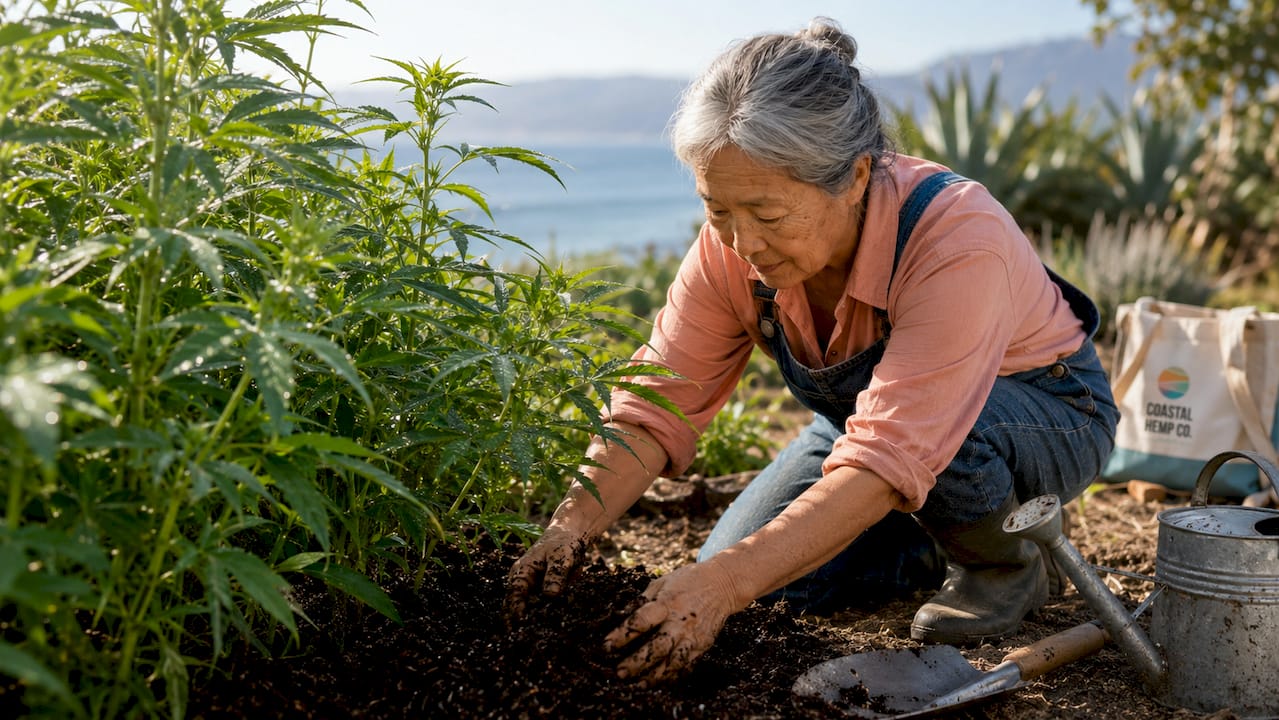
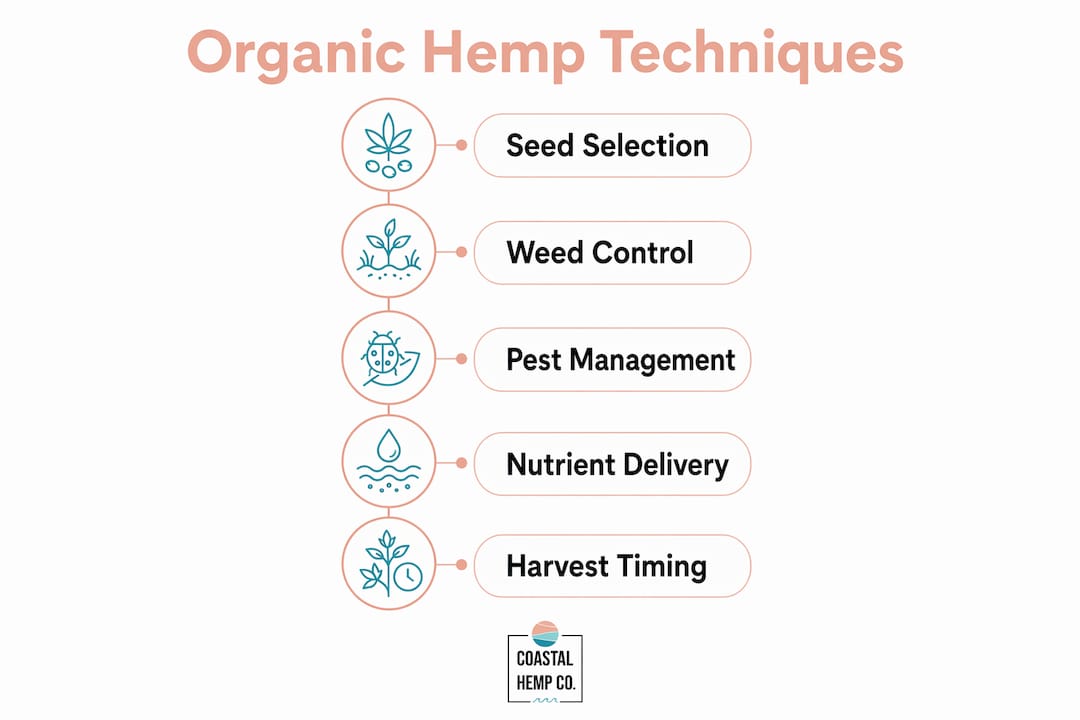
Sound technique separates a productive organic hemp farm from one that struggles through every season. The following practices form the foundation of a well-managed organic cultivation system.
Seed and cultivar selection
Start with certified organic seed whenever possible. Certified seed ensures your operation stays compliant from day one and eliminates the risk of introducing prohibited treatments at planting. If certified organic seed is unavailable for a specific cultivar, USDA NOP allows the use of untreated non-organic seed with prior documentation in your OSP. Select cultivars suited to your region’s photoperiod, disease pressure, and intended end-use, whether that is fiber, grain, or CBD flower.
Soil preparation and fertility
- Build soil organic matter through compost applications before planting. Finished compost improves water retention, feeds soil biology, and provides slow-release nutrients without synthetic inputs.
- Use cover crops like crimson clover, winter rye, or buckwheat between hemp rotations to fix nitrogen, prevent erosion, and add biomass.
- Conduct soil tests annually. Base lime and amendment applications on test results, not assumptions. Organic systems depend on biological nutrient cycling, and pH management is the foundation of that process.
Weed and pest management
Mechanical cultivation with a rotary hoe or inter-row cultivator controls weeds effectively in the early vegetative stage before hemp canopy closure. After canopy closure, hemp suppresses most annual weeds on its own. For pest pressure, beneficial insect habitat strips planted along field borders attract predatory insects that manage aphids and spider mites without sprays.
Pro Tip: Flame weeding between rows at emergence works well on bare-soil beds, but time it carefully. Hemp seedlings are sensitive to heat stress in the first two weeks after germination.
Nutrient management and harvest
Organic nitrogen sources like blood meal, feather meal, and fish emulsion deliver available nitrogen without synthetic chemistry. Pair them with mycorrhizal inoculants at transplanting to maximize root uptake efficiency. At harvest, incorporate hemp stalks and leaf material back into the soil rather than removing all residue. Effective integration of hemp within organic rotations requires site-specific decisions on tillage, cultivar choice, and residue handling to maximize soil carbon gains over time.
What are the biggest challenges of transitioning to organic hemp?
Transitioning from conventional to organic hemp farming involves real challenges. Knowing them in advance makes the process manageable.
- Managing the three-year transition window. Revenue drops during transition because crops cannot carry the organic premium. Plan cash flow carefully. Some growers use the transition period to build soil biology aggressively with cover crops and compost, so the first certified season starts with a stronger foundation.
- Weed pressure spikes early. Fields that relied on herbicides often carry large weed seed banks. Expect heavier mechanical cultivation demands in years one and two. Farmers report that weed pressure typically decreases as soil biology improves and rotation diversity increases.
- Equipment adjustments. Organic systems require cultivation equipment that conventional operations often lack. Rotary hoes, finger weeders, and flame weeders represent real capital costs. Budget for these before you start the transition, not after.
- Updating the OSP continuously. The OSP is not a document you file once. Every field change, new input, or practice adjustment requires an OSP update and notification to your certifying agent. Farmers who treat the OSP as a living management tool avoid the compliance gaps that derail audits.
- Leveraging available support. The NRCS Regenerative Pilot Program and EQIP (Environmental Quality Incentives Program) both offer cost-share assistance for cover cropping, soil testing, and infrastructure improvements. Apply for these programs during your transition period, not after certification, because funding is competitive and application cycles are annual.
Soil biology monitoring is the most underused tool in organic transition management. Quarterly biological soil tests, measuring active fungal biomass and bacterial-to-fungal ratios, give you early warning of nutrient cycling problems before they show up as crop deficiencies. Understanding hemp versus marijuana distinctions also matters during transition, since regulatory compliance for hemp production under the 2018 Farm Bill shapes what you can grow and sell throughout the certification process.
Key Takeaways
Organic hemp farming succeeds when growers treat USDA NOP certification as a management system, not a paperwork exercise, and build soil biology as the foundation of every agronomic decision.
| Point | Details |
|---|---|
| Certification threshold | Hemp operations over $5,000 in annual sales require USDA NOP certification by 2026. |
| OSP as a living document | Update your Organic System Plan every time a practice, field, or supplier changes to avoid audit failures. |
| Carbon and soil benefits | Hemp captures 8–22 metric tons of CO₂ per hectare annually and supports mycorrhizal fungi that strengthen soil biology. |
| National List compliance | Always verify inputs against the National List before application; many natural products are restricted. |
| Transition support | NRCS and EQIP programs provide cost-share funding for cover crops, soil testing, and equipment during the three-year transition. |
Why organic hemp farming is worth the patience
I have watched a lot of farmers approach organic certification as a finish line. They complete the paperwork, pass the inspection, and then coast. That is exactly the wrong mindset, and it shows up in their yields within two seasons.
The farms that thrive organically treat the OSP as a field management tool they actually use. They test soil biology quarterly, not just at planting. They rotate cultivars deliberately, not just to satisfy a checkbox. And they build relationships with their certifying agents rather than treating them as adversaries.
The carbon sequestration numbers for hemp are genuinely impressive. Capturing 8–22 metric tons of CO₂ per hectare annually puts hemp ahead of most annual crops in climate contribution. But those numbers only hold when organic management keeps the soil food web intact. Synthetic inputs collapse mycorrhizal networks fast, and rebuilding them takes years.
My honest assessment is that the three-year transition is harder than most growers expect and more rewarding than they anticipate. The farms that come out of transition with strong soil biology are more resilient to drought, pest pressure, and input cost volatility than any conventional operation I have seen. Patience and documentation discipline are the two skills that separate successful organic hemp farmers from those who abandon the process in year two.
— John
Coastalhemp and the hemp products that come from farms like yours
Organic hemp farming creates the foundation for the high-quality hemp products that consumers trust. Coastalhemp partners with top growers and brands to bring that quality directly to wellness-focused shoppers.

Coastalhemp’s catalog includes THCA gummies and concentrates sourced from premium hemp operations, alongside functional mushroom edibles and full-spectrum CBD products. Every product reflects the same commitment to quality and transparency that defines certified organic farming. Farmers who invest in soil health and clean inputs produce the raw material behind products like the Jelly THCA Live Sugar Blend Gummies that customers rely on for consistent, effective wellness support. Explore Coastalhemp’s full range and see where great farming leads.
FAQ
What is organic hemp farming?
Organic hemp farming is the cultivation of hemp under USDA National Organic Program (NOP) standards, prohibiting synthetic fertilizers, pesticides, GMOs, and irradiation from seed to sale.
How long does it take to get USDA organic certification for hemp?
The process requires a three-year land transition period before certification is possible, plus completion of an Organic System Plan and a passing on-site inspection.
What inputs are prohibited in organic hemp production?
USDA NOP prohibits synthetic fertilizers, synthetic pesticides, GMOs, and irradiation. Always verify any amendment against the National List of Allowed and Prohibited Substances before application.
Does organic hemp farming improve soil health?
Organic hemp farming consistently improves soil biology over time. Hemp roots host arbuscular mycorrhizal fungi that enhance nutrient uptake, and the crop’s dense biomass adds organic matter that feeds the soil food web.
What financial support is available for transitioning to organic hemp?
The NRCS Regenerative Pilot Program and EQIP both provide cost-share assistance for cover cropping, soil testing, and infrastructure improvements during the organic transition period.


Comments