

Hemp Alternatives Drug Test Guide: What You Need to Know
Hemp alternatives that do not trigger a positive THC drug test exist, but choosing the right ones requires understanding how drug tests actually work and which product types carry real risk. This hemp alternatives drug test guide covers the mechanics of THC detection, the product categories most likely to cause problems, and the practical steps you can take to protect yourself. Drug tests detect THC metabolites, not hemp itself, which means the chemical composition of your specific product matters far more than its legal status. Employers in safety-sensitive industries maintain zero-tolerance THC policies regardless of state marijuana laws, making product selection a serious decision.
How do drug tests detect THC from hemp products?
Drug tests screen for THC-COOH, the primary metabolite your body produces when it processes THC. Standard drug tests detect THC metabolites, not CBD or other non-psychoactive cannabinoids. This distinction is critical because it means a product can be legal under federal hemp law and still cause a positive result if it contains enough THC.
The four main test types each carry different detection windows:
- Urine tests are the most common workplace screening method. They detect THC-COOH for 3–30 days depending on frequency of use and body fat percentage.
- Blood tests have a short detection window of 1–2 days for occasional users but can extend further with daily use.
- Saliva tests detect recent use within 24–72 hours and are common in roadside testing.
- Hair follicle tests have the longest window, detecting metabolites for up to 90 days.
Drug tests cannot distinguish between THC derived from marijuana and THC derived from legal hemp. Any metabolite above the cutoff threshold triggers a positive result, regardless of the source. That fact alone changes how you should think about hemp product selection.
The risk level also depends on product type. Full-spectrum hemp oils contain the full range of cannabinoids including Delta-9 THC. Broad-spectrum products have THC removed but may still carry trace amounts if processing is incomplete. CBD isolate products carry the lowest risk because they contain a single purified compound. Repeated or daily use of full-spectrum products notably increases the chance of a positive result because metabolites accumulate faster than your body can clear them.
Pro Tip: If you use hemp products regularly and face an upcoming drug test, switch to a CBD isolate product at least two weeks before the test date. Isolates carry the lowest detectable THC risk of any hemp format.
What to look for when choosing hemp alternatives for drug tests
Product selection is the single most controllable factor in your drug test risk. The right choices reduce risk significantly. The wrong ones can cost you a job offer or a professional license.
-
Verify the Certificate of Analysis (COA). Every reputable hemp product should have a third-party lab report showing exact cannabinoid concentrations. Check that the COA comes from an independent lab, not the manufacturer’s in-house testing. Look specifically for Delta-9 THC levels below 0.3% by dry weight.
-
Choose CBD isolate or broad-spectrum over full-spectrum. Full-spectrum products contain the widest range of cannabinoids, including measurable THC. Broad-spectrum products have THC removed, though trace amounts can remain. CBD isolate contains only cannabidiol and carries the lowest risk profile.
-
Treat “THC-free” labels with skepticism. 24% of “THC-free” labeled hemp products contained detectable Delta-9 THC in recent research, with levels ranging from 0.015 to 0.656 mg/mL. That finding means a label alone is not sufficient protection. Always verify with the COA.
-
Avoid Delta-8, THCA, and THCP products before a test. Delta-8 THC and THCA products commonly cause positive drug test results even when derived from legal hemp. Delta-8 is chemically similar to Delta-9 and triggers the same screening markers. You can learn more about hemp-derived Delta-9 THC and how it appears in products you might not expect.
-
Reduce dosage and frequency before a scheduled test. Metabolite levels correlate directly with how much and how often you use a product. Lower doses clear faster. Cutting back two to four weeks before a test gives your body time to reduce metabolite concentration below cutoff thresholds.
Pro Tip: Request the COA directly from the brand’s website rather than accepting a printed copy with a product. Online COAs are harder to falsify and are typically updated with each production batch.
Hemp product categories and their drug test risk profiles
Not all hemp products carry the same risk. Understanding the differences helps you make informed choices without giving up hemp benefits entirely.
Low-risk product types
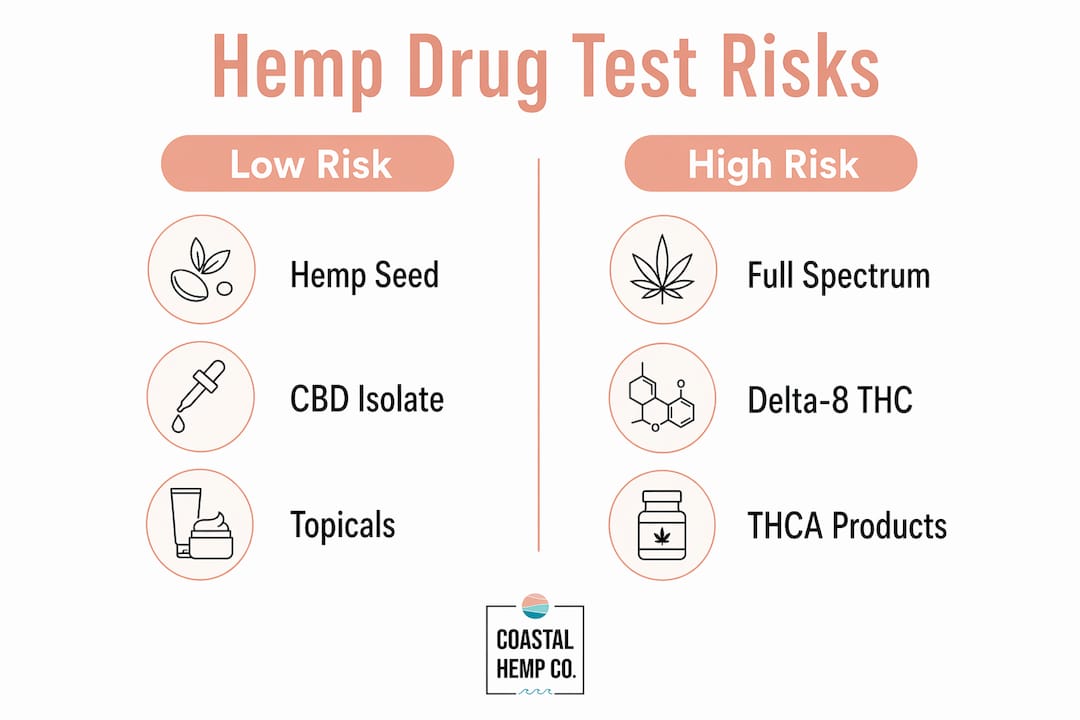
Hemp seed foods and minimally processed products rarely cause positive drug tests because they contain extremely low THC levels. Hemp seeds, hemp seed oil used in cooking, and hemp protein powders fall into this category. Modern test cutoffs make a positive result from these foods unlikely under normal consumption patterns.
CBD isolate tinctures and topicals also carry low risk. Topicals applied to the skin do not enter the bloodstream in meaningful amounts, making them the safest format for external use. Isolate tinctures, when properly manufactured and labeled, contain no detectable THC.
Moderate-risk product types
Broad-spectrum CBD oils sit in the middle of the risk range. Manufacturers remove THC during processing, but the process is not always complete. Mislabeling compounds the problem. A broad-spectrum product from a brand without rigorous third-party testing can still deliver enough THC to accumulate in your system over time. Hemp sourcing transparency and lab verification matter most in this category.
High-risk product types
Full-spectrum CBD oils and hemp extracts carry the highest risk among traditional CBD products. They contain the full cannabinoid profile of the hemp plant, including Delta-9 THC within legal limits. Daily use of full-spectrum products is the most common cause of unexpected positive results among hemp consumers.
Delta-8 THC, THCA, and THCP products represent the highest risk category of all. These compounds are psychoactive, chemically similar to Delta-9 THC, and reliably trigger positive drug test results. The fact that they are derived from legal hemp does not change how a drug test reads them. If you are subject to workplace testing, these products are not compatible with that requirement.
| Product Type | THC Presence | Drug Test Risk |
|---|---|---|
| Hemp seed foods | Negligible | Very low |
| CBD isolate products | None | Very low |
| Broad-spectrum CBD oil | Trace possible | Low to moderate |
| Full-spectrum CBD oil | Present | Moderate to high |
| Delta-8 / THCA / THCP products | Present | High |
Steps to use hemp alternatives safely before a drug test
Preparation reduces risk. These steps give you the best chance of a clean result while still using hemp alternatives.
-
Audit your current products. Pull the COA for every hemp product you use. Confirm the Delta-9 THC concentration and check whether the lab is accredited and independent. Discard any product without a verifiable COA.
-
Switch to a lower-risk format. Move from full-spectrum to broad-spectrum or isolate products at least three to four weeks before your test. This reduces the volume of THC metabolites entering your system while still providing hemp benefits.
-
Reduce your usage frequency. Dose and frequency correlate directly with metabolite accumulation. Cutting from daily use to every other day, then to occasional use, gives your metabolism time to clear existing metabolites. Your body fat percentage, hydration level, and metabolic rate all affect clearance speed.
-
Eliminate all Delta-8, THCA, and high-THC hemp products immediately. These are not compatible with drug test preparation. There is no safe window for continued use if a test is approaching. Review the differences between hemp and marijuana to understand why legal status does not equal test safety.
-
Use an at-home drug test to self-monitor. At-home urine tests detect THC metabolites at cutoffs similar to workplace screenings. Testing yourself 5–7 days before an official test gives you time to adjust if the result is unexpected. These tests are widely available at pharmacies and provide a reliable baseline check.
-
Do not combine hemp products with other THC sources. Even small amounts of marijuana, edibles, or vape products will compound your metabolite load and increase detection risk significantly.
Pro Tip: Drink adequate water in the days leading up to your test, but do not attempt extreme hydration on test day. Diluted urine samples are flagged as inconclusive and may require a retest under observation.
Key Takeaways
Choosing hemp alternatives that do not trigger a positive drug test requires verified lab testing, product type awareness, and sufficient clearance time before any scheduled screening.
| Point | Details |
|---|---|
| Tests detect THC metabolites | Drug screens target THC-COOH, not CBD, so any product with THC poses a risk. |
| Mislabeled products are common | 24% of “THC-free” labeled products contained detectable THC in recent research. |
| Product type determines risk | CBD isolate and hemp seed foods carry the lowest risk; Delta-8 and THCA carry the highest. |
| Frequency increases detection | Daily full-spectrum use accumulates metabolites faster than your body can clear them. |
| Self-testing adds a safety layer | At-home urine tests help you confirm clearance before an official workplace screening. |
What I have learned after years of watching people get this wrong
The most common mistake I see is people treating “hemp” and “THC-free” as synonymous. They are not. The legal definition of hemp requires Delta-9 THC below 0.3% by dry weight, but that threshold was set for agricultural classification, not for drug test safety. A product can be fully legal and still deliver enough THC to accumulate in your system over weeks of daily use.
The second mistake is trusting labels without verifying COAs. I have seen people lose job offers because they relied on a “broad-spectrum” label from a brand that had no third-party testing on record. The research backs this up. When nearly one in four “THC-free” products contains detectable THC, the label is not a guarantee.
My honest advice for anyone in a safety-sensitive job is to treat hemp products the same way you would treat any substance that could affect your employment. That means using dosage best practices, verifying every product with a current COA, and being transparent with your employer when the situation allows it. The hemp industry is improving its labeling standards, but it is not there yet. Until it is, the responsibility falls on you to verify what you are actually consuming.
— John
Coastalhemp’s tested hemp alternatives for wellness-focused consumers
Coastalhemp partners with top growers and brands to bring you products backed by real lab data, not just marketing claims. Every product in the Coastalhemp catalog is selected with quality and transparency in mind, which matters most when you are making decisions that affect your health and your livelihood.
For consumers who want effective hemp benefits with controlled cannabinoid profiles, Coastalhemp carries options like the Enjoyable Neuro Enhancer Gummies, a low-THC, lab-tested format designed for daily wellness use. If you prefer a topical with no systemic absorption risk, the organic CBD balm with lavender and eucalyptus is a practical choice. Browse the full catalog at Coastalhemp to find products that match your wellness goals and your testing situation.
FAQ
What does a hemp drug test actually screen for?
Drug tests screen for THC-COOH, a metabolite your body produces when it processes THC. They do not detect CBD or most other hemp cannabinoids directly.
Do hemp oils show up on drug tests?
Full-spectrum hemp oils can cause positive results because they contain Delta-9 THC. Broad-spectrum and isolate oils carry lower risk, but mislabeled products still pose a threat.
Are Delta-8 and THCA products safe to use before a drug test?
No. Delta-8 THC and THCA are chemically similar to Delta-9 THC and reliably trigger positive drug test results, even when derived from legal hemp.
How long does THC from hemp products stay in your system?
Urine tests can detect THC-COOH for 3–30 days depending on frequency of use, body composition, and metabolism. Daily users clear metabolites more slowly than occasional users.
Can I use at-home drug tests to check my THC levels?
Yes. At-home urine tests use cutoff thresholds similar to workplace screenings and give you a reliable self-assessment before an official test.
Recommended
- Hemp Recreational Alternatives: What They Are in 2026
- Hemp vs Marijuana Differences: What You Need to Know
- Hemp Alternative Dosage Best Practices: 2026 Guide
- Why Hemp Alternatives Are Less Intense Than THC
Hemp alternatives that do not trigger a positive THC drug test exist, but choosing the right ones requires understanding how drug tests actually work and which product types carry real risk. This hemp alternatives drug test guide covers the mechanics of THC detection, the product categories most likely to cause problems, and the practical steps you can take to protect yourself. Drug tests detect THC metabolites, not hemp itself, which means the chemical composition of your specific product matters far more than its legal status. Employers in safety-sensitive industries maintain zero-tolerance THC policies regardless of state marijuana laws, making product selection a serious decision.
How do drug tests detect THC from hemp products?
Drug tests screen for THC-COOH, the primary metabolite your body produces when it processes THC. Standard drug tests detect THC metabolites, not CBD or other non-psychoactive cannabinoids. This distinction is critical because it means a product can be legal under federal hemp law and still cause a positive result if it contains enough THC.
The four main test types each carry different detection windows:
- Urine tests are the most common workplace screening method. They detect THC-COOH for 3–30 days depending on frequency of use and body fat percentage.
- Blood tests have a short detection window of 1–2 days for occasional users but can extend further with daily use.
- Saliva tests detect recent use within 24–72 hours and are common in roadside testing.
- Hair follicle tests have the longest window, detecting metabolites for up to 90 days.
Drug tests cannot distinguish between THC derived from marijuana and THC derived from legal hemp. Any metabolite above the cutoff threshold triggers a positive result, regardless of the source. That fact alone changes how you should think about hemp product selection.
The risk level also depends on product type. Full-spectrum hemp oils contain the full range of cannabinoids including Delta-9 THC. Broad-spectrum products have THC removed but may still carry trace amounts if processing is incomplete. CBD isolate products carry the lowest risk because they contain a single purified compound. Repeated or daily use of full-spectrum products notably increases the chance of a positive result because metabolites accumulate faster than your body can clear them.
Pro Tip: If you use hemp products regularly and face an upcoming drug test, switch to a CBD isolate product at least two weeks before the test date. Isolates carry the lowest detectable THC risk of any hemp format.
What to look for when choosing hemp alternatives for drug tests
Product selection is the single most controllable factor in your drug test risk. The right choices reduce risk significantly. The wrong ones can cost you a job offer or a professional license.
-
Verify the Certificate of Analysis (COA). Every reputable hemp product should have a third-party lab report showing exact cannabinoid concentrations. Check that the COA comes from an independent lab, not the manufacturer’s in-house testing. Look specifically for Delta-9 THC levels below 0.3% by dry weight.
-
Choose CBD isolate or broad-spectrum over full-spectrum. Full-spectrum products contain the widest range of cannabinoids, including measurable THC. Broad-spectrum products have THC removed, though trace amounts can remain. CBD isolate contains only cannabidiol and carries the lowest risk profile.
-
Treat “THC-free” labels with skepticism. 24% of “THC-free” labeled hemp products contained detectable Delta-9 THC in recent research, with levels ranging from 0.015 to 0.656 mg/mL. That finding means a label alone is not sufficient protection. Always verify with the COA.
-
Avoid Delta-8, THCA, and THCP products before a test. Delta-8 THC and THCA products commonly cause positive drug test results even when derived from legal hemp. Delta-8 is chemically similar to Delta-9 and triggers the same screening markers. You can learn more about hemp-derived Delta-9 THC and how it appears in products you might not expect.
-
Reduce dosage and frequency before a scheduled test. Metabolite levels correlate directly with how much and how often you use a product. Lower doses clear faster. Cutting back two to four weeks before a test gives your body time to reduce metabolite concentration below cutoff thresholds.
Pro Tip: Request the COA directly from the brand’s website rather than accepting a printed copy with a product. Online COAs are harder to falsify and are typically updated with each production batch.
Hemp product categories and their drug test risk profiles
Not all hemp products carry the same risk. Understanding the differences helps you make informed choices without giving up hemp benefits entirely.

Low-risk product types
Hemp seed foods and minimally processed products rarely cause positive drug tests because they contain extremely low THC levels. Hemp seeds, hemp seed oil used in cooking, and hemp protein powders fall into this category. Modern test cutoffs make a positive result from these foods unlikely under normal consumption patterns.

CBD isolate tinctures and topicals also carry low risk. Topicals applied to the skin do not enter the bloodstream in meaningful amounts, making them the safest format for external use. Isolate tinctures, when properly manufactured and labeled, contain no detectable THC.
Moderate-risk product types
Broad-spectrum CBD oils sit in the middle of the risk range. Manufacturers remove THC during processing, but the process is not always complete. Mislabeling compounds the problem. A broad-spectrum product from a brand without rigorous third-party testing can still deliver enough THC to accumulate in your system over time. Hemp sourcing transparency and lab verification matter most in this category.
High-risk product types
Full-spectrum CBD oils and hemp extracts carry the highest risk among traditional CBD products. They contain the full cannabinoid profile of the hemp plant, including Delta-9 THC within legal limits. Daily use of full-spectrum products is the most common cause of unexpected positive results among hemp consumers.
Delta-8 THC, THCA, and THCP products represent the highest risk category of all. These compounds are psychoactive, chemically similar to Delta-9 THC, and reliably trigger positive drug test results. The fact that they are derived from legal hemp does not change how a drug test reads them. If you are subject to workplace testing, these products are not compatible with that requirement.
| Product Type | THC Presence | Drug Test Risk |
|---|---|---|
| Hemp seed foods | Negligible | Very low |
| CBD isolate products | None | Very low |
| Broad-spectrum CBD oil | Trace possible | Low to moderate |
| Full-spectrum CBD oil | Present | Moderate to high |
| Delta-8 / THCA / THCP products | Present | High |
Steps to use hemp alternatives safely before a drug test
Preparation reduces risk. These steps give you the best chance of a clean result while still using hemp alternatives.
-
Audit your current products. Pull the COA for every hemp product you use. Confirm the Delta-9 THC concentration and check whether the lab is accredited and independent. Discard any product without a verifiable COA.
-
Switch to a lower-risk format. Move from full-spectrum to broad-spectrum or isolate products at least three to four weeks before your test. This reduces the volume of THC metabolites entering your system while still providing hemp benefits.
-
Reduce your usage frequency. Dose and frequency correlate directly with metabolite accumulation. Cutting from daily use to every other day, then to occasional use, gives your metabolism time to clear existing metabolites. Your body fat percentage, hydration level, and metabolic rate all affect clearance speed.
-
Eliminate all Delta-8, THCA, and high-THC hemp products immediately. These are not compatible with drug test preparation. There is no safe window for continued use if a test is approaching. Review the differences between hemp and marijuana to understand why legal status does not equal test safety.
-
Use an at-home drug test to self-monitor. At-home urine tests detect THC metabolites at cutoffs similar to workplace screenings. Testing yourself 5–7 days before an official test gives you time to adjust if the result is unexpected. These tests are widely available at pharmacies and provide a reliable baseline check.
-
Do not combine hemp products with other THC sources. Even small amounts of marijuana, edibles, or vape products will compound your metabolite load and increase detection risk significantly.
Pro Tip: Drink adequate water in the days leading up to your test, but do not attempt extreme hydration on test day. Diluted urine samples are flagged as inconclusive and may require a retest under observation.
Key Takeaways
Choosing hemp alternatives that do not trigger a positive drug test requires verified lab testing, product type awareness, and sufficient clearance time before any scheduled screening.
| Point | Details |
|---|---|
| Tests detect THC metabolites | Drug screens target THC-COOH, not CBD, so any product with THC poses a risk. |
| Mislabeled products are common | 24% of “THC-free” labeled products contained detectable THC in recent research. |
| Product type determines risk | CBD isolate and hemp seed foods carry the lowest risk; Delta-8 and THCA carry the highest. |
| Frequency increases detection | Daily full-spectrum use accumulates metabolites faster than your body can clear them. |
| Self-testing adds a safety layer | At-home urine tests help you confirm clearance before an official workplace screening. |
What I have learned after years of watching people get this wrong
The most common mistake I see is people treating “hemp” and “THC-free” as synonymous. They are not. The legal definition of hemp requires Delta-9 THC below 0.3% by dry weight, but that threshold was set for agricultural classification, not for drug test safety. A product can be fully legal and still deliver enough THC to accumulate in your system over weeks of daily use.
The second mistake is trusting labels without verifying COAs. I have seen people lose job offers because they relied on a “broad-spectrum” label from a brand that had no third-party testing on record. The research backs this up. When nearly one in four “THC-free” products contains detectable THC, the label is not a guarantee.
My honest advice for anyone in a safety-sensitive job is to treat hemp products the same way you would treat any substance that could affect your employment. That means using dosage best practices, verifying every product with a current COA, and being transparent with your employer when the situation allows it. The hemp industry is improving its labeling standards, but it is not there yet. Until it is, the responsibility falls on you to verify what you are actually consuming.
— John
Coastalhemp’s tested hemp alternatives for wellness-focused consumers
Coastalhemp partners with top growers and brands to bring you products backed by real lab data, not just marketing claims. Every product in the Coastalhemp catalog is selected with quality and transparency in mind, which matters most when you are making decisions that affect your health and your livelihood.
For consumers who want effective hemp benefits with controlled cannabinoid profiles, Coastalhemp carries options like the Enjoyable Neuro Enhancer Gummies, a low-THC, lab-tested format designed for daily wellness use. If you prefer a topical with no systemic absorption risk, the organic CBD balm with lavender and eucalyptus is a practical choice. Browse the full catalog at Coastalhemp to find products that match your wellness goals and your testing situation.
FAQ
What does a hemp drug test actually screen for?
Drug tests screen for THC-COOH, a metabolite your body produces when it processes THC. They do not detect CBD or most other hemp cannabinoids directly.
Do hemp oils show up on drug tests?
Full-spectrum hemp oils can cause positive results because they contain Delta-9 THC. Broad-spectrum and isolate oils carry lower risk, but mislabeled products still pose a threat.
Are Delta-8 and THCA products safe to use before a drug test?
No. Delta-8 THC and THCA are chemically similar to Delta-9 THC and reliably trigger positive drug test results, even when derived from legal hemp.
How long does THC from hemp products stay in your system?
Urine tests can detect THC-COOH for 3–30 days depending on frequency of use, body composition, and metabolism. Daily users clear metabolites more slowly than occasional users.
Can I use at-home drug tests to check my THC levels?
Yes. At-home urine tests use cutoff thresholds similar to workplace screenings and give you a reliable self-assessment before an official test.




Comments